
When asked to define the whole duty of a man in a political year, nine out of ten persons in the South or Middle West would say, “To holler right, vote straight, and eat as much barbecue as any other man in the country.”
From Harper’s Weekly (1906), describing the barbecues in vogue at the time.
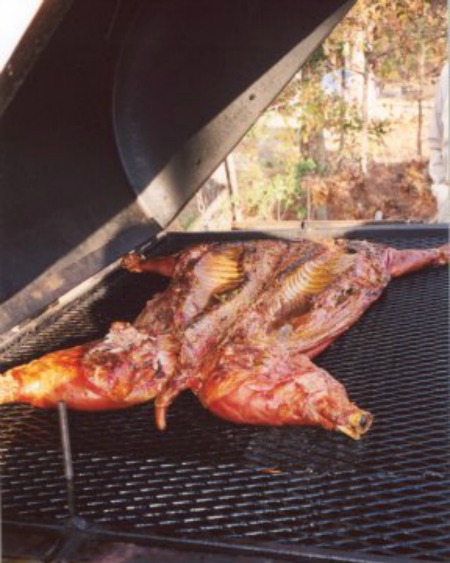
Any month of the year or any occasion is good for a Pig Pickin’ in North Carolina. Unlike other food preparation in the South, which is usually dominated by women, barbecue is a male domain. The barbecue style will vary according to what area you’re in:
In the eastern part of the state, the entire pig (split down the middle) is cooked, and the sauce is made with vinegar and pepper.
In the western part, only pig shoulders are cooked, and a tomato-based finishing sauce is used.
While visiting my friends, Bill and Andra Cook of Raleigh, North Carolina (a couple of years ago), Bill’s father, Elbert Cook of New Bern, North Carolina, brought his homemade barbecue pit (which he has fixed on a trailer) to the Cook’s home and carefully tended the pig. When done, we pulled the meat off the ribs with our fingers and ate pig pickin’. It was finger lickin’ good!
North Carolina Pig Pickin’ History:
Before the Civil War, pigs were a food staple in the South because they were a low-maintenance and convenient food source. The pigs could be put out to root in the forest and caught when the food supply became low. These semi-wild pigs were tougher and stringier than modern-day pigs. Pig slaughtering became a time for celebration, ant other families would be invited to share in the eating. Out of these gatherings grew the traditional southern barbecue. Plantation owners regularly held large barbecues for their slaves. According to historians, southerners ate, on average, five pounds of pork for every one pound of beef.
In the 19th century, barbecues were an important feature of church functions and political rallies. Members of both political parties would come to the same gathering, with the leaders of each party competing with one another to supply the largest contribution of food and drink. Folks would gather from afar to reach the appointed place in time for the speeches, band concert, and all-important barbecue. The only accompaniments to the roast pig were thick slices of good bread, cucumbers (fresh and pickled), and whiskey. The saying “going whole hog” came out of these political rallies.
During the 20th century, barbecue joints or pits flourished (a typical joint or pit was a bare concrete floor covered by a corrugated tin roof and walls). Restaurants grew out of a simple barbecue pit where the owner sold barbecue to take away. Many were open only on weekends, since the “pit men” worked on farms during the week. As the century progressed, barbecue joints grew and prospered.
Traditionally, coleslaw, baked beans, corn on the cob, and hushpuppies are served with the meal – don’t forget the sweet ice tea.
- 1 (60 to 100-pound) dressed pig*
- Coarse salt
- 60 pounds charcoal briquettes, divided
- 1 gallon apple cider vinegar
- 1 (28-ounce) bottle ketchup
- 2 3/4 cups firmly-packed brown sugar
- 1/4 cup garlic powder
- 1/4 cup salt
- 1/4 cup crushed red pepper
- 1 tablespoon black pepper, ground
- 1/2 teaspoon cloves, ground
-
Split open the whole dressed pig and butterfly (slit the backbone to allow the pig to lay flat across the grates, being careful not to pierce the skin). Trim and discard any excess fat (excess fat may cause a flare-up during cooking). Sprinkle the cavity with salt, cover, and let pig sit overnight.
-
Place 20 pounds of charcoal in the barbecue pit or pig cooker (add charcoal as needed during cooking process). Pour charcoal lighter fluid on the briquettes and ignite. Let the charcoal burn until a fine white ash covers the briquettes.
-
Place a heavy gauge wire screen or rack about a foot above the coals. Place butterflied pig on rack (skin side up) and season with additional salt. Close lid of the cooker.
-
Raise temperature of cooker slowly. It should take up to 3 hours to get external temperature to 200 degrees F. (meat will crust over if temperature is too high). Let external temperature rise to 250 degrees F. Carefully watch the temperature to maintain the 250 degrees F. external temperature.
-
Cook approximately 7 to 8 hours or until the internal temperature of the pig reaches 170 degrees F.
-
When done, turn pig over (skin side down) and spread with Secret Sauce (see recipe below). Cover and cook an additional 1 hour until skin is crisp. Remove from cooker.
-
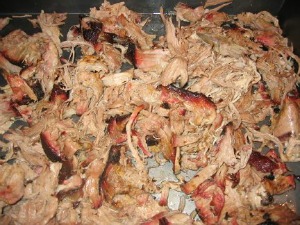
Slice or chop the meat or allow guests to pull meat from the bones. Serve with additional Secret Sauce. Serves many hungry people.
-
-
-
This recipe was generously donated by Al Carson of Raleigh, North Carolina.
-
Most families and restaurants that are known for their barbecues make their own Secret Sauce. In fact, they will tell you that the "secret is in the sauce." You would no more ask a barbecue man for his sauce recipe that you would for the use of his dog. Most people simply call their sauce "Secret Sauce."
-
In a large stainless-steel pot over medium-high heat, combine all the ingredients; bring to a boil. Reduce heat to low and simmer for approximately 15 minutes or until crushed red pepper sinks. Remove from heat.
-
It should be bottled hot, not boiling. Just hot enough that the bottles are hard to hold for more than a few seconds. Fill bottles within 1/2 inch of the top. By bottling hot, it will seal itself. Does not need refrigeration until after opening and then only to protect flavor.
-
If you like the sauce even hotter, add 1/4 cup of Tabasco before cooking.
-
NOTE: The sauce does not seem to have a problem with spoilage. I have used unopened bottles a year later and they have been very good. The sauce does get hotter with age.
* A live pig weighing 90 to 130 pounds will dress out a carcass approximately the desired weight. Dressed means that the pig is prepared for pig pickin' cooking. Do not remove the skin.
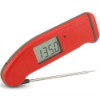 I get many readers asking what cooking/meat thermometer that I prefer and use in my cooking and baking. I, personally, use the Thermapen Thermometer. Originally designed for professional use, the Super-Fast Thermapen Thermometer is used by chefs all over the world. I only endorse a few products, on my web site, that I like and use regularly.
You can learn more or buy yours at: Super-Fast Thermapen Thermometer.
Sponsored Content
Check out the history and recipes of more favorite Southern Foods:
Boiled Peanuts
Chess Pie
Chitterlings/Chitlins
Collard Greens
Conch Chowder
Country Captain Chicken
Country Ham and Red Eye Gravy
Cuban Sandwich – Cubano Sandwich
Fried Catfish
Frogmore Stew
Grits – Shrimp & Grits
Hoppin’ John
Hot Brown Sandwich
Huguenot Torte/Ozark Pudding
Hushpuppies
Lady Baltimore Cake
Mint Julep
North Carolina Pig Pickin’
Robert E. Lee Cake – General Robert E. Lee Cake
She Crab Soup
Sweet Tea
Key Lime Pie
She Crab Soup
Shoofly Pie
One Response to “North Carolina Pig Pickin Recipe”
DAVID HANEY ROANOKE iLLINOIS BOIX 92
WE WAS IN SOUTH CAROLINA THIS YEAR AND OUR FRIEND GAVE US SOME GENERAL Mc Arthur’s Original Picking Bar B Q sauce and was wondering if it is sold in ILLINOIS. WE LIVE CLOSE TO PEORIA ILLINOIS. OR GIVEUS A ADDRESS SO WE CAN ORDER SOME. MY HUSBAND REALLY LIKES IT THANKS A LOT