
How To Cook A Turkducken
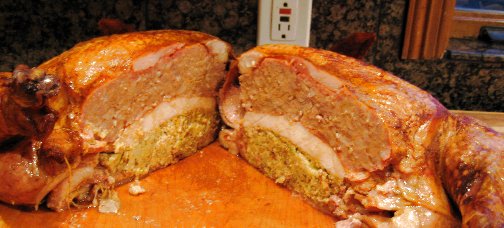
Turduckens – What the heck is that? Well, it is a 15 to 16 pound deboned turkey (except for wing bones and drumsticks), a fully hand de-boned duck, and a fully de-boned chicken, all rolled into one and stuffed with lots of delicious stuffing. Three kinds of stuffing are layered between the three kinds of meat.
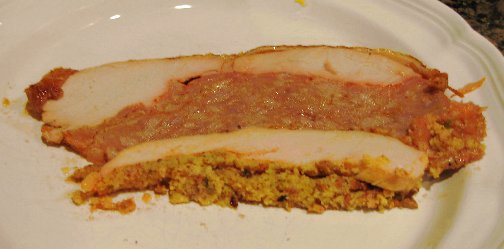
This regional delight has become one of the latest food fads. From the outside it looks like a turkey, but when you cut through it, you see a series of rings making up the three birds and three stuffing.
History:
One possible origin dates back a bit and says the turducken is somewhat derived from the galantine (an 18th century French blend of a de-boned bird stuffed with a mixture of finely ground veal, poultry, fish, vegetables, or fruit with bread crumbs and seasonings). Since Cajun people originated from French Canada, it could be assumed that the recipe came with them and morphed into today’s version.
The November 2005 issue of National Geographic magazine traced the origins of the dish in the United States to Maurice, Louisiana, and “Hebert’s Specialty Meats.” Herbert’s has been making turduckens since 1985 when they claim a local farmer (whose name that has since been forgotten) brought in a turkey, a duck, and a chicken, and asked Hebert’s to follow his directions in preparing them. Herbert’s now sells around 3,300 a year.
They share a friendly rivalry with famous Cajun chef Paul Prudhomme who claims to have been the first to serve them. Louisiana chef Paul Prudhomme says he is the one that developed the recipe for them. In 1986, Paul Proudhomme secured the turducken trademark from the U.S. Patent and Trademark Office. In 1987, The Prudhomme Family Cookbook [1987] shared the recipe with the culinary world:
“Word Mark TURDUCKEN Goods and Services IC 029. US 046. G & S: COMBINATION TURKEY, DUCK AND CHICKEN ENTREE FOR CONSUMPTION ON OR OFF THE PREMISES. FIRST USE: 19801127. FIRST USE IN COMMERCE: 19801127 Mark Drawing Code (1) TYPED DRAWING Serial Number 73576432 Filing Date January 6, 1986 Current Filing Basis 1A Original Filing Basis 1A Published for Opposition June 3, 1986 Registration Number 1406947 Registration Date August 26, 1986 Owner (REGISTRANT) PRUDHOMME, PAUL DBA K-PAUL’S LOUISIANA KITCHEN INDIVIDUAL UNITED STATES 406 CHARTRES STREET NEW ORLEANS LOUISIANA 70130”
How to Cook Perfect Turducken Recipe:
Purchasing a Frozen Turducken:
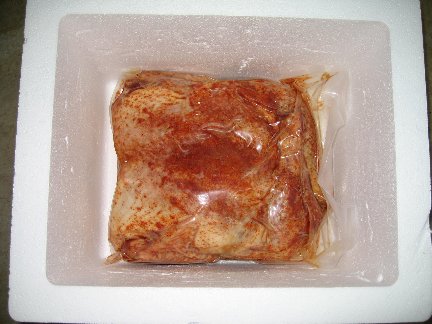
If the Turducken has been purchased through mail order, make sure it arrives frozen with a cold source in an insulated carton. Transfer it immediately to the freezer.
NOTE: If the turducken arrives warm, notify the company. Do not use the product.
Thawing a Frozen Turducken:
If your turducken is frozen, allow it to thaw 3 to 4 days in the refrigerator. It takes a full 24 hours to defrost every five pounds of frozen turkey in the refrigerator (the only safe method). A 20-pound turducken needs to defrost for a full 4 days.
Be sure it is completely thawed before cooking. Times are based on fresh or completely thawed frozen birds at a refrigerator temperature of about 40 F. or below. For a quick thaw, place in cool water for 6 to 9 hours. If your turducken is partially frozen, you may need to cook it an additional 30 to 45 minutes.
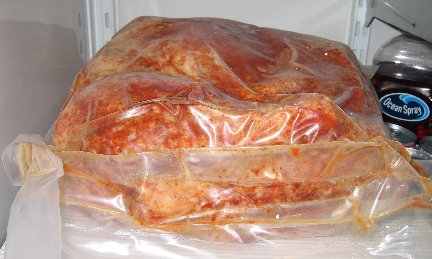
Oven Temperature: Preheat oven to 225 degrees F. Temperature control is critical since the turducken is so massive that it has to be cooked slowly at a low temperature to prevent burning the outside before the interior is cooked. Purchase and use an Cooking Thermometer to obtain the correct oven temperature. Calibration of the oven’s thermostat may be inaccurate.
Oven Rack: Place the oven rack in the center position of your oven.
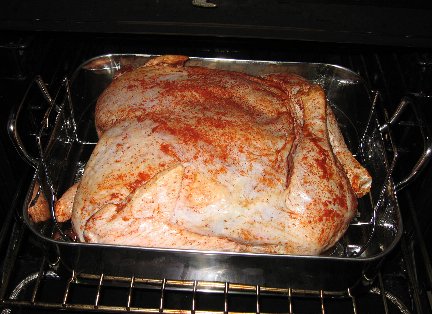
Roasting Pan: When ready to bake, take the turducken completely out of the packaging and place breast-side up, on a flat wire rack in a large shallow turkey roasting pan (2 to 2 1/2 inches deep.) Tuck wing tips back under shoulders of bird. NOTE:m Dark roasting pans cook faster than shiny metals.
Baking: Your turducken will take approximately 8 to 9 hours to bake. Bake or 4 hours uncovered. At the 4 hour mark, brush the skin with vegetable or olive oil and then cover with aluminum foil. Cook an additional 4 to 5 hours until the interior temperature reads 165 degrees F. on your meat thermometer.
Use a food thermometer to ensure that all layers of the turducken and stuffing reach a minimum safe internal temperature of 165 F. The thermometer should be placed at the center of the thickest part of the turducken to determine the safe internal temperature. Please rely on internal temperature with a meat thermometer and not time cooked for doneness. After each use, wash the stem section of the thermometer thoroughly in hot, soapy water. The USDA has come up with a one-temperature-suits-all for poultry safety: 165 degrees F. For safety and doneness, the internal temperature should be checked with a meat thermometer
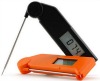 This is the type of cooking and meat thermometer that I prefer and use in my cooking. I get many readers asking what cooking/meat thermometer that I prefer and use in my cooking and baking. I, personally, use the Thermapen Thermometer shown in the photo on the right. To learn more about this excellent thermometer and to also purchase one (if you desire), just click on the underlined: Thermapen Thermometer.
There will be no need to baste the the turducken, but accumulated drippings in the bottom of the roasting pan may need to be removed from the pan every few hours. Remember – Save the pan drippings for your gravy. Remove the turducken from the oven.
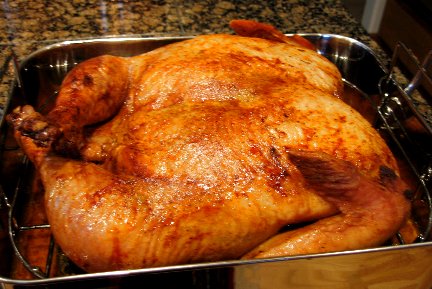
Rest Time: Once you remove the turkey from the oven, tent it with aluminum foil and allow it to rest for 1 hour, so the meat can firm up and hold the juices, making it easier to carve.
Gravy: Make gravy according to your favorite recipe. Check out Making Perfect Turkey Gravy.
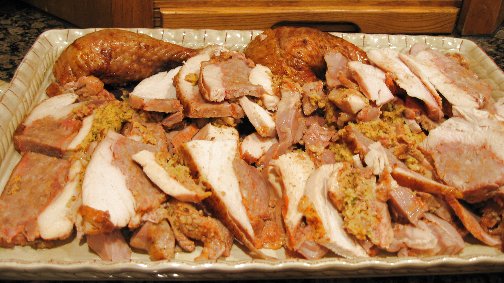
Carving: Using strong spatulas inserted underneath the turducken, carefully transfer it to a cutting board or a serving platter. I found it was easier to just remove it with my hands (of course I wore gloves). Remove any strings used and, using a sharp knife, cut the turducken in half lengthwise (from the neck to leg area – you will have two halves). Slice across from leg to leg, wing to wing so each slice reveals all three (3) meats and dressings. Be sure to present and show off the turkducken to your guests before carving.
United States Department of Agriculture (USDA) says:
Slice and serve the cooked Turducken within 2 hours after cooking. If it is not intended to be served within 2 hours, then slice and cut in smaller portions before putting in the refrigerator to cool fast. A whole cooked turducken may not cool to a safe temperature within the time needed to prevent bacterial growth.
Be sure to make your slices crosswise so that each slice contains all three dressings and all three meats. Cut each slice in half for serving.
After slicing and serving the turducken, refrigerate any leftovers in a shallow container within 2 hours of cooking. Perishable food should not be left out more than 2 hours at room temperature (1 hour when the temperature is above 90 degrees F.). Use the leftovers within 3 to 4 days after cooking or freeze for longer storage.
Questions and Anwers:
How many people does a Turducken feed?
Depending on size ordered – 15 to 20 normal people (or 8 REALLY hungry people)
How much does a Turducken weigh?
15 to 22 pounds.
Does the Turducken contain any MSG or preservatives?
No. It is prepared with all natural products.
Is the Turducken spicy?
It is well seasoned, but not Spicy (hot).
Can I refreeze the Turducken?
If the turducken has been purchased through mail order, make sure it arrives frozen with a cold source in an insulated carton. Transfer it immediately to the freezer. If the turducken arrives warm, notify the company. Do not use the product.
Can I deep-fry a Turducken?
No. There are no bones to support it.
Can I grill or smoke a Turducken?
Yes. Set the Turducken on aluminum foil, so it does not stick to the grill; or set in an aluminum pan. Put a thermometer in the grill. At 350 degrees F., place the it on the grill/smoker and cook accordingly.
Categories:
Cajun & Creole Chicken Cajun/Creole Holiday Turkey Dinners Poultry Dishes HIstory Turkey
4 Responses to “Turducken History and Recipe”
Jane Cohlmia
We have purchased at 15 lb. turduken for the first time. Normally, with regular turkeys I have always brined in advance. Should I do the same for the turduken? I believe that it is preseasoned and I’m wanting to make sure that it would hurt to brine. Comments please?
Linda Stradley
No. Remember the Turducken contains stuffing.
Kathleen
HELP……..How long do I cooked a 4 lb. turducken with jambalaya stuffing?
Mary
How long is cooking time for a Boneless 4 lb. turducken and what temp. Please?