
How to purchase, thaw, stuff turkey, and roast turkey
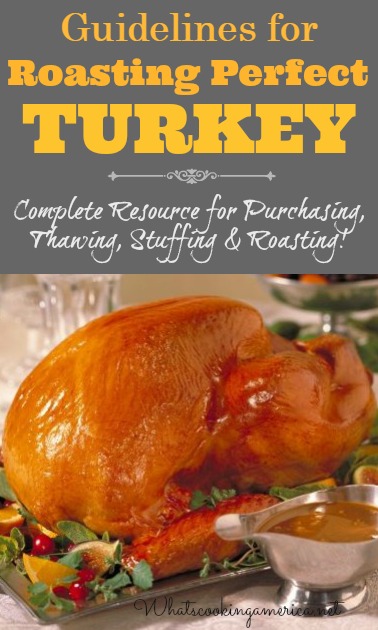
How to Purchase Turkey:
Purchase one (1) pound of raw turkey per person (includes a moderate amount for leftovers).
1 1/2 pounds per person, if you have hearty eaters or want ample leftover.
3/4 pound of whole turkey per person for no leftovers.
Uncooked, boneless turkey roast – at least 1/3 pound per person.
Uncooked, bone-in turkey breast – 3/4 pound per person.
Make sure your roasting pan, oven, and refrigerator can accommodate the size turkey you purchase.
Frozen vs. Fresh Turkey – What type should you buy:
Please read Turkey Terminology – Types of Turkeys
Frozen Turkey: Do you know that a “frozen” turkey is fresher than a so called “fresh” turkey? Turkeys chilled below 0 degrees F. must be labeled “frozen.” Or, if they’re sold already defrosted, you may see “previously frozen” on the label. You can purchase frozen turkeys months in advance. Turkeys can be kept frozen in the freezer indefinitely, but for best quality should be used within 1 year of purchase. Keep frozen until you are ready to thaw it.
This is what my favorite butcher told me. The so-called fresh turkeys have been sitting around for many, many days. From the processing, trucking to the grocery store, and then in the grocery store. These are not fresh turkeys! His advice is to only purchase frozen turkeys, as they are flash frozen immediately after being butchered. Frozen turkey are fresher turkeys!
Hard-chilled or not previously frozen: Turkeys that have been chilled below 26 degrees F, but not below 0 degrees F. can not be labeled fresh, but they do not have to be labeled frozen either. If a turkey is not labeled as either fresh or frozen, it is most likely in this category. This type of bird may also be identified as “hard-chilled” or “not previously frozen.”
Fresh Turkey: A turkey may be labeled “fresh” only if it has never been chilled below 26 degrees F. (Turkey meat, according to the National Turkey Federation, doesn’t freeze at 32 degrees F, but at a temperature closer to 26 degrees F.)
If you order a fresh turkey, pick it up from the store only a day or two ahead of time. Handle raw turkeys safely. Take the turkey home directly from the grocery store. At home, place the turkey immediately in the refrigerator or freezer.
Store turkeys in the coldest part of your refrigerator at 40 degrees F. or below. A locally raised fresh turkey will last only 1 to 2 days refrigerated. Commercially raised fresh turkey in their unopened packaging may last longer and should be marked with a Use By date.
I, personally, recommend that you do not buy fresh prestuffed turkey. If not handled properly, harmful bacteria that may be in the stuffing can multiply very quickly. The USDA recommends only buying frozen prestuffed turkey that display the USDA or State mark of inspection on the packaging that shows these turkey have been processed under controlled conditions.
Methods To Defrost or Thaw Turkey:
Preferred Method – Refrigerator Method:
Turkey should be thawed it its original plastic wrapper. Place the frozen turkey on a rimmed cookie sheet or in a pan to catch any juices that may leak.
Start defrosting the frozen turkey in the coldest part of the refrigerator, in the back. – NEVER DEFROST TURKEY AT ROOM TEMPERATURE, since bacteria multiplies and breeds at room temperature. Every five (5) pounds of turkey will require 24 hours of thaw time in the refrigerator (i.e., a 15-pound turkey will take three (3) full days). For most of you, this means buying a frozen turkey on a Saturday or Sunday and letting it rest on the very bottom shelf of your refrigerator until Thursday morning.
Use an instant-read digital thermometer to check the temperature of the turkey meat in various locations. If the meat is colder near the bone or center of the bird than near the surface, keep thawing! You want about a 40 degrees F. to 45 degrees F. (5 to 7 degrees C.) reading throughout.
Approximate Refrigerator Turkey Thawing Time (40 degrees F.)
Hours and Days to Allow for Thawing Turkey by Turkey Weight
5 to 10 pounds – 24 hours to 48 hours (1 to 2 days)
10 to 15 pounds – 48 hours to 72 hours (2 to 3 days)
15 to 20 pounds – 72 hours to 96 hours (3 to 4 days)
20 to 25 pounds – 96 hours to 120 hours (4 to 5 days)
Last minute method – Cold Water Method:
If you need to thaw the turkey more quickly, you may thaw the bird in COLD tap water, in the original wrapping. The cold water must be changed every time the cold water gets above 40 to 45 degrees F. (5 to 7 degrees C.) or every 20 to 30 minutes to avoid bacterial growth. Allow approximately 30 minutes per pound using this method. Cook the turkey immediately after it is thawed. Do not refreeze.
Use an instant-read digital thermometer to check the temperature of the turkey meat in various locations. If the meat is colder near the bone or center of the bird than near the surface, keep thawing! You want about a 40 degrees F. to 45 degrees F. (5 to 7 degrees C.) reading throughout.
Approximate COLD Water Turkey Thawing Time
Hours to Allow for Thawing Turkey by Turkey Weight
5 to 10 pounds – 2-1/2 hours to 5 hours
10 to 15 pounds – 5 hours to 7-1/2 hours
15 to 20 pounds – 7-1/2 hours to 10 hours
20 to 25 pounds – 10 hours to 12-1/2 hours
How To Stuff Your Turkey:
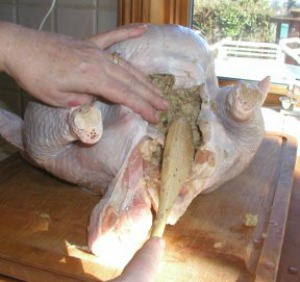 Please read Advice on Stuffing a Turkey Safely
Prepare Stuffing/Dressing: Prepare stuffing safely. Mix and stuff the turkey just before roasting it. If more convenient, the wet and dry ingredients only can be prepared ahead of time and chilled.
Prepare Turkey: Be sure the turkey is completely thawed. Remove the plastic wrapper from the turkey. Do not forget to remove the paper wrapped packet of giblets and the neck found in the body and neck cavities. Blot turkey inside and out with paper towels.
Amount of Stuffing: Stuff the bird properly. The turkey should be stuffed loosely about 3/4 cup of stuffing per pound of turkey. This will help allow the stuffing to reach the proper 165 degrees F. internal temperature whether the stuffing is in the bird or in a casserole. Use a meat thermometer to be sure. T he stuffing should be moist, not dry, since heat destroys bacteria more rapidly in a moist environment
Do not stuff the turkey ahead of time. The turkey insulates the stuffing from the refrigerator’s cold and can keep the stuffing in a dangerous temperature range (40 degrees to 140 degrees F.) that allows bacteria to multiply.
Preparing Turkey for Cooking:
Place turkey breast-side up on a flat wire rack in a shallow roasting pan 2 to 2 1/2 inches deep. Optional steps:
Tuck wing tips back under shoulders of bird (called “akimbo”).
Add 1/2 cup water to the bottom of the pan.
In the beginning only, a tent of aluminum foil may be place loosely over the breast of the turkey for the first 1 to 1-1/2 hours, then removed for browning. Or, a tent of foil may be placed over the turkey after the turkey has reached the desired golden brown.
How To Roast the Stuffed Turkey:
Cook at the proper temperature. The stuffed turkey should be placed immediately in a preheated oven set no lower than 325 degree F. Cooking overnight in a “slow” oven is NOT recommended since food borne bacteria can form under these conditions. For safety and doneness, the internal temperature should be checked with a meat thermometer. The meat thermometer must be placed properly in the thigh joint. Safe cooking relies on the use of a meat thermometer. The USDA has come up with a one-temperature-suits-all for poultry safety: 165 degrees F.
Cooking Thermometers: Several types of thermometers are available on the market: regular, oven-proof; instant read and digital; pop-up timers; and microwave-safe thermometers.
Purchasing and Using Cooking Thermometers: Make sure the thermometer you buy or use is designed for meat and poultry. At the beginning or toward the end of the roasting time an oven-proof thermometer may be placed in the thigh joint of the turkey to check the internal temperature at intervals during the cooking time. Or an instant-read may be used periodically to check the internal temperature during cooking.
 This is the type of cooking and meat thermometer that I prefer and use in my cooking. I get many readers asking what cooking/meat thermometer that I prefer and use in my cooking and baking. I, personally, use the Thermapen Thermometer shown in the photo on the right. Originally designed for professional users, the Super-Fast Thermapen Thermometer is used by chefs all over the world. To learn more about this excellent thermometer and to also purchase one (if you desire), just click on the underlined: Thermapen Thermometer.
If your turkey has a “pop-up” temperature indicator, it is also recommended that you also check the internal temperature of the turkey in the innermost part of the thigh and wine, and the thickest part of the breast with a meat thermometer.
The temperature must reach a minimum of 165 degrees F. in the thigh before removing from the oven. The center of the stuffing should reach 165 degrees F. after stand time.
Juices should be clear. In the absence of a meat thermometer, pierce the turkey with a fork in several places; juices should be clear with no trace of pink. After each use of your meat thermometer, wash the stem section of the thermometer thoroughly in hot, soapy water. The old-fashioned way of wiggling the leg to see if it is loose will give you an indication that the turkey is ready, but unfortunately, by the time the leg is truly loose, the turkey is sadly overcooked. The only reliable test for doneness is to check the internal temperature with a meat thermometer in the thickest part of the thigh, without touching the bone.
Tenting the Cooked Turkey: Once you remove the turkey from the oven, tent it with aluminum foil and allow it to rest for 15 to 20 minutes, so the meat can firm up and hold the juices, making it easier to carve. This allows all the juices that gather during roasting to be reabsorbed into the fibers of the turkey meat. If you skip resting the cooked turkey, you will likely spill flavorful juices out onto the platter when the turkey is carved.
Turkey Cooking Times:
The new roasting times are based on the recommendations above and on a 325 degree F. oven temperature. These times are approximate and should always be used in conjunction with a properly placed meat thermometer
.
Approximate Turkey Cooking Times:
UN-STUFFED TURKEY
4 to 8 pounds………….1-1/2 to 3-1/4 hours
8 to 12 pounds…………….2-3/4 to 3 hours
12 to 14 pounds……………3 to 3-3/4 hours
14 to 18 pounds……………3-3/4 to 4-1/4 hours
18 to 20 pounds……………4-1/4 to 4-1/2 hours
20 to 24 pounds……………4-1/2 to 5 hours
STUFFED TURKEY
8 to 12 pounds…………….3 to 3-1/2 hours
12 to 14 pounds……………3-1/2 to 4 hours
14 to 18 pounds……………4 to 4-1/4 hours
18 to 20 pounds……………4-1/4 to 4-3/4 hours
20 to 24 pounds……………4-3/4 to 5-1/4 hours
NOTE: It is safe to cook a turkey from the frozen state, but the cooking time will take at least 50% longer the the above recommended time for a fully thawed turkey. Remember to remove the giblet packages before your start the cooking.
Different Types of Turkey Cooking Styles:
 Barbecued or Grilled Turkey
Outdoor barbecuing or grilling is a very easy and a efficient way to cook your Thanksgiving or Christmas turkey. No mess in your oven or the kitchen! A whole turkey may be prepared on either a gas grill or a charcoal grill. This method requires a covered barbecue grill and heavy duty aluminum foil. Your turkey will be crisp outside and juicy inside.
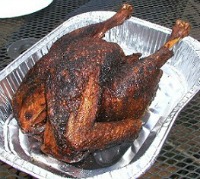
Cajun Fried Turkey
This is the best way of cooking a turkey I have ever tasted! This way of cooking your turkey is anything but greasy as the deep-frying process seals the outside and the turkey remains incredibly juicy, while the skin gets wonderfully crispy. These fried turkeys were a big hit at our festival!
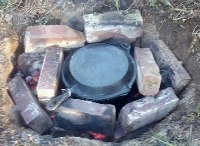 Outdoor Turkey Pit Cooking Recipe – Turkey In the Hole Recipe
This style of pit cooking is also know as “Bean Hold Cooking.” A pit barbecue is an exercise in turning a hole in the ground into an oven with hot coals provide the heat. Covering the top with aluminum foil and then dirt, regulates the oxygen so the coals burn slowly, providing an even, controlled heat for many hours. If you have the time and place to cook your holiday turkey in an outdoor pit. This make a great Thanksgiving or Christmas turkey dinner.
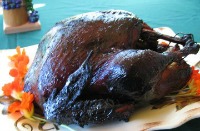 Smoked Turkey
Smoking a turkey is no different from barbecuing in your back yard. You follow all these rules without even noticing them in most cases – so go ahead, give it a try. You will not be dissatisfied when you try a smoked turkey.
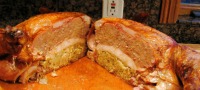 Turducken
What the heck is that? Well, it is a 15 to 16 pound deboned turkey (except for wing bones and drumsticks), a fully hand deboned duck, and a fully hand deboned chicken, all rolled into one and stuffed with lots of delicious stuffing (three kinds of stuffing are layered between the three kinds of meat). This regional delight has become one of the latest food fads. From the outside it looks like a turkey, but when you cut through it, you see a series of rings making up the three birds and three stuffing.
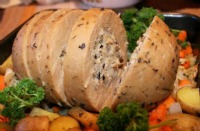 Tofurky/Tofurkey Recipe with Vegan Gravy
Tofurky is very popular “mock” meat substitute to serve for Thanksgiving and Christmas dinners. I am not a vegetarian or a vegan, but I have several family members who are. For them and my many readers who are also vegetarians or vegans, I created this page on how to cook Tofurky.
Helpful hints and tips on preparing your holiday turkey dinner:
Perfect Turkey Gravy
Homemade gravy, made using the turkey giblet stock, pan drippings, and meat juices from the roast turkey, is an essential part of a traditional Thanksgiving dinner.
Guidelines for Brining Poultry
This is the secret that chefs never tell you about. It’s very easy and economical, and requires no special cookware. Brining is like a marinade, as it keeps food moist and tender.
Let’s Make Turkey Stock
Don’t throw out those leftover turkey bones! My favorite thing to do the morning after Thanksgiving is to make homemade turkey stock from the turkey carcass. It is so easy to do and so delicious!
Linda’s Favorite Turkey Stuffing
Whether you call it “stuffing” or “dressing,” what’s not to love about turkey stuffing? Everyone knows that stuffing is the best part of a turkey dinner!
Make Ahead Mashed Potatoes
Save your valuable kitchen time on Thanksgiving day by using this easy-to-make mashed potato dish for your next Thanksgiving dinner. This is the recipe I use every year for Thanksgiving Dinner.
Using a Cooking or Meat Thermometer
Have you ever cut into a turkey to see if it has finished cooking? You DEFINITELY need to use a cooking thermometer! A cooking thermometer or meat thermometer should not be a “sometime thing.” Use it every time you prepare foods like poultry, roasts, hams, casseroles, meat loaves and egg dishes.
Internal Temperature Cooking Charts
Cooking thermometers take the guesswork out of cooking, as they measure the internal temperatures of your cooked meat, poultry, seafood, baked goods, and/or casseroles, to assure that a safe temperature has been reached, harmful bacteria have been destroyed, and your food is cooked perfectly. Always follow internal cooking temperatures to be safe!
Advice on Handling Leftovers Safely
Leftover” foods are cooked foods that you or your family do not eat within 2 hours after they are cooked. The chance of food poisoning increases the longer you store a food after it is cooked. Improper handling or storing cooked food is one of the most common causes of food poisoning in the home.