
Stuffing a Turkey Properly and Safely
U.S. Department of Agriculture
Food Safety and Inspection Service
Washington, DC 20250
Consumer Education and Information

Stuffing a Turkey – To stuff or not to stuff — that is the question on the U.S. Department of Agriculture’s Meat and Poultry Hotline. It is an important question to ask as the Thanksgiving and Christmas holiday draws near, because cooking a home-stuffed turkey can be somewhat riskier than cooking one not stuffed. If the stuffing is not cooked and handled properly, food borne illness could occur.
However, with careful preparation and the use of a meat or cooking thermometer to ensure that safe temperatures are reached, consumers can safely enjoy the traditional holiday stuffing inside OR outside the bird,” says Bessie Berry, Food Safety and Inspection Hotline Manager.
NOTE: The USDA has come up with a one-temperature-suits-all for poultry safety: 165 degrees F. For safety and doneness, the Internal Temperature of the turkey should be checked with a meat or cooking thermometer.
IMPORTANT: Although a “pop-up” thermometer that comes with many turkeys is one way to judge the turkey’s doneness, it can not tell you the temperature of the stuffing. An instant meat or cooking thermometer should also be used with stuffed turkeys.
After the estimated cooking time has elapsed, a meat thermometer should be inserted in several places, including the innermost part of the thigh and the center of the stuffing, to check the temperatures.
 This is the type of cooking and meat thermometer that I prefer and use in my cooking. I get many readers asking what cooking/meat thermometer that I prefer and use in my cooking and baking. I, personally, use the Thermapen Thermometer shown in the photo on the right. Originally designed for professional users, the Super-Fast Thermapen Thermometer is used by chefs all over the world. To learn more about this excellent thermometer and to also purchase one (if you desire), just click on the underlined: Thermapen Thermometer.
To Take Temperature of Thigh – Place the thermometer in the thickest part of thigh away from the bone of the turkey to check the internal temperature at intervals during the cooking time.
To Take Temperature of Breast – Insert thermometer at neck end, holding it parallel to the turkey. Confirm temperature by inserting thermometer in both sides of the turkey.
Once the turkey meat and the stuffing have reached the proper temperatures, the turkey should be removed from the oven and allowed to “stand” for 15 to 20 minutes before removing the stuffing and carving.
If you are not prepared to use a meat thermometer to measure the internal temperature of the stuffing in the bird, then the stuffing should be cooked outside the turkey.
Family favorite Turkey Stuffing/Dressing Recipes:
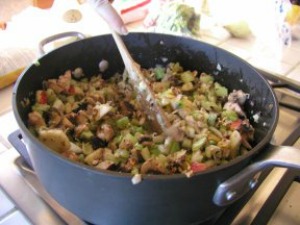 Turkey Stuffing
This is my family’s favorite Turkey Dressing/Stuffing recipe that I make every year. Whether you call it “stuffing” or “dressing,” what’s not to love about turkey stuffing? It is often one of the best parts of a turkey dinner. It is so easy to prepare. Also be creative and add your family’s favorite ingredients.
Sweet Onion Cornbread Stuffing
This wonderful cornbread stuffing will delight your family and friends. It is easy to make and so delicious! Use it as a great stuffing alongside of your poultry dishes.
Sweet Onion Cornbread Stuffing
This wonderful cornbread stuffing will delight your family and friends. It is also easy to make and so delicious! Use it as a great stuffing alongside of your poultry dishes.
Additional Important Food Safety Guidelines to Follow:
Handle raw turkeys safely. Take the turkey home directly from the grocery store. Errands should be run first, before going to the store. At home, place the turkey immediately in the refrigerator or freezer. A fresh turkey should be cooked within two days.
Defrosting Turkey. Defrost frozen turkeys in the refrigerator, allowing 24 hours for each five pounds. For faster thawing, place the frozen turkey in cold water, allowing about 30 minutes per pound. The water should be changed every half-hour. A turkey may be defrosted in the microwave if it is large enough, but follow the manufacturer’s instructions. Cook immediately after defrosting.
Prepare stuffing safely. Mix the stuffing just before it goes into the turkey. If more convenient, the wet and dry ingredients can be prepared ahead of time and chilled. Mix the ingredients just before placing the stuffing inside the turkey or in a casserole.
Stuff the bird properly. The turkey should be stuffed loosely about 3/4 cup of stuffing per pound of turkey. This will help allow the stuffing to reach the proper 165 degrees F. internal temperature whether the stuffing is in the bird or in a casserole. Use a meat thermometer to be sure. The stuffing should be moist, not dry, since heat destroys bacteria more rapidly in a moist environment.
Cook at the proper temperature. The stuffed turkey should be placed immediately in a preheated oven set no lower than 325 degrees F. Cooking overnight in a “slow” oven is not recommended since food borne bacteria can form under these conditions.
Storing leftovers. Leftovers should be stored within two hours of cooking. Cut the turkey off the bones. Refrigerate the stuffing and the turkey separately in shallow containers. Use leftover turkey within four days; stuffing and gravy, in one or two days.
2 Responses to “Stuffing a Turkey Properly and Safely”
Donna O'Dell
I took stuffed turkey out of oven at 180degrees on oven thermometer. We aren’t eating until tomorrow evening. What should I do to keep turkey and stuffing safe to eat? Can I take care of it in the morning and be safe for dinner tomorrow night? Thanks!!
Brenda
If the internal temp of your turkey and stuffing reached 165 degrees F, then you can assume it’s properly cooked. Remove the stuffing and store separately from the turkey meat in the refrigerator until you are ready to warm it up and eat.