
How Baking Powder Works – Types of Baking Powder – How To Test Baking Powder
Baking Powder is a leavening agent that contains a combination of baking soda, cream of tartar, and a moisture absorber (like cornstarch). It is used like yeast, but it acts much more quickly.
It is used in batters where there is no acid present, such as in: cookies, cakes, pastries, pies, quick bread, etc. It makes the baked goods voluminous by allowing gas formation when an acid comes into contact with it and/or when it is heated.
Because it acts immediately upon the addition of water, a filler (usually cornstarch) is added to absorb the moisture and prevent premature activity.
Types of Baking Powder:
Double-acting: Most are double-acting, which means it reacts twice; one acid that dissolves when it comes in contact with water and a second acid that does not dissolve until it reaches a higher temperature. This type of double action ensures that the finished product is light and fluffy.
Single-acting: Mainly used by manufacturers and are usually not available for retail sale.
Food Chemistry Rule in Using Baking Powder:
When creating a recipes, the food chemistry rule is 1 to 1 1/4 teaspoons of baking powder per 1 cup flour.
If too much is used in your recipe, this produces big bubbles that will run into each other and then rise to the surface and pop. The result is that the muffins, cakes or quick breads become heavy or sunken.
Following are the most common brands found in your local grocery stores:
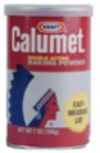 Calumet is sodium aluminum sulfate – a phosphate powder in which the acid ingredients are sodium aluminum sulfate and calcium phosphate.
Available in the United States. Owned by Kraft Foods.
It is gluten-free and certified Kosher by the Union of Orthodox Jewish Congregations of America.
 Clabber Girl is gluten-free and certified Kosher by the Union of Orthodox Jewish Congregations of America.
Ingredients: Corn Starch, Bicarbonate of Soda, Sodium Aluminum Sulfate, Acid Phosphate of Calcium.
Available in the United States. Owned by Clabber Girl Corporation.
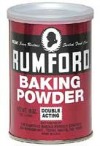 Rumford is an all-phosphate powder (containing calcium acid phosphate – no aluminum). It is gluten-free and certified Kosher by the Union of Orthodox Jewish Congregations of America.
Ingredients: Monocalcium Phosphate, Sodium Bicarbonate (Baking Soda), Food-Grade Cornstarch.
Available in New England and the northeastern United States. Owned by Clabber Girl Corporation.
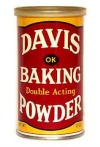 Davis is gluten-free and certified Kosher by the Union of Orthodox Jewish Congregations of America.
Available in New England and the northeastern United States. Owned by Clabber Girl Corporation.
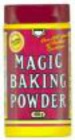 It is an all-phosphate powder (containing calcium acid phosphate – no aluminum).Magic Baking Powder is manufactured by Kraft foods Canada and sold only in Canada. Magic Baking Powder is certified Kosher by the Kashruth Council of Canada.
How To Purchase Baking Powder:
When buying and stocking up, try to find the most current date available by looking for a manufacturing or expiration date on the product. Keep in mind when it was manufactured and how long it has been sitting on the store’s shelf, because time weakens its potency.
Just because you bought it last week, it does not mean it was made last week and is as fresh as possible.
Once a can is opened, it should be good for 3 to 6 months.
How To Store Baking Powder:
Store at room temperature in a dry place.
A cabinet or pantry away from the sink or heat source (such as the stove, direct sunlight), is a perfect place.
Do not store in the refrigerator as it may shorten the shelf life due to condensation that occurs on the can.
How To Test Baking Powder:
Baking powder does lose it’s potency over time, about 6 months. If you are unsure of its freshness, you should test it before using.
First stir the contents of the can to see if there are any lumps. Lumps are an indication that it has picked up moisture, and has started a reaction in the can.
Check the code dates on the bottom of the can to make sure it is still in code. Baking powder has a usual useful life of 24 months from the date of manufacture.
Stir 1 teaspoon baking powder into 1/3 cup of hot water. If it bubbles gently, it is fine to use.
If you have a can that has been sitting in your cupboard for a year or more – toss it out!
How To Make Baking Powder:
If you have run out you may be able to make a substitution by using the following:
For one teaspoon baking powder = mix 1/2 teaspoon cream of tartar plus 1/4 teaspoon baking soda.
If you are not using immediately, add 1/4 teaspoon cornstarch to absorb any moisture in the air and to prevent a premature chemical reaction between the acid and alkali.
Remember that a recipe for baked goods is like a formula. The ingredients work together to create an acceptable finished product. Substitutions don’t always work as well as the original ingredients called for in the recipe. Any substitutions that you make come with the risk that the recipe will not turn out as intended.
Baking powder acts immediately upon addition of water, therefore a filler (usually cornstarch) is added to absorb the moisture and prevent premature activity. Various powders were sold in the first half of the 19th century.
Learn more About Baking Powder
History:
1843 – The first modern version of baking powder was discovered and manufactured by Alfred Bird (1811-1878), British chemist and founder of Bird and Sons Ltd. His improved version of baking powder was created so he could make yeast-free bread for his wife, Elizabeth, who had allergies to eggs and yeast. According to the article Pharmacy – the mother of invention? from the Royal Pharmaceutical Society of Great Britain:
His first invention was baking powder. The Illustrated London News, 24 April, carries a report that “Mr Alfred Bird, chemist, Birmingham, communicated with the Duke of Newcastle, as head of the War Department, offering to supply the troops in the East with his baking and fermenting powder, which would admit of their being regularly supplied with fresh bread, as well as prove invaluable in the hospitals for the supply of the sick and wounded with bread, light cakes, light puddings, and other articles of food suited to their condition.” In due course Bird received an order to supply his baking powder to H M Forces.
1846 – Justus Von Liebig (1803-1873), German chemist, explored the relationships of organic chemistry to agriculture and plant physiology. Students came from all over Europe, Great Britain, and the United States to study with him. Instead of using yeast he tried to raise bread with sodium bicarbonate and hydrochloric acid, with uncontrollable, dramatic and sometimes explosive results.
1855 – Eben Norton Horsford (1818-1893), who earlier studied under Justus von Lieberg from 1844 to 1846, and George F. Wilson (1818-1883) began the manufacture of chemicals under the company name of George F. Wilson and Company in Providence, RI. Two years later, their business became known as the Rumford Chemical Works, which soon became one of the the largest and most successful chemical plants in the country. Horsford formulated and patented Rumford Baking Powder, the first calcium phosphate baking powder:
Original patent, No. 14,722, was granted to Eben Norton Horsford, April 22, 1865, for 14 years, for an ‘improvement in preparing phosphoric acid as a substitute for other solid acids,’ and was reissued to the Rumford Chemical Works, as No. 2,597, May 7, 1867, for an ‘improvement in the manufacture of phosphoric acid and phosphates for the use in the preparation of food, and for other purposes.’
In 1847, Eben Horsford was appointed to Harvard’s Rumford Chair of the Application of Science to the Useful Arts. American-born physicist, Benjamin Thompson Rumford (1753-1814), later known as Count Rumford, left Harvard University the funds with which was founded the Rumford professorship, known as Rumford Chair of the Application of Science to the Useful Arts. It is not known if Eben Horsford named his company and baking powder after his chair at Harvard University or after Benjamin Thompson Rumford. According to the Horsford Family Papers, 1681-1954:
Rumford Chemical Works, 1852-1892
Letters from George F. Wilson make up the bulk of this sub-series and are arranged chronologically. George F. Wilson co-founded the Rumford Chemical Works and took care of the business of operating the company. Methods of manufacture, development of new products and markets for new products are among the subjects discussed in this correspondence. The Rumford Chemical Works produced Horsford’s chemical inventions. Among the products manufactured and sold were Horsford’s yeast powder, baking powder and cream of tartar used in baking; acid-phosphate used for indigestion; and anti-chlorine used as a bleaching agent.
1866 – Brother’s Cornelius (1828-1898) and Joseph Hoagland (1841-1899) formed a partnership to develop a baking powder company called Royal Baking Powder Company. According to the article The Hoagland Brothers on Shelter Island from 1881 to 1896, by Patricia Shillingburg:
In 1866 Cornelius and Joseph formed a partnership to develop a baking powder company. William Ziegler and John H. Seal were brought in as investors in 1873 and it was at that point that the Royal Baking Powder Company was formed. Joseph, later in life, took full credit for the success of the company. He promoted the brand extensively. In speaking about the creation of “brands,” Gerben Bakker, in a speech, The Enclosed Economy: How Public Goods Splinter into Private Properties, explained:
It all started with the grocer J. C. Hoagland, who noticed that the baking powder he was making did not bring in much revenue. He suffered from competition, because baking powder was easy and cheap to make. Hoagland therefore decided to name his powder the Royal Baking Powder, and to sink a huge sum into an advertising campaign. Soon, Hoagland was spending half a million dollars a year on advertising, an enormous amount at the time, but customers came to have a boundless trust in Royal Baking Powder. They were willing to pay several times the price of exactly the same thing from another producer.
According to the San Francisco Call, Enemies of the Republic, Part 2, by Lincoln Steffens, regarding William Ziegler, President of the Royal Baking Powder Company:
Ziegler went into the baking-powder business way back in 1868 with the Hoaglands, a firm of druggists at Fort Wayne, Indiana. The young man mastered the business, technically as a pharmacist, commercially as a salesman. He fought for his share in the profit; he left them and established a competitive business to force his point, and in 1873 they let him in. So you see, Young Man, it isn’t alone sobriety, industry, and honesty that make success, but battle, too. Ziegler organized the Royal Baking Powder Company in 1873, with himself as treasurer.
The Business grew for three or four years, when it was discovered that alum and soda made a stronger leaven, and cheaper. Worse still, alum was plentiful. Anybody could go into its manufacture, and many did. The Royal, to control the cream of tartar industry, had contracted to take from European countries immense quantities of argol, the wine-lees from which cream of tartar is made. They had to go on making the more expensive baking-powder or break a contract. That would be “bad business.”
1889 – William M. Wright (1851-1931) and chemist George Campbell Rew (1869-1924) developed a double-acting baking powder whose leavening action began in the dough and repeated in the oven. They marketed the product under the name Calumet Baking Powder. Wright was the master of Calumet Farm, the single most successful racing stable in American history with six Kentucky Derby winners, first near Chicago and later at Lexington, KY. Wright was also the cousin of Wilbur and Orville Wright. George Rew was know as the “Calumet Baking Powder King.” According to the Genealogy of a Campbell Family from Virginia:
Following graduation, the young chemist was hired by William M. Wright, a food salesman who was attempting to develop a new and better baking powder. Together they “perfected the formula and the production process for the double-acting baking powder,” which to this day is a staple in every kitchen. The powder was produced by the Calumet Baking Powder Company of Chicago. In 1896 he was made Vice-President, and later he became President of the company. In 1928, two years after his death, the company was bought by General Foods.
About 1907, he and three other men drove overland from Chicago to the Pacific coast in a promotion for F. B. Stearns of Cleveland, Ohio. In their Stearns model 30/60 Tourer, they were the first to travel west by car along the old Santa Fe Trail. To make better progress over rough terrain, they removed the tires and lifted the car onto the railroad tracks thereby riding on the wheel rims. Although the trip was made entirely for pleasure and no night driving was attempted, the drive took only 19 days and set a record for daylight travel. One puncture was the only cause for stoppage in the entire 2,800 miles.
4 Responses to “Baking Powder”
José Maldonado- Pons
You forgot to mention Argo aluminum-free baking powder. It comes in a good size for the serious home baker(24 oz).
Chris
The description of Calumet is confusing:
“Calumet Baking Powder is sodium aluminum sulfate – a phosphate powder in which the acid ingredients are sodium aluminum sulfate and calcium phosphate.”
Sodium aluminum SULFATE isn’t a phosphate powder.
It might be better just to list the ingredients for each of them as done with Clabber Girl.
James Paci
Where can I find the article from the Royal Pharmaceutical Society on Alfred Bird’s baking soda?
Dennis Plante
What does the “OK” on the Davis Baking Powder can refer to?