
Question:
(1) Does cream of tartar go stale or lose it’s effectiveness with age?
(2) If you do not have cream of tartar, is there a substitute? I am baking Snickerdoodle cookies.
Answers:
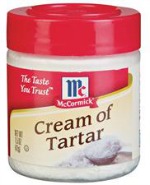 Shelf Life of Cream of Tartar – From everything I have read and seen in our winery, it has an indefinite shelf life if kept tightly closed and stored away from heat. As my husband and I have a vineyard and make wine, I see no reason that you can not keep it indefinitely.
Cream of tartar is the common name for potassium hydrogen tartrate and also tartaric acid, an acid salt that has a number of uses in cooking. It is obtained when tartaric acid is half neutralized with potassium hydroxide, transforming it into a salt. Grapes are the only significant natural source of tartaric acid, and cream of tartar is obtained from sediment produced in the process of aging wine. It is found on the insides of the wine barrels and sometimes at the bottom of bottles of wine. It crystallizes out as a hard crust in the barrels.
It is best known for helping stabilize and give more volume to beaten egg whites. It is used as the leavening agent in baking powders. It is also used to produce a creamier texture candy and frosting. It is used commercially in some soft drinks, candies, bakery products, gelatin desserts, and photography products. It can also be used to clean brass and copper cookware.
Substitute – The answer is – there is not a good substitution for cream of tartar. If it is used along with baking soda in a cake or cookie recipe, omit both and use baking powder instead. If the recipe calls for baking soda and cream of tarter, I would just use baking powder.
Normally, when cream of tartar is used in a cookie, it is used together with baking soda. The two of them combined work like double-acting baking powder. When substituting for cream of tartar, you must also substitute for the baking soda. If your recipe calls for baking soda and cream of tarter, I would just use baking powder.
One (1) teaspoon baking powder is equivalent to 1/4 teaspoon baking soda plus 1/2 teaspoon cream of tartar. If there is additional baking soda that does not fit into the equation, simply add it to the batter.
Remember – When making substitutions in baking, you may end up with a somewhat different product. The taste, moisture content, texture and weight of a product can be affected by changing ingredients.
15 Responses to “Cream of Tartar”
Brenda Curtis
If a recipe calls for 1 tsp cream of tartar and 1 tsp of baking soda, to substitute baking powder – how much do I need>
Linda Stradley
For one teaspoon baking powder = mix 1/2 teaspoon cream of tartar plus 1/4 teaspoon baking soda. If you are not using immediately, add 1/4 teaspoon cornstarch to absorb any moisture in the air and to prevent a premature chemical reaction between the acid and alkali.
Remember that a recipe for baked goods is like a formula. The ingredients work together to create an acceptable finished product. Substitutions don’t always work as well as the original ingredients called for in the recipe. Any substitutions that you make come with the risk that the recipe will not turn out as intended.
Check out What’s Cooking America’s article on Baking Powder.
Rebecca Fagersten
What if the recipe I’m using calls for cream of tartar only without any baking soda or powder? How do I substitute it then?
Linda Stradley
It is always best to follow the recipe ingredients and direction as given in the recipe and not to substitute.
Sarah
What substitute can i use instead of cream tartar for making playdough?
I cant find cream tartar where i live
Brent Green
The recipe calls for Cream of Tartar
But if you don’t have it in your pantry and your recipe calls for it, just substitute fresh lemon juice or white vinegar for the cream of tartar. For every 1/2 teaspoon of cream of tartar in the recipe, use 1 teaspoon lemon juice or white vinegar. As an example, if your cookie recipe calls for 1 teaspoon baking soda, add 2 teaspoons lemon juice instead of the cream of tartar. If your simple syrup recipe asks for 1/8 teaspoon cream of tartar, use 3-4 drops of lemon juice. And for the whipping egg whites? Add 1/2 teaspoon lemon juice per egg white.
The results will be so close, you probably won’t notice the substitution.
Laa paa
I’ve actually made playdough without cream of tartar, I’ll just skip it.
Shareeqah
If a recipe calls for 2 tsp of cream of tartar and 1 tsp of baking soda, how much baking powder do I used to substitute?
Cassondra
You will need 4 teaspoons of baking powder
Husna Khatoon
What if my sugar cookie calls for 1/2 tsp baking powder and 2 tsps cream of tartar (no baking soda) and I do not have cream of tartar on hand, then what do I substitute for the cream of tartar?
Whats Cooking America
Cream of Tartar is an acid and when combined with baking soda acts as a leavener in baking. If you do not have cream of tarter in hand, you can substitute lemon juice or white vinegar as an acidic replacement. For 1/2 teaspoon of cream of tarter in a recipe – substitute 1 teaspoon of lemon juice or white vinegar. Baking powder and cream of tartar are not typically combined in a sugar cookie recipe, you either use baking soda and cream or tartar or you substitute with just baking powder.
Alexis
How would I substitute 1/4 teaspoon of Cream of Tarter?
Tavlyn Bijoy
Hii I wanted to bake a cake but in that the recipe called for baking soda and baking powder and cream of tartar I am in India cream of tartar is not available here how can I substitute it
Tom Walker
So why even use baking powder? Isn’t it just easier to use baking soda with cream on tartar (adjusting to get the correct ratio of soda with powder), rather than baking soda and baking powder, which I am always replacing every few months to make sure the baking powder is fresh?
Deb
My recipe calls for a heaping Tbsp of baking powder AND 1/2 tsp of cream of tartar. What benefit does using both provide in a biscuit recipe? Can I omit the cream of tarter without affecting the rise?