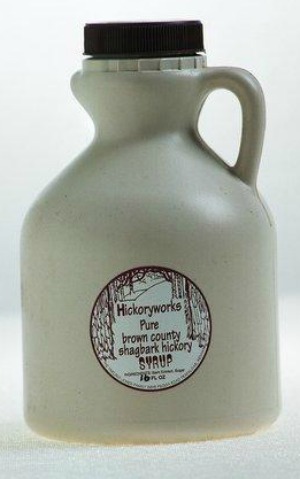
How did this unique recipe come about? A chance roadside encounter with a mysterious stranger. While Gordon and Sherrie were working up downed trees on their land, an old man pulled up and asked if he could buy some firewood. Noticing a shagbark hickory tree nearby, the man told Gordon of a unique syrup his great, great grandmother made from the bark of such trees. Striking a deal with this man to give him free firewood, he reappeared a few weeks later with the tattered recipe on yellowed parchment, a piece of paper Gordon and Sherrie protect like gold today since they are the only two who fully know its contents. “It makes me feel a little like Colonel Sanders with a secret recipe,” Gordon says with a smile. Today, the only written documentation of shagbark hickory syrup is the yellowed parchment supplied by the then-96-year-old man. Jones and Yarling know neither the man’s name nor whether he’s still alive, but they protect the paper like gold. “It makes me feel a little like Colonel Sanders,” Jones said. “That’s the secret behind our success.”
The husband and wife, following a ritual whose roots likely trace to American Indians who inhabited the area, have become one of the world’s few, if not only, manufacturers of shagbark hickory syrup. Unlike maple syrup, shagbark hickory syrup is not made from tree sap. It is a sugar syrup flavored with extract from bark of the shagbark hickory tree. “We’re not exactly sure where the extract comes from. We think it comes from right here,” said Jones, pointing to a thin lining on the bark’s underside.
Jones and Yarling found that by rendering a mysterious extract from the bark of trees native only to Indiana, Kentucky and Michigan, they have been able to produce a syrup craved by white-tablecloth restaurants from San Francisco to New York. Jones and Yarling are Hickoryworks’ only employees, but the demand for the syrup has far outstripped the supply of trees they have on their land. Yarling emphasizes that the trees are not harmed and the bark grows back. The duo now pays suppliers to bring them all the bark they can haul, which is dumped behind Jones’ and Yarling’s secluded home. Attached to the home is a special room where the bark is cleaned by hand. It is then heated in what Jones calls a combination between a wok and pressure cooker to render the extract, which is cooled and aged, Jones said, “like fine wine.” The whole process takes about three and a half weeks.
There’s no mystery to why some of the area’s finest restaurants began ordering the syrup in increasing numbers in the early 1990s. Chefs said they use the syrup in almost anything calling for sugar or maple syrup. It is used in glazes over beef, pork, chicken or fish. It is also used as a drink mixer; in salad dressings; as an ingredient in cakes, cookies and brownies; or straight over ice cream and pancakes.
“It’s one of the most unique things I’ve ever tasted. It has an earthy, smoky flavor without the maple kick. Once I tasted it and tested it, I found its applications are almost boundless.” – Tim Mally, Executive Chef at Ye Olde Library Restaurant in Carmel
“I like to mix it with bourbon as a marinade for ribs.” – Julie Child
“Its uses for me just keep expanding,” – Todd Harmon, executive chef at The Twin-V Cafe on the north side.
Check out the Hickoryworks Hickory Syrup and purchase some of this fantastic and tasty Hickory Syrup.
The World’s Original and Only Hickory Syrup
4 Responses to “Hickory Syrup”
Nancy Patrick
I ALWAYS renew my supply of Shag Bark Syrup at the Indiana State Fair. At the Fair today 17 Aug 2018 and you were not there! ????? It’s a long trip from NY to be disappointed.
Amy
@ Nancy Patrick – any luck in finding Hickoryworks syrup? Wondering if they are no longer producing the syrup?
Rene Walczak
Anyone looking for Hickoryworks shag bark syrup can find it with us — BooYAH! Shrubs. We are working together with Gordon Jones, follow his recipe, rely on him to taste each batch, and bring him out for shag bark hunting. Unfortunately, we lost Sharon a couple years back and Gordon is in nursing care, but being well taken care of by us. We can also be found at local Indy farmers markets and the syrup is sold at Georgetown Market, Good Earth and in Nashville, IN, The General Store.
Vince Wagner
Just tried some hickory syrup obtained from Monticello visit – their brand / Recipe dating back to President Jefferson! Fantastic!! Would love to try another – please provide price & availability! Thanx!!