
Why Do Some Eggs Float? – Fresh Eggs vs. Old Egg
QUESTION:
If you have kept eggs past the use before date, try to boil them, and if most sink to the bottom of the pan and a few float on the water – should you throw out the floating eggs? It has been a while since I was taught much about eggs and I do not remember any of my eggs ever floating. If the floating eggs are not bad then why do they float?
QUESTION:
I sometimes notice that in a batch of six (6) or so chicken eggs that have finished hard-boiling, several will barely float to the surface. All six are known to be average freshness for supermarket supplied eggs. Upon peeling, careful inspection shows no abnormalities. When eaten they taste fine. Any idea what’s going on? A pretty thorough search of the WEB didn’t turn up any answer, so the information isn’t commonly known.
ANSWER:
Learn All About Eggs and How To Cook Them.
Egg shells may seem pretty solid, but they are in fact slightly porous.
Old eggs float in fresh cold water because of a large air cell that forms as the egg cools after being laid. As the egg ages, air enters the egg and the air cell becomes larger and this acts as a buoyancy aid.
Generally, fresh eggs will lie on the bottom of the bowl of water.
Eggs that tilt so that the large end is up are older. The tilting is caused by air pockets in the eggs that increase in size over time as fluid evaporates through the porous shell and oxygen and gases filter in. The older an egg gets the more gas builds up inside it. More gas = more floating! Eggs that float could be bad. You might want to break it open and check it for a foul smell, a sure sign that it has rotted.
Carefully lower your eggs into fresh cold water (do not use salted water) using a spoon:
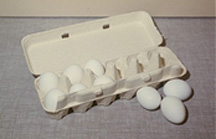
If the egg stay at the bottom – it is fresh.
If the egg is at an angle on the bottom – it is still fresh and good to eat.
If the egg stands on its pointed end at the bottom – it is still safe to eat but best used for baking and making hard-cooked eggs.
If the egg float – they’re stale and best discarded.
The final test:
To make sure the egg is not spoiled, break it into a clean bowl and check to make sure it doesn’t have a bad odor or appearance.
Comments from Readers:
Recently I was informed the way to tell if an egg was bad was to place it in water and see if it floats. Because as the egg aged, gasses were created in the egg causing it to float. Having more air in the egg makes the egg more buoyant. I disagreed with this explanation but was pointed to your website which supported this explanation. On your website under the question: “Why do some eggs float?” you state:
Egg shells may seem pretty solid, but they are in fact slightly porous. Old eggs float in fresh cold water because of a large air cell that forms as the egg cools after being laid. As the egg ages, air enters the egg and the air cell becomes larger and this acts as a buoyancy aid.
Generally, fresh eggs will lie on the bottom of the bowl of water. Eggs that tilt so that the large end is up are older, and eggs that float are rotten. The tilting is caused by air pockets in the eggs that increase in size over time as fluid evaporates through the porous shell and oxygen and gases filter in. The older an egg gets the more gas builds up inside it. More gas = more floating!
I am glad to now know how to determine if an egg is bad or not, but I did want to set you (and your readers) straight on why egg floats. You are partially correct, however, it is not the fact that air is getting into the egg that makes it float. It is the fact that mass is leaving the egg. Since the eggshell does not expand or contract, the density of the egg is only dependent on the mass of the egg (density equals mass divided by volume and the volume of the egg is constant). If the egg weighs less than the amount of water displaced by the egg it will float. If it weighs more, it will sink. It does not make a difference if there is more or less air in the egg. For example, if the inside matter (yolk and whites) were replaced with a steel ball of equal weight, there would be a lot of air in the egg. But the overall weight of the egg would be the same (actually it would be slightly heavier since air does have a weight associated with it and now you would have more air in the egg) so the egg would still sink. The reason why an egg floats is because as it decomposes, water vapor and gases are released through the porous shell. This is what causes the yolk and whites to shrink which in turn makes the air cell larger. Some ambient air enters the shell as the water vapor and decomposition gasses leave, but overall the mass of the egg is reduced. More mass is going out of the shell than coming in through the shell. More mass leaving = less weight = more floating!
Thank you – Rob Dyer
40 Responses to “Why Do Eggs Float? How To Tell A Bad Egg”
Jane Doe
I’ve raised chickens for the better part of 30 years now and up until recently always believed that a floating egg was a rotten one. However, it appears I have some Wyandottes who lay eggs with enormous air pockets in my current flock, because I have eggs that I know for a fact are only 2 weeks old (in the fridge the whole time) that float like fishing bobs. I marked a couple dozen to let age a few weeks so they’d be easier to peel since fresh eggs don’t peel for nothing (yes I’ve tried ALL the tricks). The others in the carton sank, but those light tan ones from the Wyandottes all floated. The same eggs, even if cracked the day they are laid, hit the skillet and bust all over the place. Forget about over easy with them, they might as well be pre-scrambled. I joke that those particular hens must fart right before the shell goes on and that’s why their eggs are all gassed up, ha, but honestly, no clue. The whole flock is 1-2 years old, they’re all free range, eating the same thing.
Linda Stradley
That is very interesting. As I have never raised chickens, I did not know about this. Thank you for sharing this with everyone.
lee
I also have wyandottes whose eggs float also when fresh.
Rlongo
Our neighbor gave us a lot of eggs that were supposed to be fresh off the farm. When I crack them open they smell ok but they are very liquidy and they do float. Are they still ok to eat as long as they don’t smell?
sas212
This is good to know as I gave my daughter a dozen eggs that had been stored in the fridge and were less than a month old. She went to boil them and was surprised that most of them floated since we know for a fact they were still fairly fresh. I too, have two wyandottes who lay light tan and speckled eggs and I have two RIR who lay reddish tan eggs. I was totally perplexed by why the eggs might be floating but you may have answered my question! Thank you for sharing 🙂
Karen
I tried my neighbors chicken eggs and didn’t eat them again because they tasted to gamey. So I eat organic store bought, Egglands Best. I recently put three in cold water and a small part of larger end floats. Should I not eat them?
Linda Stradley
I use fresh chicken eggs all the time myself.
Carefully lower your eggs into fresh cold water (do not use salted water) using a spoon:
If the egg stay at the bottom – it is fresh.
If the egg is at an angle on the bottom – it is still fresh and good to eat.
If the egg stands on its pointed end at the bottom – it is still safe to eat but best used for baking and making hard-cooked eggs.
If the egg float – they’re stale and best discarded.
The final test:
To make sure the egg is not spoiled, break it into a clean bowl and check to make sure it doesn’t have a bad odor or appearance.
fakeagent
Your style is unique in comparison to other people I have read stuff from. Many thanks for posting when you’ve got the opportunity, Guess I will just book mark this web site.
Libby Edwards
So the real question is a floating egg good or bad? I’m a little confused I bought some fresh eggs from a farmer I had six white eggs had bought from the store, I bought two dozen of fresh brown eggs from a farmer ….my brown eggs floated…my white eggs sank to bottom. So are they good or are they
Linda Stradley
From everything I have learned from experts, if the egg float – they are stale and best discarded
Nancy Greenwood
Some months ago I purchased eggs from the farmers’ market and got into a discussion about egg storage. She informed me that they do not wash their eggs so they don’t have to be refrigerated like store bought eggs. Even organic eggs have to be washed if sold commercially she said. Many countries don’t have refrigeration but they do eat eggs. Does it make a difference if eggs are unwashed so they still have the natural film of coating that nature provides? Thank you… I just boiled eggs that were floating which is why I was looking this up.
Linda Stradley
Yes, it makes a difference in the life of raw eggs. The lady at the Farmers’ Market is right.
Myrtle Houston
I have told many people about the same thing and I Seshan I am very happy to see it with other people I love to teach and I love cooking . Keep up the good work. Sincerely BOSS GG CHEF
Russell Palmer
I find even if the eggs float, does not mean they are rotten. The best way to check is break one or two in a bowl. If they are rotten, you will immediately smell it. I have had some that float and when I checked them in a bowl, smelled fine. I fried them and they did not taste bad at all. I believe it is from the actual egg aging in the shell that causes them to float. I guarantee you will smell a rotten egg when you break it.
Jed
Floating egg is bad is hogwash. I threw my floating eggs away then went back and checked half. All good. So I ate the other half.
Joe
-____- mass does not leave anything. density changes mass is always the same. Mass is the constant. Mass is how heavy something is. Volume is the variable and density is a variable. Thats why a periodic table is arranged based on the mass. Egg floats because density is lower than water’s density. Gas acting as buoyancy is waaaay better explanation than mass leaving.
Expert
I agree
Jethro
Not all eggs that float are bad. Eggs that float are more often than not just older eggs. Most fresh eggs sink to the bottom. However, some bad eggs sink and some freshly laid eggs float. You should check your floaters before throwing them out unless you just like to waste them for no reason.
Andrew
Sorry but I don’t buy it. I can take eggs that are 1-2 days old from my chickens and more than half will either float or stand up at the bottom of the bowl. My eggs are taken from the boxes each morning and evening and stored at 75 degrees unwashed in a basket on my counter. I never remove the bloom from the egg as I never seen a reason to. My chickens always lay clean eggs on fresh bedding. By no means are these eggs “old” as the float test would make you think.
Expert
Just 20 minutes ago…..
I removed 1 and 1/2 cartons (18 packs) of store bought eggs from the back of my cold refridgerator where I store them. Big white ones from Hickmans Farms here in Arizona. Noticed 11 floated in cool water.
Boil. Sit 15 min.
Noticed 11 still floating.
Broke one open. Ate it. Yum.
Looked at sell by date…. July 01, 2017
Thought….Today is October 31, 2017
Thought about the fact that I just ate an egg that was likely 4 to 5 months old.
Cracked open the rest. Enjoying egg salad. Deciding not to take more than a couple days to eat all of it. Hmmmmm….. better share it.
Thought about how I should make eggs at home more often.
Blake King
I’ve ran a test a number of times and find even eggs that float taste fine. They’ve usually been in the fridge longer (2-4 weeks), I boil them, they float and they smell and taste fine.
Debbie
I’ve been getting my free range organic eggs from “the egg lady” for three years and have never had a problem until this morning. I have one very large egg floating. Hmmmm
I know my eggs I get are either one or two days from the hens, so I’m not worrying about spoilage.
I do want to suggest how to hard boil a fresh egg without peeling half the whites away.
Drop raw egg into softly boiling water
Soft boil for 12-15 minutes depending on size of egg.
Emmediately drop cooked eggs into a bowl of ice water. Let Set for 5 minutes.
Every egg peels like perfection!
Enjoy your perfectly peeled egg.😊
Linda Hurd
That really does work but for some reason folks will not try it. The farm eggs peel just as well as the store bought. The people I have told continue to buy store eggs so they can peel them easily.
Naomi
That could explain a lot! My parents raise chicken s and sometimes, I get floating eggs among the fresh 18 pack! I was afraid to try to eat them even though they smelling fine and look fine ( yes, I myself, am a chicken 😜)thanks for sharing!
Bryan
Can anyone tell me if baking (bars or cake) with eggs that are 2-3 wks past the “sell by” date would effect the outcome?
Tamara Smith
If you’re cracking the egg to bake with it you would smell if the egg is bad if it doesn’t smell bad it most likely is not bad if it doesn’t have a discolored look or coloring to it and no bad smell use it bake way enjoy your treat
Lenora Knapp
Will a rotten egg smell when boiled?
Whats Cooking America
If it smelled before you boiled it, then it will smell while boiling. Throw it out.
Kenneth Kjer
I grew up on a beef, pork and chicken farm. We had our own slaughter house and meat cutting facility. We sold farm fresh eggs. I do not believe that you can tell the fresh of an egg by how it floats in water. I have candled I don’t know how many eggs over the years, but whether they sink or float is a poor way. The candle test is the best way and that can bee done with a small bright flashlight in a partially darkened room. But if you want to avoid all that learn the codes on the egg carton. One is the sell by date which is self explanatory, the other is the Julian date. The 3 digit number next to the sell by date is the Julian date and that is the day the eggs are packed. The Julian date is based on the Julian calendar and tells you the day of the year. Example Jan, 1, 001, Dec 31 is 365. Eggs are usually good 4-5 weeks after the Julian date. Longer depending on refrigeration. I keep my refrigerator at about 45F so they keep a little longer. If in doubt I candle them.
onesies and twosies game
ost however , I was wondering if you could write a litte more on this subject? I’d be very grateful if you could elaborate a little bit more. Bless you!
Jeff Dotson
Just because eggs float does not mean they are rotten. I have eaten plenty of eggs that floated. I have raised numerous chickens and even that fresh some float. Most that start out floating sink after a few minutes of boiling
Adeline Esposito
Me too.. If they don’t smell,and look good we use them
Brenda
Eggs that float are not necessarily rotten. When they float, they may be less fresh but then again, maybe not. We do not refrigerate our eggs but instead keep them in a cool place. When using eggs, I crack each one into a small bowl before adding it to a recipe, if the egg yolk is rounded and firm, the white viscous, I use the egg. If the yolk breaks and runs in a thin nonviscous white, I toss the egg — not because it is necessarily rotten but because it is not sufficiently fresh for me to use. If the yolk breaks because I am careless and I can see it still has rounded margins and doesn’t run and that the white is viscous, I’ll use the egg in my cooking.
Sometimes I have not properly tracked the age of my eggs. That happened today as I was about to boil 8 eggs. Three floated. I broke them each into a bowl separately expecting to see runny non-fresh eggs. All three did meet my criteria for freshness upon inspection. And so now we are having 5 boiled eggs and 3 poached ones.
Eve Breckenridge
I take care of chickens. I have half my eggs float even the day I collect. I collect every two days. I always believed the float test till now. I have five different kinds. I KNOW the are FRESH
l e
So, the evidence supports that while rotten eggs float, not all eggs that float are in fact rotten
Nancy
A floating egg a great guide if you don’t know how old your eggs are and you want to avoid a possible rotten egg.
l e
After posting this I boiled a dozen eggs that had been in my refrigerator for a few weeks and put them in water; 5 of the eggs floated,so, I boiled them separately; they peaked perfectly and tasted no different then the other eggs.
I actually took pictures to post but cannot find an option for posting them 🙁
Lisa Clermont
I have been blessed/cursed w/a VERY sensitive nose. (Call sign: NOSEy). I also really like hard boiled eggs. That combination makes eating a bad or iffy egg something of a nightmare if you get my drift. (Multiple puns intended). Lets say you boil a batch of “sinkers” a little more than a week ago. The 2 you have left would make a nice lunch but experts say to toss them for SURE if they are that old. But WAIT! Their unboiled carton mates haven’t expired yet. If the raw ones are still good and heat kills germs then shouldn’t they still good (assuming pristeen storage and shell condition)?
Experts say bioling removes the protective coating and can cause microscopic cracks so hard boiled eggs have a much shorter shelf life then raw. But here are my questions
If i peel them and my super-nose detects no sulpher, could they be safe to eat? (This is the same nose that notices a big time sulfer smell when I peel the eggs that pass the sink test but rest on the bottom with one end up. IE: …not as fresh, are safe to eat, but should be hard boiled or used for baking).
brian Kalanj
I’ve raised laying hens for about 6 years,I do not wash the eggs, nor do I refrigerate them.Some float,some don’t,makes no difference,if in doubt smell it…smells like a bad egg don’t eat it….otherwise yummy yummy,they’ll last on the counter for weeks if you let em’.Best to let them sit for a week or so before hardboiling ,makes for much easier peeling.Expiration dates are made to sell eggs.
b
Jen T
I just boiled five eggs that were getting old (almost to the sell by date and standing on end in water). Once they were boiled, I peeled them and put them in pickling brine (my son’s request). They all float. So, my question is – do all hard-boiled eggs float? Is it just because of the brine solution (from pickled beets)?
Most of our hard boiled eggs are eaten as is or made into egg salad, so I have no idea if this is to be expected. I pickled eggs once before, but there were so many – and we added the liquid after the eggs – that I couldn’t tell if they would have been floating.