Tea Travels!™… Afternoon Tea – Tips, Terms and Traditions
Tea Time F.A.Q. – by Ellen Easton ©2006-2008 – All Rights Reserved
Tea Time Frequently Asked Question:
Check out more of Ellen Easton’s Tea Travels™ articles and recipes.
Learn about the History of English High Tea and more delicious Afternoon Tea Recipes.
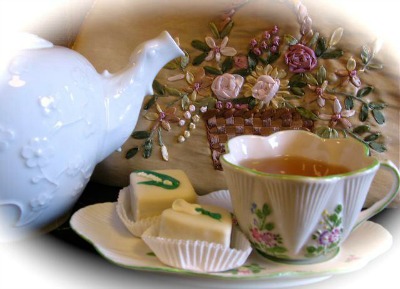
What is decanted tea and what does it mean if listed on a menu?
Because the patron never sees the actual leaves in the teapot one should never feel that the quality of the tea is lacking or that the establishment may list one type of tea and then serve another.
First and foremost, you can be rest assured that a reputable venue would never list one type of tea and then serve another brand or one of lesser quality.
The reason the teas are steeped and decanted in the kitchen pantry is to insure that the actual tea is served at the correct brewing time for each blend. The strainer is used at table side to insure that no tea leaves escaped into the pot. The teapots each accommodate at least one cup, but as many as three cups of tea. The quality of the third cup is the same as the first when served decanted.
All blends do not have the same steeping time, yet all teapots need to be brought to the table at the same time. If the tea leaves were placed into the teapot with hot water poured over the leaves and then served to the guest, by the time the tea was strained at the table many of the blends would be ruined. The tea leaves would be stewing in the pot past the correct brewing times.
Adding hot water to a teapot filled with already brewed leaves is, in fact, incorrect. An establishment that is too lazy to serve properly brewed tea and thinks that hot water poured over brewed leaves is good enough for a guest, doesn’t think very much of the guest.
One should regard their guests so highly, that a second pot of freshly brewed tea is served instead of hot water poured over stewed leaves.
It is my understanding that from the earliest ancient Chinese customs, all tea was decanted before serving. To this day Asian food establishments serve all tea decanted.
Originally, in the 1840s, when the genre of afternoon was created by Anna, the 7th Duchess of Bedford, tea was served with loose leaf teas in a pot, the teapot was brought over to a kettle to be filled with the hot water. The tea steeped and then, if served correctly, the entire pot of tea was decanted, through a strainer, into a second pot, leaf free. The decanted pot of tea could then accommodate a tea cozy to keep the tea warm. Again, if a tea cozy is placed over a pot containing leaves, the leaves will stew.
Tea leaves left in a teapot past the correct brewing time releases tannins that cause the tea to become bitter.
Due to the physical logistics of most public spaces, it is not possible to use two individual teapots table side to decant tea from one pot into another. Therefore, an industry approved, eco -bio friendly product called the T-sac can be used to contain the lose leaf tea while brewing. When the tea is brewed, the T-sac is removed, leaving properly brewed tea in the teapot. Again, as sometimes a leaf or two can escape into the pot, a strainer is used table side.
Yes, many five star hotels, in past times, served tea pots with the leaves left in the pots. It is not the correct way to serve good tea. In fact, with past complaints so plentiful and comments so negative about the stewed leaves, it is to the credit of any venue, now dedicated to the art of tea and it’s proper service, if they have taken the steps to correct past service mistakes.
What do I do with my iced tea spoon if no saucer has been placed under the glass?
Either place the iced tea spoon on the side of another plate or ask the server or hostess to remove the spoon from the table. Never leave the spoon in the glass, especially when actually drinking your tea. Despite what one may have read or heard otherwise, even when practiced with aplomb, there is never a correct time or good excuse for bad manners.
How can a venue insure the service of warm scones?
The second course can be passed, Russian style. This is to insure that the scones are served warm. The scones would be cold if left sitting on the top tier of a tray.
In the 1800s, due to the kitchen being far away from where afternoon tea was served, the scones were placed on the top of a three tier tray with a heated silver warming dome. The scones were consumed after the sandwiches and savories. Today, although the tops of the trays are dome shape, as you will notice, the three tier trays no longer have the warming domes.
TEA TRAVELS™ – Wishing You Happy TEA TRAVELS!™ Tea is the luxury everyone can afford!™ and Good $ense for $uccess are the trademarked property of Ellen Easton/ RED WAGON PRESS
Ellen Easton, author of Afternoon Tea~Tips, Terms and Traditions (RED WAGON PRESS), a lifestyle and etiquette industry leader, keynote speaker and product spokesperson, is a hospitality, design, and retail consultant whose clients have included The Waldorf=Astoria and Plaza Hotels. Easton’s family traces their tea roots to the early 1800s, when ancestors first introduced tea plants from India and China to the Colony of Ceylon, thus building one of the largest and best cultivated teas estates on the island.
Purchase Ellen Easton’s Tea Books:
Each 5 x 7 book is $20 postpaid Continental USA only. Wholesale and fundraising accounts welcome. Include name, address, zip code, and phone number for shipping. Check or MO order payable to: RED WAGON PRESS, 45 East 89th Street, STE. 20A, New York, NY 10128-1256. All inquires to teatravels@aol.com
AFTERNOON TEA…TIPS, TERMS and TRADITIONS
72 pages of how to’s, 27 photos, history, etiquette and FAQ about afternoon tea, serving styles and more. “Tea is the luxury everyone can afford!™”
TEA TRAVELS™ – FOR THE HOLIDAYS
64 pages, 21 color photos. A complete holiday menu includes 25 easy to prepare recipes; theme teas, decorating & gift ideas; invitation template and secret sources.
Categories:
Afternoon Tea Etiquette and Protocols
6 Responses to “Tea Questions and Answers”
Viginia Luther
Thank you for sharing
Kirsten Pollock
This is really a great stuff for sharing. Keep it up. Thanks for sharing.
Susan
I love the tea ceremony, especially when my Chinese friends come to my apartment and we are drinking some tea together.
professional resume help
I did not know that there are various things to know about teas and more to learn about it until I found this blog. Thank you so much for your generosity of sharing this information. Sometimes, being a wide reader have this benefit of getting knowledge and awareness of even simple things. I am a coffee and tea lover since it gives me more energy in performing multi-tasks at work or at home everyday. It is so amazing to know and learn more about what you love and getting stuffs like this as well.
Brielle Luna
This is wonderful
Helena
Thanks for sharing this type of informative article. I have learned some right stuff here. I really like your articles.