
ALWAYS wash your hands before and after handling food:
This is the easiest food safety tip in the book – when preparing food, keep surfaces and utensils clean. Surfaces are not just counter-tops and cutting boards; do not forget to clean your utensils, too.
Wash your hands between each cooking task!
A simple trick that I use is to fill my kitchen sink with hot, sudsy water. This serves two purposes for me.
When preparing food, I can toss the dirty dishes into the hot water as I cook. This makes for easier cleanup. As you cook, stick your hands in the water to clean.
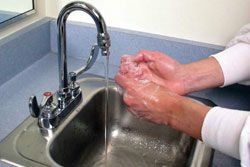
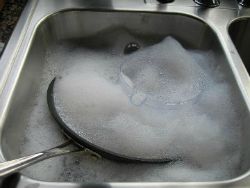
Photos from the U.S. Department of Health and Human Services and from Linda’s Kitchen
Avoid cross-contamination:
Do not use the same platter and utensils for raw and cooked meat and poultry. Use one cutting board for raw meats, another for fruits and vegetables that will not be cooked.
Always serve food on clean platters:
Now, you are probably thinking – “I know that! Why is she saying that to me?” But think? Have you every taken raw meat to the barbecue on a plate and then put the cooked meat back on the same plate to serve? Do not do this unless you have washed the dish in between. Raw meat has bacteria that will spread to the cooked meat.
Keep hot food hot and cold foods cold: COLD
Hot Foods – 140 degrees F. and above
Cold Foods – 40 degrees F. or below
If you have hot food/foods in the oven, put an accurate cooking or meat thermometer in the thickest part of the meat or center of your casserole. Adjust the oven temperature so that the food stays at an internal temperature of 140 degrees F. or above. An oven temperature of 200 to 250 degrees F. should be sufficient to hold the food. Cover the dishes or wrap with aluminum foil to prevent dryness.
 I get many readers asking what cooking/meat thermometer that I prefer and use in my cooking and baking. I, personally, use the Thermapen Thermometer shown in the photo on the right. To learn more about this excellent thermometer and to also purchase one (if you desire), just click on the underlined: Thermapen Thermometer.
Do not leave food at room temperature longer than 2 hours (1 hour when summer room temperatures are hot).
Thaw foods in the refrigerator, not on the counter. Also make sure that meat juices can’t drip onto other foods.
To store hot foods, refrigerate immediately in shallow containers to cool them more quickly.
Prevent Food Poisoning – When in doubt, throw it out!
Put food away as soon as you are done with it. Be sure to discard any food that has an off-color or order, or food that has warmed to room temperature for an unknown period of time.
If you have any question in your mind about the freshness or safety of eating a food product, throw it out. Do not guess – just do not eat something that you are not sure about. It is better to be safe than sorry!
Food Safety Pages:
Buffet and Party Safety
Also includes what to do if your guests have been delayed at least an hour.
Golden Rules of Food Safety
If you have any question in your mind about the freshness or safety of eating a food product, throw it out. It is better to be safe than sorry!
Picnic Safety Tips
There is nothing more American than the picnic. Picnics can take on many forms, such as the community picnic, friends and neighbors, tailgate parties, or ball games. There is also one sure thing at every picnic-lots of good food. The important point is to have safe and healthy food, not food that can cause food borne illness. Always prepare and store food properly.
Summer Safety Tips
Summer is the time for barbecues and picnics. The biggest party crasher at summer picnic and buffets is food borne bacteria. You can’t see them and you can’t taste them, but you sure can feel them if illness occurs hours or days later.
Categories: