
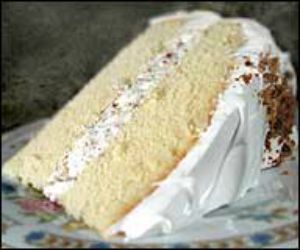
The Lady Baltimore Cake is a Southern specialty. A favorite wedding cake, this mountainous cake, of several layers, is a white cake topped with a boiled or “Seven Minute Frosting.” What makes the Lady Baltimore Cake so distinctive is the combination of chopped nuts and dried or candied fruits in its frosting. This cake has complex flavors and is very unique.
History of Lady Baltimore Cake:
Historians have not been able to find any recorded mention or recipe for the Lady Baltimore Cake until 1906 when it began showing up in newspaper articles. So, who actually invented or first made this cake is a matter of dispute. Following are some claims:
(1) Owen Wister (1860-1938), a popular novelist, picked Charleston, South Carolina, as the setting of his new romance novel. He modeled the central character, Lady Baltimore, after one of the city’s former belles, Alicia Rhett Mayberry. In the novel, Lady Baltimore created a cake also called “Lady Baltimore.” Wister’s description of the cake sent readers of his novel scrambling to find the recipe, which had not been created yet. In his novel, Wister wrote:
“I should like a slice, if you please, of Lady Baltimore,” I said with extreme formality. I returned to the table and she brought me the cake, and I had my first felicitous meeting with Lady Baltimore. Oh, my goodness! Did you ever taste it? It’s all soft, and it’s in layers, and it has nuts – but I can’t write any more about it; my mouth waters too much. Delighted surprise caused me once more to speak aloud, and with my mouth full, “But, dear me, this is delicious!”
(2) According to historians, Florence and Nina Ottelengui, who managed Charleston’s Lady Baltimore Tea Room for a quarter of a century, developed the cake toward the end of the nineteenth century from a version of the common “Queen Cake” of that period. They are said to have annually baked and shipped a cake to Owen Wister. At Christmas time, they shipped hundreds of white boxes carrying tall, round fragile gift cakes to all parts of the country.
(3) According to the research of Janet Clarkson of The Old Foodie blog, the first recipe appeared on December 24th 1906 in the Daily Gazette And Bulletin newspaper of Williamsport, Pennsylvania:
Lady Baltimore Cake
Beat the whites of six eggs. Take a cup and a half of granulated sugar, a cup of milk, nearly a cup of butter, three cups of flour and two teaspoonfuls of good baking powder. Sift the flour and baking powder together into the other ingredients, adding the eggs last of all. Bake in two buttered pans for fifteen or twenty minutes.
For the frosting: Two cups of granulated sugar and a cup and a half of water, boil until stringy, about five minutes usually does it. Beat the whites of two eggs very light, and pour the boiling sugar slowly into it, mixing well. Take out of this enough for the top and sides of the cake, and stir into the remainder for the filling between the two layers, one cup of finely chopped raisins and a cup of chopped nuts. This is delicious when properly baked.
- 2 1/2 cups cake flour, sifted
- 2 1/2 teaspoons baking powder
- 1/4 teaspoon salt
- 1 cup milk
- 1 1/2 teaspoons pure vanilla extract
- 1/4 cup vegetable shortening
- 1/4 cup butter, room temperature
- 1 1/2 cups sugar (granulated)
- 4 egg whites, stiffly beaten
- 2 egg whites
- 1 1/2 cups sugar (granulated)
- 2/3 cup water
- 1 teaspoon light corn syrup
- 1 teaspoon pure vanilla extract
- 1/4 cup raisins, cut fine
- 1/4 cup figs, cut in strips
- 1/4 cup candied cherries, chopped
- 1/2 cup walnuts or pecans, chopped
-
If you do not want to take the time to make your own cake from scratch, use a purchased white cake mix instead - I will not tell!
-
Preheat oven to 350 degrees F.
-
Prepare 2 or 3 (8-inch or 9-inch round cake pans) by lightly greasing the pans with vegetable shortening, then lining the inside of the pans with parchment paper, and then lightly grease with vegetable shortening the top of the parchment paper. Then dust the inside of the pans with flour. NOTE: The older versions of Lady Baltimore Cake were made with two (2) layers, but most of today's version are made with three (3) layers - your choice.
-
In a bowl, combine the cake flour, baking powder, and salt; set aside.
-
In another bowl, combine the milk and vanilla extract; set aside.
-
In a large bowl of your electric mixer, cream together the vegetable shortening, butter, and sugar until light and fluffy.
-
With the mixer on low speed, add about 1/3 of the flour mixture, mix just until the flour is almost completely blended. Scrape the bowl down, and add approximately 1/2 of milk mixture, blending just until mixed. Scrape the bowl down again and continue alternating with the flour mixture and milk mixture, ending with the remaining flour mixture, and stirring just until blended. Set aside.
-
In a mixing bowl and using clean beaters, beat the egg whites with an electric mixer until stiff peaks form. Gently fold approximately 1/4 of the beaten egg whites into the batter to lighten the batter, and then fold in the remaining egg whites.
-
Spoon the batter into the prepared cake pans; smooth the tops. Bake approximately 30 to 35 minutes or until a toothpick inserted in the center come out clean. Cake is done when the internal temperature registers approximately 205 to 209 degrees F. on your cooking thermometer.
-
Remove from oven and place the cake pans on wire cooling racks to cool for 10 to 15 minutes; remove from the cake pans and place the cake layers on the wire cooling racks to finish cooling.
-
Prepare Meringue Frosting.
-
Prepare Fruit-Nut Filling. Add approximately 1/4 of the prepared Meringue Frosting to the Fruit-Nut mixture; gently stir to combine.
-
Using a spatula, spread the Fruit-Nut Filling evenly between the cake layers as you put the cake layers togeher. Spread remaining Meringue Frosting on sides and top of cake.
-
In a large mixing bowl using clean beaters, beat the egg whites with an electric mixer until stiff peaks form. Set aside.
-
In a small heavy saucepan over medium heat, combine sugar, water, and corn syrup. Cook, stirring frequently, until sugar has dissolved and syrup is clear. Increase heat to high and bring syrup to a boil. Boil without stirring until syrup reaches 248 degrees F. on a candy thermometer, approximately 5 minutes. Remove from heat.
-
With the mixer at medium-high speed, pour the hot syrup slowly, in a thin steady stream, into the previously beaten egg whites. Add vanilla extract and continue beating until the mixture is cool, thick, and shiny, approximately 10 to 12 minutes.
-
In a bowl, combine raisins, figs, candied cherries, and walnuts or pecans; set aside.
Source: I adapted this recipe from a 1950’s Betty Crocker Cookbook.
6 Responses to “Lady Baltimore Cake History and Recipe”
dottie palladino
am looking for Lady Baltimore cake recipe found in cookbook titled ‘Mrs. Whaley’s Charleston Kitchen’. Mrs Whaley was the late Emily Cheeka Whaley, a local grande dame of entertainment. thank you
Ben
This is a link for Dottie
http://charlestonmag.com/recipes/lady_baltimore_cake
Mimi C. S.
I have this same titled recipe from a cookbook in 1923. And, seriously, it in no way resembles your very complete recipe above. I’m pasting the gist of what my cookbook says:
1/2 cup butter
1 1/2 cups granulated sugar, sifted
1 cup cold water
3 even cups Igleheart’s Swans Down Cake flour, sifted 3 times before measurings
2 rounded tsps royal baking powder
4 egg whites.
Flavor with 1/4 tsp almond extract and 1/2 tsp vanilla, mixed
Cream the butter and sugar, add 1-3 of the water with 1 cup flour, beat thoroughly and add second cup of flour, continue beating into the last cup of flour. Sift the baking powder and add as the others, then the rest of the water, flavor and cut and fold in the stiffly beaten egg whites very carefully.
As with most of my grandmother’s recipes you need to be part detective part chef in order to pull these recipes off perfectly. As for myself, I’m learning how to cook and improve my skills by researching her recipes. Sharing as I thought you’d be interested as a culinary historian, too.
Heather M
Used this recipe as the white cake base for some cupcakes. Loved it! White cake can be blah and/or super spongey like a pound cake. Asked my friend for a good white cake that actually has a crumb (but not fall apart like a yellow cake does). This was perfect! Great taste (you could reduce the vanilla a little if you wanted a base cake that didn’t hold up on its own as much) and easy to make with these directions! 🙂
Kathryn S.
Mimi C.S.,
This reminds me of the kinds of notes I write myself exactly how much of an ingredient or which ingredients (because often I forget one). I think that’s pretty much what your grandma was doing. She knew the procedures, she’d make lots of cakes, she was just writing down the bare bones of the recipe so she didn’t leave anything out. She probably baked all her cakes at the same temperature, or if she had a wood or coal stove, she was experienced enough to tell that the oven “felt” hot enough. These kinds of recipes get you into the cook’s head sometimes. Thanks for sharing.
Tina
This recipe is definitely easier to follow than the recipe in my 1929 New Delineater Recipes book. However, my book has it as a white cake with boiled icing and a layer of chocolate cream and almond paste as the fillings. I have yet to find another recipe online that has these fillings. Very interesting to see all the different variations out there!