
 Photo from Fisheries and Aquaculture, Government of Newfoundland and Labrador.
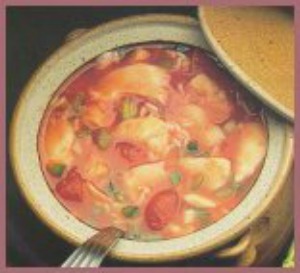
Chowder has remained a steadfast tradition in Newfoundland, New Brunswick, Nova Scotia, and other Maritime Provinces of Canada throughout the centuries. Newfoundland is known for their outstanding salt cod chowder and fish stews. Fish chowder is found on virtually every menu.
Acadia, the region of New Brunswick and Nova Scotia populated by descendants of Canadas earliest French settlers have their own chowder called Acadian clam chowder. Acadian food is rooted in French cuisine. Order a bowl of Acadian clam chowder and its likely to be sprinkled with dulse, a tangy purple sea vegetable that is dried in the sun and eaten raw or is ground into flakes and used as a seasoning.
Most historians agree that the first chowders were brought to North America by English and French fishermen to Newfoundland, Canada. Sailors from around the world visited the island’s coastlines for centuries. Fisherman from Brittany, Normandy, and the Basque region fished these waters centuries ago. The discovery of the super abundant Grand Banks off the coast of Newfoundland by fishermen from northern countries, coupled with the poverty of Mediterranean fish stocks, led to a large trade in cod (the most frequently caught fish in the North Atlantic). The large-scale fishing of the Newfoundland banks began as early as the late fifteenth century, although Basque and Irish fishermen were there earlier. Virtually all cod was imported from the North Atlantic. By 1500, thousands of fishermen and seamen were sailing to the Newfoundland banks in a variety of ships and bringing their salt cod either to Brittany, England, Norway, or Holland for shipment or directly to the Mediterranean.
From there, the chowder spread to Nova Scotia, New Brunswick, and down the coast to New England. The sailor generally had enough food when sailing, but it was of poor quality. Since fishermen generally went on voyages for long periods of time, anywhere from 6 to 9 months, ships had to be stocked with a large quantity of food that would be able to last without spoiling. The main form of preservative was salting, so the bulk of provisions taken aboard sailing ships was salt beef, salt pork, salt fish, and ship’s biscuit or hard tack, which was a very coarse, hard bread (records exist which show that some of these biscuits were being issued up to 40 years after they were baked). Soaking the hard bread and salt cod would produce a kind of salt-cod chowder similar to the fresh chowder that the fishermen ate in their homeland. Shark meat, their main source of fresh meat, was especially common with British seamen in making chowder.
Since the seasonal beginnings of the first European settlers to the island, Newfoundland has had a long and interesting economic dependence on the fishery and therefore relied heavily on fish, not just to make a living but also just to live. Even today, in traditional Newfoundland cuisine, fish (particularly cod) is often the centerpiece of the table. Every part of the cod is eaten with only the bones and skin being discarded.
One of the quintessential Newfoundland dishes is Fish ‘n Brewis (pronounced broos). The fish used in this fish stew or chowder is salt cod, and the brewis is made from hardtack or hard bread. Today, Fisherman’s Brewis is sometimes the same as Fish and Brewis, but often the fish and bread are chopped while hot and mixed together, or fresh cod is used instead of salt cod. There are numerous recipes for it which vary from region to region but the recipe also varies depending on where it is prepared, whether in the home or on a boat. Every Newfoundland cook has his or her own way of preparing it, every area its style. A typical recipe for Fish n Brewis:
“Break up and soak in cold water overnight four cakes of hard bread, also called hard tack. It’s also as hard as stone, thus the overnight soaking. By morning all or most of the water should be absorbed, in which case you add a little more to keep the biscuit from burning. Place to boil and add a half-teaspoon of salt. When the water boils up all through the bread, drain it and break into pieces with a fork. Next you’ll boil a pound or two of well-watered (soaked) salt cod for twenty minutes. Strain. Flake into pieces and remove the bones. Then combine the fish and the bread. Take a piece of fat back pork (about half a pound). Cut the pork into small bits and fry until it’s crisp and brown. Pour the bits and the pork fat over the fish and bread.”
John Thorne, in his book Serious Pig, writes of that Joseph Banks (1743-1820), British botanist and explorer, who spent several months in Newfoundland studying the flora and fauna of the island. As a naturalist, Joseph Banks accompanied Captain James Cook on expeditions to Australia and Tahiti, where he cataloged new species of plants and animals; as an explorer, he helped chart sea passages along the coast of Canada to the Arctic. Joseph Banks also made observations of the fishing and the fish chowder:
“After having said so much about Fishing it will not be improper to say a little about the Fish that they catch and of the Dish they make of it Calld Chowder which I believe is Peculiar to this Country tho here it is the Chief food the the Poorer & when well made a Luxury that the rich Even in England at Least in my opinion might be fond of. It is a Soup made with a small quantity of salt Pork cut into Small Slices a good deal of fish and Biscuit Boyled for about an hour unlikely as this mixture appears to be Palatable. I have scare met with any Body in this County Who is not fond of it whatever it might be in England. Here it is certainly the Best method of Dressing the Cod which is not near so firm here as in London whether or not that is owning to the art of the fishmongers I cannot pretend to say.”
Categories:
Chowder History Food History Halibut, Cod, Red Snapper, Tilapia & Sea Bass New England Seafood, Soups and Chowders