
Hopped up – it is! This tomato based, Manhattan-style chowder has one very potent ingredient: datil pepper. Datil peppers are hotter than jalapeno or Tabasco peppers but not quite as hot as habeneros. They are green to yellow-orange, and a little bigger than a jalapeno.
Long lines of diners at local restaurants attest to the popularity of this fiery chowder. Most historians, when writing about clam chowder, fail to mention Minorcan. Maybe it is because they do not know about it, or because the datil pepper used in this chowder is grown only in the St. Augustine area.
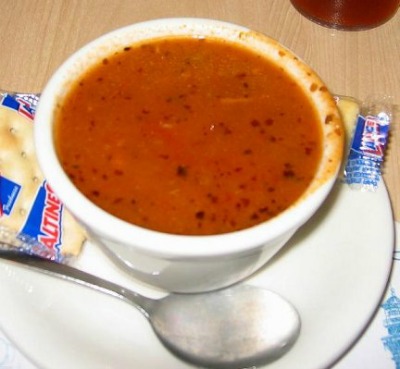
Photo from O’Steen’s Restaurant in St. Augustine, FL.
Minorcan Clam Chowder History:
The Minorcan tale and the Minorcan clam chowder began when eight ships were launched off the coast of Spain (Mediterranean Island of Minorca) in 1768. The 1,403 passengers on board were bound for an indigo plantation in New Smyrna, south of St. Augustine. Though the Minorcans believed themselves to be contracted as indentured servants to Dr. Andrew Turnbull, the plantation’s owner, the realty was a situation bordering on enslavement. For nine long years, the Minorcans were forced to endure suffering and hardship.
Settlers who managed to survive, escaped in 1777 from the plantation and made their way to St. Augustine, where they came under the protection of Governor Patrick Tonyn. They brought their own spices and cooking traditions with them, and the key ingredient was the datil pepper. Just as in New England, chowder was an easy food to make, it could be cooked in one pot, and it would feed many hungry people. It was a meal made from necessity using fish that was plentiful in their new surroundings and their own familiar seasonings, not one they had brought from their homeland. The Minorcans were extraordinary fishermen. The fish was plentiful and the soil was poor, so their creativity probably led to dishes like chowder.
Maggi Smith Hall, author of Flavors of St. Augustine, a cookbook that traces the history of St. Augustines’ cooking, found evidence that the tomato was grown in St. Augustine at least during the second Spanish period (1784-1821). She states:”Tomatoes were one of the crops grown by Phillip Fatio, who had a plantation in Switzerland, Florida. So, while New Englanders were enjoying their cream-based chowder, those make-do Minorcans were already using the tomato.”
- 1/2 pound bacon
- 3 large onions diced
- 3 large green bell peppers diced
- 4 stalks celery, diced
- 1 quart chopped clams with juice
- 1 to 2 bottles clam juice optional - may not need
- 2 16-ounce cans large crushed tomatoes
- Salt and pepper to taste
- 1/2 teaspoon thyme or to taste
- 2 bay leaves
- 2 to 3 datil chile pepper or to taste, diced*
- 5 large potatoes peeled and cut into 1/2-inch cubes
-
In a frying pan, fry bacon, stirring occasionally to prevent sticking, until crispy; drain off the fat and reserve. Remove bacon from the pan with a slotted spoon onto paper towels to drain. Break or cut fried bacon into pieces: set aside for garnish.
-
In large soup pot or cast-iron Dutch Oven, add 2 to 3 tablespoons of the bacon fat. In the bacon fat, add onions, green peppers and celery and saute until soft.
-
Add clams and clam juice, tomatoes, salt, pepper, thyme, bay leaves, and datil peppers. Bring just to a boil. Reduce heat and simmer 1 hour. Add potatoes and cook 30 to 45 minutes more.
-
NOTE: Add additional stock, or clam juice if broth is too thick. You may have to add a little water (or more tomatoes) to adjust consistency. You can also adjust the amounts of vegetables to suit your taste as this chowder is thick and chunky.
-
Some people prefer to refrigerate the prepared soup over night before serving. If you decide to refrigerate, reheat soup before serving.
-
Makes 10 servings.
* Habanero or jalapeno chile peppers may be substituted, but your chowder will not be considered authentic. If you do not live in the St. Augustine, Florida area, it is pretty much impossible to find these chile peppers.
One Response to “Minorcan Clam Chowder History and Recipe”
Jerry
Do you leave the seeds in the chopped peppers ? If you don’t want much heat, will there be enough flavor with only 1 or 2 peppers, or should you add an additional 1 or 2 “seeded” peppers for flavor ?