
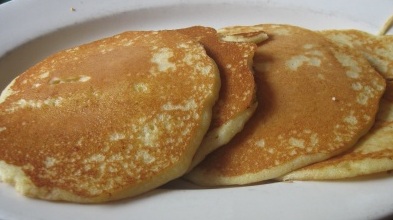
Johnnycake History:
Johnnycakes, johnny cakes, jonnycake, ashcake, battercake, corn cake, cornpone, hoecake, hoe cake, journey cake, mush bread, pone, Shawnee cake, jonakin, and jonikin. These are all regional names for this cornmeal flatbread.
The origin of the name johnnycakes (jonnycakes) is something of a mystery and probably has nothing to do with the name John. They were also called journey cakes because they could be carried on long trips in saddlebags and baked along the way. Some historians think that they were originally called Shawnee cakes and that the colonists slurred the words, pronouncing it as johnnycakes. Historians also think that “janiken,” an American Indian word meant “corn cake,” could possibly be the origin.
The settlers of New England learned how to make johnnycakes from the local Pawtuxet Indians, who showed the starving Pilgrims how to grind and use corn for eating. When the Pilgrims landed at Plymouth in 1620, most of their wheat brought from England had spoiled on the long voyage. It is said that Myles Standish (1584-1656), the military leader of the Plymouth Colony, discovered a cache of corn stored by the Indians.
An Indian named Tisquantum (1585-1622), also known as Squanto, was helpful in the settlers’ survival during the winter of 1621. Tisquantum was one of five Indians taken to England in 1605 by Captain John Weymouth, who was employed by Sir Ferinando Gorges of the Plymouth Company and set out to discover the Northwest Passage. In 1614, Tisquantum was brought back to American, assisting some of Gorges’ men in mapping the New England coast. Tisquantum lived out the rest of his life in the Plymouth Colony teaching the settlers how to grow corn, pound corn into meal, and how to cook with it. He also acted as interpreter and guide.
- 1 cup white cornmeal
- 3/4 teaspoon salt
- 1 cup water
- 1/2 cup milk
- Bacon drippings
-
In a medium bowl, place cornmeal and salt.
-
In a medium saucepan over high heat, bring water to a rapid boil; remove from heat. With the saucepan in one hand, let the boiling water dribble onto the cornmeal while stirring constantly with the other hand. Then stir the milk into the mixture (it will be fairly thick, but not runny).
-
Generously grease a large, heavy frying pan (I like to use my cast-iron frying pan) with the bacon drippings and heat. When pan is hot, drop the batter by spoonfuls. Flatten the batter with a spatula to a thickness of approximately 1/4 inch. Fry until golden brown, turn, and brown on the other side (adding more bacon drippings as needed).
-
Serve hot with butter, maple syrup, or applesauce.
-
Makes 4 servings.
8 Responses to “Johnnycake History and Recipe”
caleb
Is it pancakes made with cornmeal instead of flower.
Whats Cooking America
Yes, per the history and recipe, they are like a pancake made with corn meal.
Lou
What grind of cornmeal is most used? Coarse, medium of fine?
Becky
Honestly I don’t think the grind matters. Back then you’d have been grinding by hand. A finer grind would mean your cornmeal would be stretched farther though. So it’s to your advantage to grind it finer and make the cakes thinner. Additionally if you have no cow, you don’t add milk, you just use a little more water. You could also add in flour if you grow some and have a great harvest. As for me…..I’m allergic to dairy AND wheat so it’s straight up corn, salt and water over here 🙂
Lyds
Is there a substitute for cornmeal?
MJ
why do you use butter and syrup on top of the Jonny cakes??
Malinda Lounsbury
By family tradition and because it tastes wonderful! As a “bread” helping with chili or soup we usually just eat it warm with butter, but as a treat or dessert we warm it, butter it, and pour on the maple syrup.
Gail
Corn cakes are a long long centuries old that goes way that quick back when. I know they’re saying it’s a Latin thing, but it’s actually a worldwide thing wherever they grind corn. Indians have been making it forever since way back when called it fry bread. The Scottish has been making it, and they put corn kernels in it, it actually tastes better. How I know this, I’m part history of Cherokee and Scottish. Recipes been handed down to me that actually came from the ggggg-great-grandparents from Scotland. I love fried corn cakes no matter where they came from or how they’re cooked and you can be very creative and put whatever you want in there, and I like Jalapenos in mine as well! Try adding whole kernel corn and jalapenos you might like it. Also can add some browned sausage. However it’s made, it’s going to come out delicious!