
Foxgloves – Beautiful, but Deadly!
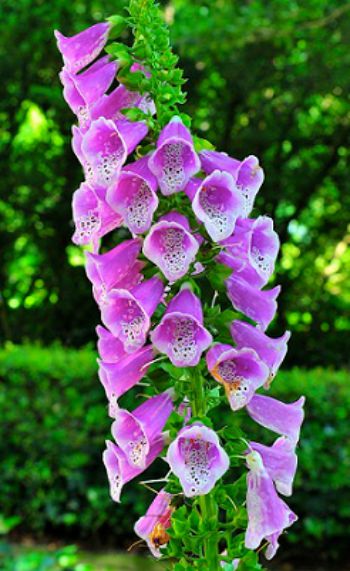
The roots, sap, flowers, seeds, pollen, and leaves of foxglove are all poisonous – even when dried. I know because I was poisoned when I accidentally inhaled the dried seeds and pollen.
My Story by Linda Stradley:
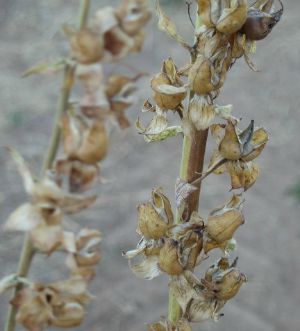
Day 1: On July 29, 2006, I was cleaning up my flower beds getting ready for an outdoor gathering at our place that evening. I have several volunteer foxglove plants in my yard. The flowers were all dried up, and the plants didn’t look pretty anymore. So, I cut off the long stems where all the seed pods are. One of the stems burst or exploded (and I mean exploded) in my face. I inhaled the spores and pollen when this happened. I was amazed as I had never had any thing like this happen before.
A couple of hours later, I started breaking out with hives* on my face (see info on hives below). At first I thought some bugs had bitten me. By the end of the day, I had a rash developing over my face and neck. I didn’t know what to make of the rash, as I am a person who usually does not get pimples.
* Hives, also called urticaria, are rounded or oval bumps (swellings) on the skin that often are itchy. Sometimes they are red, but they don’t have to be. Hives happen when the cells in the skin called mast cells release histamine, a chemical that causes tiny blood vessels (capillaries) to leak fluid. When this leaking fluid accumulates in the skin, it forms the small swellings that we recognize as hives.
Day 2 to 5: I kept getting more break outs the next couple of days. Remembering the foxglove incident, I looked up foxgloves on the internet and found out they are poisonous. If a child eats the leaves they can die. Also the leaves look similar to comfrey and many adults have mistaken them for comfrey and got violently ill (and even died) from eating them. I learned they can cause a hives and a swollen throat. All the articles said to take antihistamines for hives. For two days I took the non-prescription antihistamine called Clairtin for the hives, and it did stop more from coming.
Day 6: As soon as the hives stopped, I then got a sore throat, and then it advanced to the ears. I thought, ok, my body will work it’s way through this.
Day 9: My husband, Don, had to take me to the emergency room at 3:00 a.m. in the morning as I started spitting up blood. At the hospital, they did all kinds of tests and discovered it had advanced to pneumonia in my lungs. The doctor was amazed that this had happened to me. It turns out that I definitely have an allergy to foxgloves, and by inhaling the spores, they had poisoned my system. All because of the foxgloves!
Day 10: My husband went out in the yard and dug up all the plants he could find. More will probably come up in the spring, but they will also be dug up and destroyed. So if you have any foxgloves in your yard, destroy them – pull up the entire plant.
Important Information about foxglove – Please Read!
Other common names: Digitalis, purple foxglove, witches’ gloves, dead men’s bells, thimbles, fairy cap, fairy glove, fairy thimbles, fairy finger, fairybells, dog’s-finger, finger flower, lady’s-glove, lady’s-finger, lady’s-thimble, popdock, flapdock, flopdock, lion’s-mouth, rabbit’s-flower, cottagers, throatwort, Scotch mercury, bloody fingers, virgin’s glove.
Foxglove, also called Digitalis purpurea, is a common biennial garden plant that contains digitoxin, digoxin, and other cardiac glycosides. These are chemicals that affect the heart. Digitalis is poisonous; it can be fatal even in small doses. It was the original source of the drug called digitalis.
Originally introduced into this America from Europe as an ornamental garden plant, foxglove may now be found wild in a few localities in parts of Oregon, Washington, and West Virginia, having escaped from cultivation and assumed the character of a weed. It occurs along roads and fence rows, in small cleared places, and on the borders of timberland.
The entire plant is toxic (including the roots, sap, flowers, seeds, and leaves)
Although the leaves of the upper stem are particularly potent, with just a nibble being enough to cause death. The upper leaves of the stem are more dangerous than the lower leaves. Foxglove is most toxic just before the seeds ripen. It tastes spicy hot or bitter and smells slightly bad. This plant is so poisonous that ingesting only .5 gram dried or 2 grams of fresh leaf is enough to kill a person. Even inhaling the pollen can cause reactions to some people.
There have been instances of people confusing the digitalis with the harmless comfy plant (which is often brewed into a tea) with fatal consequences. Other fatal accidents involve children drinking the water in a vase containing digitalis plants. Drying does not reduce the toxicity of the plant. The plant is toxic to animals including all classes of livestock, as well as cats and dogs.
A single foxglove plant can produce over a million seeds, it does sow itself prolifically in unexpected places. And, being a biennial, it only produces a low cluster of leaves during its first year.
Additional Comments from Linda:
I realize that all people are not allergic to foxgloves, but if you are or think you could be – beware! Read the comments below from other readers who have experienced the side effect of these beautiful foxgloves.
If you have small children, please don’t plant them in your garden. Just because they do not bother you, does not mean they will not bother your child or even your friends visiting your home. Remember that even inhaling the pollen can cause serious reactions to some people. It is better to be safe than sorry!
I still think that Foxglove Flowers are beautiful, but now I just view them as I drive down the road.
NOTE: If anyone has had a similar experience with foxglove, I would appreciate it if you would share your experience with me and my readers. Please email Linda Stradley.
Comments from readers:
I am writing in response to the foxglove article. I also had a reaction to this plant, although not quite as serious, I now know the true deadliness of this beautiful plant. My family and I went on a long road trip from Mississippi to Washington state in 2006, to visit my grandmother and family. As we were driving, I spotted millions of foxglove along the side of the road (we were on our way back to our hotel). I told my husband to pull over so I could pick some of them. He pulled over, I picked a rather large amount, maybe 20, and we bundled them in a newspaper and brought them to the hotel where I put them in a large vase. About 2 hours later my hands started tingling and burning. I didn’t make the connection, and washed my hands with very hot soapy water. Then the stinging subsided.
I knew these plants were poisonous, but never thought about them being a skin irritant. Also the thought that this is the plant that heart medicine digoxin is made from. So I really think if I hadn’t washed my hands thoroughly (of course we threw the plants out) it could’ve been a lot worse. Thank you for bringing attention to this. These gorgeous deadly beauties are sold at garden centers of places like Wal Mart, Lowe’s, and Home Depot in the south. Because they are an item of uniqueness down here, and I think they need to come with a warning label. This is not a plant to mess with. – Laura Gaudet (4/18/16)
My five-year-old daughter was playing with the blooming volunteer foxglove in our yard this afternoon. I have heard people say they were allergic to foxglove, but I did not know these plants were poisonous. About 10 minutes after she stopped playing with the plant, she complained of a bug bite on the top of her leg. We got into the car to do an errand, and she was itching and scratching what looked to be nettle stings on the top of her leg. But the time we got to the store, the skin on both her thighs (from knee to groin area) was aflame in a large inverted triangular red hive. And when we returned home and she took off her dress, her back side looked like a neon sign – a patchwork of little and big red swollen circles. After a clay mask, a call to the pediatrician, a baking soda bath, and some Benadryl, her skin started to settle down.She’s asleep now and seems to be doing fine. Needless to say, I just removed all foxgloves plants from our yard and into our neighbor’s garden bin for compost. Thanks for creating this website. It was a helpful resource for confirming our thoughts about M’s sudden skin rash. – Susan Lavell Warm (6/28/13)
 I am studying ikebana, Japanese flower arranging. I had a mental container that is pretty unique and I was looking for flowers in my yard to create a nice flower arrangement. Well, there was a large stand of foxgloves (I didn’t know what it was then), so picked several stems and arranged it along with peonies and hostas. I emailed the photo to a friend who is a master gardener and asked if he could identify them and he told me what they were foxgloves. He said he pulled them out all the time barehanded and didn’t have a problem.
Now, the other part of the story is that my husband had developed a rash on the backs of his hands that was itchy, weepy and getting pretty bad. Turns out he had pulled out clumps of the foxgloves because it was overgrowing some of it other plants several days before. After I started doing some investigating about foxgloves, I found your posting and told him about it. He went to the doctor and was prescribed some ointment that cleared it up pretty well.
No more foxgloves for me – except to admire at a distance. And he’s been vigilant in keeping the foxgloves at bay in our yard using gloves! Thanks for your post. – Karen from Redmond, WA (3/27/13)
I just got out of the hospital after a week of treatments for exposure to foxglove pollen. I did not touch the plant and did not get hives or itching on my skin. My reaction was swift and severe – I suddenly couldn’t breathe. I had disturbed a foxglove plant whose blooms were nearly done. At first the doctors were not convinced that it was actually foxglove that was the cause. This was the first year we had these blooms in one of our gardens, and I was unaware that they were toxic even if you didn’t touch them. I have never had allergies to anything before, but I must be extremely sensitive to this plant. It caused spasms and swelling in my bronchial tubes that is just now passing. If the hives and swelling can last for days on your skin, I am wondering what it is doing to my internal system, not to mention the digitalis effects on my heart.
We have completely removed the plants and will watch next year for any strays that may appear. Thanks for your articles on this. I have not heard of too many instances of breathing problems from foxglove. – Alene, MN (8/28/12)
I was out mowing the grass in our yard one Friday, when I passed by the dried up Foxgloves that my wife has in the garden. I guess I got too close to one of the plants and bent it with the mower. As I continued forward with the mower, the stalk sprang back and brushed the underside of my left biceps and the dried flowers scratched me. I thought nothing of it and kept mowing. I went into the house when done, had lunch and took a shower. The next night, I began to feel a terrible itch on my left inner biceps. I thought I had been bitten repeatedly by some unseen bug as we had been to an outdoor concert that evening. I noticed that the area was inflamed and bumpy with oozing sores.
When I awoke on Sunday morning, a rash was forming on my arms, legs and especially my midsection. I thought I had contracted something at the public pool where my family swims since most of the rash was in my bathing suit area (very unpleasant). However, no one else in the family showed any sign of any skin irritation. I finally went to see the doctor and was diagnosed with contact dermatitis. It was then that I remembered the brush with the Foxglove. Here I am, several days and a partially finished prescription of steroids and the rash is only starting to subside (the intolerable itching continues). I have never had an allergic reaction from contact with any plant before in my life. This has been a miserable experience. I am insisting that my wife rid our home of these poison plants so that neither I nor my kids ever experience this misery again. – Fred of Baltimore, Maryland (7/20/12)
This past weekend I must have pulled up a kitchen size garbage bag worth of Foxglove with my bare hands. It was looking overgrown and had gone to seed, so I thought it was time to clean it up. Today (Tuesday) I noticed that the backs of my hands had bumps. Now, I know I’m highly allergic to Poision Ivy, and I was clearing out our ivy as well that day but, the bumps on the back of my hands aren’t BB sized like my previous Poision Ivy episodes. In fact, I would not have even noticed them today if my hands had not been in the sun on the steering wheel. If Foxglove is truly that reactive, then I would suggest using disposable gloves when working with it. I am presently self medicating and will report on the progress. Thank you – Steve (7/03/12)
Whilst I do appreciate the fact that foxgloves should be handled with great care, I must stress that they are so common in Germany and Britain, where I live now, and I have never come across any illnesses or even fatalities caused by these absolutely beautiful plants. I have young children who are growing up with many dangers around them in the world, aware of how to handle potential danger. My borders are traditional, with many, many foxgloves at the back of my herbaceous borders, providing the most beautiful backdrop to the lavender blues in front. I annually handle the dried seeds and encourage further spread of the flower. I agree, however, that it is absolutely vital to be informed and to inform visitors to the garden of the potential dangers. Thank you for raising awareness. –Stephanie Baines, West Stockwith, UK (6/02/12)
I was just at Colonial Williamsburg (Williamsburg, VA) and there are a lot of Foxglove. Good thing I didn’t get affected as I was taking pictures of them up close. I don’t understand why those people at Colonial Williamsburg have a lot of these plants. Incidentally, I just sent them an email informing them about how dangerous / poisonous this plant can be. – Rodolfo Abraham Quinio (5/21/12)
I have experienced being allergic to foxglove with similar symptoms. First I wasn’t sure which plants flowers I was allergic to, and I then found that it was the foxglove I was allergic to. I was doing gardening and getting rid of the dry plants. – Jagrati Limbochia (4/15/12)
I would like to say that I have grown foxgloves for many years and handled them many times with absolutely no ill-effects. These are a wild variety, not specially bred ones. They are also extremely common absolutely everywhere in the British countryside and are not cutting a swathe through the nation’s children. I appreciate that there may be a tiny number of people who have unusual reactions but I would expect them to be documented by cast-iron testing and medical evidence, not half-baked assertions of the “I had an itch and finally realized it must be the foxglove I handled days ago because I heard they were poisonous” variety. There are a lot of credulous and suggestible people around. It is an absurdity to suggest that foxgloves be banned from sale due to a tiny number of uninvestigated probelms against them. I hope you will add my statement to your web-site in the interests of balanced reporting. Best wishes – Heather Morris, UK (8/29/11)
I found your web page while searching for information on the toxicity of fox glove. I was working in my garden today and upon pulling my fox glove, I was sprayed all over by the seeds of the plant. Fortunately, the seeds did not get into my mouth. Immediately, I washed the exposed skin and blew my nose to rid of any seeds I may have inhaled.
After reading the comments from your readers about their exposure to fox glove, I called my doctor who then said to call the poison center. The poison center said I will be alright. They said fox glove is highly toxic when it has been tasted or eaten. If the seeds are breathed in, then problems may occur. I wanted to share this with you so that future concerned readers may want to contact the poison center if they have ingested the toxic plant. The number to the poison center is 1-800-222-1222. – Loretta Ferguson 8/11/11
You could not imagine how thankful I am to read what you shared. I was at Southern States and got attracted to a pot of this plants. I simply held the leaves and touched the flowers. I did not even attempt to sniff the pretty flowers – thank God. Within an hour, I had severe rashes on my neck. The following day I had three huge bumps on my neck. Exactly like the hives you had mentioned. Not knowing what it was and what could have caused it, I seriously thought it was just a mosquito bite. On the third day, the three bumps were so huge I dismissed the mosquito bite theory and thought it was a bee bite as there were bees on the coneflowers at Southern States too and tried to avoid that area.
But really, how can a bee get to my neck, bite me three times without me hearing or noticing it crawling or buzzing around? My husband examined the hives on my neck and he didn’t see where the insect stung. It was so itchy and painful for days, the rash got bigger and so did the hives. My neck looked like I had goiter or something. The pain and swelling continued at least a week and I even have difficulty turning my head. Now thank God it’s over.
When I read what was shared in your web page, I am sure it was the foxglove, as it was the only plant I admired and touched that afternoon on my quick visit to the store. I would have not attributed the sores on my neck to that pretty foxglove if I have not been enlightened by all these sharing which I truly appreciate so much. In a way I am pretty upset with the garden shop. Displaying such a dangerous plant without any warning of its harm. One would think Southern States should know better than just to put this thing on display, intentionally luring but exposing every innocent admirer to its danger. Can you imagine if my kids were shopping around with me and touched this thing while I was happily admiring this poisonous plant with them????
I am calling and meeting the store manager of Southern States, this is for sure. I don’t think it is right for us to just take this incident (harm done to us) lightly and let this garden shops operate business irresponsibly by displaying this plant/flower without any word of caution to their customers.– Maria Arceo, Richmond, VA (7/6/11)
Hi, I’m so glad to be reading this now. I just went and bought 2 foxglove plants from BJ’s. I thought they were not only beautiful looking but they were cheap. I haven’t had the chance to plant them yet but now I’ll be throwing them away! I have 3 boys who are always outside playing and they have their friends over all the time so I would feel terrible if any of them got sick from this plant. I can’t believe they sell this in the store with no warning. Here I was looking up how to plant and care for them, and I saw you’re story. Thank you for the warning it saves me the horror of it happening to my kids. – E. Nicoletti, New York (6/28/11)
I once used the word “foxglove” in a poem inspired by a child. I thought it sounded woodsy and ethereal. I was so happy to come upon some at a garden center, and I purchased a container of a small to medium leafy plant. I planted it about a week ago – handling it by the big leaves. No sign of any danger. I read your warning, however, just 15 minutes ago and quickly removed it placing it carefully in a lawn bag. RIP I may be immune, but I’m taking no chances. Poison ivy likes me and I once came down with a very bad case of hives on my left hand – a reactioododendron – and revise that poem! Thanks for the detailed report. – Alan, Georgia (4/09/11)
I, too, am a victim to the foxglove plant. We have just recently moved into a new house with an established garden, which had about 4 foxgloves planted outside our family room. Just before Christmas I was tidying up the plants and cut off the dead flower heads of the foxglove plants. Several days later I started itching all over my body, head and even my eyes slightly stung, this got worse over the coming days. I have since spent loads of money on anti-histamines, creams, doctors, and even went to a skin specialist about this allergic reaction (but not knowing what caused it!) This has been on going, about 5 weeks now. I have cleared the garden up again, pulling the dried dead leaves away from the bottom of the foxgloves – making my itch worse of course!
Yesterday I went to find more relief as I am at my wits end with this itchy rash/hives! I went into the local health shop and spoke to the woman in there, who helped me eliminate environmental and dietary changes etc. She asked me were there any foxgloves in my garden as they are highly toxic to some people – well the penny dropped! I immediately came home and looked up on the internet about these plants and came across your site. Hallelujah!!
I have since dug them out and thrown them away (which was foolish can I say, as I had a full-on intense reaction almost seconds later, confirming that this plant was at fault!) I am now looking at getting well again, regaining my sanity, my sleep, and my family back again! Thank you to Linda and many others who have helped. – Jo Jamieson, New Zealand (1/27/11)
I looked online to find the proper care for our beautiful new foxglove plants. I was so happy that I did! My daughter planted them a couple of weeks ago, and she developed a severe case of hives. She said she felt like she was stung be a bee on her ear lobe as well. THANK YOU SO MUCH for this article. The foxglove will be pulled immediately with long sleeves and gloves! Thanks again! – Nancy, Indianapolis, IN (6/01/2010)
Hi. You can call me Tim from Charlottesville, VA. I’m only 14, so it’s not as dramatic. But here’s my story. Just last week, I was at my friend’s house and he has MANY plants growing behind his house. Out of all of them, I saw a foxglove beginning to flower. I have always wanted to grow foxgloves cause I love plants (and they look cool). So my friend said “alright, you can have it”. So he got a pot of dirt and we began to slowly dig out the foxglove. Then I took it by the stalk and gently put the flower in the pot. That was when my right wrist and arm began itching, but we thought they were just two little bug bites and so I resisted itching them. We watered the plant and went inside. By that time, the two “little bumps” turned into two huge lumps! I still didn’t itch it and my friend just put some tape over it (to prevent me from itching it).
A few minutes later, while we were studying, I looked at my arm and the area around the lumps were reddening with speckles! That’s when my friend’s older brother put some rubbing alcohol on the place and it stopped bothering me. After that, we remembered the foxglove and decided to look up some care info. The first thing that popped up was “foxgloves are beautiful, but are poisonous”. WHAT!?
I remembered that I was the only one that touched the leaves and had my hand near the blooms. Turns out that the seeds gave me the two hives and the pollen gave me the rash. Yet the seeds are actually used for medicines and remedies to cure some weird things. And this was one where it was just developing blooms (about 2 or 3 blooms). So in the end, my friend took the foxglove, cut of some leaves, and threw it behind his house and cut down all the other going-to-be foxgloves. The rubbing alcohol did the trick. Now the lumps are nothing but two little red dots (barely). They should stop selling these things in stores. – Tim from Charlottesville, VA (5/25/2010)
About a month ago, I bought some foxgloves and monks hood. I merrily planted them and was so happy because next year I was going to have beautiful flowers. I am not sure how soon after the planting that my right ankle bone had a small red mark on it, much like when you bump it. Then the ankle became redder and the swelling appeared. I got a lump the size of a nickel on the outer calf of my right leg about half way between the ankle and the knee – it was tender. Then I got a lump on the bone that goes from my wrist to my elbow on my right arm. My left leg, not to be out done, followed suit. The little bumps went from the nickel size to a fist size. My feet were swollen to 3 times the size and so were my ankles. It looked like I had scalded them with boiling hot water. The lumps have now gone up to my knees, so my knees are 3 times the size they should be.
I had no idea that these two plants were so deadly to some people. I had seen pictures of them and was so happy to get them. I loved the flowers. Of course I had to handle them with lots of care, holding the roots in my hands to make sure the soil did not fall away. I did not wear gloves and spent a lot of time making sure they were positioned into the ground properly. I know I am super sensitive to a lot of things so possibly this is what is going on. It has been almost 4 weeks, and I have no idea how much longer it will be. I have used homeopathy remedies and bathed in the tub every day using either food grade hydrogen peroxide 35% or epsom salts. It is slowly turning around, but at this time it is still painful. I also had pain in my ears, the joints of my wrists hurt, and the list goes on.
I phoned a lot of nurseries and the one I spoke to actually sounded interested. I suggested they go onto internet and have a look at what is being posted. I suggested it could save a law suit, and they were quite certain that is something they wanted to avoid. Too bad these two plants are so pretty. – Edith Ziegler, Ontario Canada (9/15/09)
So you are saying we should all stop growing foxglove because a few people are allergic to them. Yes, I know they are poisonous if eaten, but how do you explain the thousands of nurseries who grow and propagate foxglove with out ill effects? I handle them and get no reaction. T here are hundreds of poisonous plants in gardens everywhere, should we just eliminate them also? In all fairness, you should change your website to reflect that YOU had an allergic reaction, and that a small % of other people may also be effected. I say let’s keep growing foxglove. – Bob Krummel (7/02/09)
I was helping an elderly neighbor tidy her garden today and I pulled up a foxglove plant (no gloves) and 3 hours later I felt this light throbbing sensation all over my hands and the skin on my hands looked like it had aged 10 years! An hour later I was experiencing some tiny bumps on my hands and lots of itching. Fortunately the foxglove was not in bloom. This is the morning after … there is still some slight dryness and prickliness to my hands, but the massaging in of the cold pressed avocado oil really seems to have helped. I guess mine was a mild case … as I am not experiencing any other symptoms.
Many thanks for your page – very helpful. I didn’t know the leaves were poisonous as well! This would be very useful information for schools as we have foxgloves growing all over the place in the UK. – Maya, Solihull, UK (5/13/09)
I visited a nursery and was going through through and was admiring foxglove flowers and thinking how I would love to have them. I remember gently rubbing the leave for the feel of it. Very shortly, I noticed that I was having trouble breathing and started coughing. Luckily my sister was with me and got me out of the area and into the garden shop, sat me down and got me water. My throat seemed to close up and I felt like I was going to pass out. They offered to call ambulance but I just kept sipping water and it soon went away. I couldn’t figure it out but assumed it might be the foxglove.
The next year we visited Williamsburg and the wind was blowing and all of a sudden I got the same feeling, started looking around and lo and behold there were beautiful foxgloves. I exited quickly and got away from them. Again I got some water and sat for a period of time and I was OK. I didn’t develop any skin problems but just my throat seem to be closing up. Needless to say, I stay away from them but wonder what the problem is.– Diane Lowdermilk (2/03/09)
I have a garden business and on Tuesday I was cutting back way too many foxgloves in a client’s garden. I live in Falmouth, Maine and I have a garden business. She inherited these foxgloves “beauties” when she bought the house. I have been redesigning her garden and have been removing the small spin offs for three years. I had never done such an extensive cut back all at once so the problem never arose. But this time I filled four very large bags with foxglove stalks and was carrying them out of the garden to bag time and time again and stupidly with a sleeveless shirt the stalks kept resting on my left upper arm.
By Wednesday afternoon I started to itch on upper left arm. A few hours later a large red patch appeared and then an oozing in the middle. The area was also felt very hot and I felt miserable. I went to the doctor and they thought possibly poison ivy, but there is none on this property. Then a light went on – I wondered if it was the foxglove cleanup. Sure enough your message made it very clear.
The Benadryl has helped me too, and I was given a prescription cortisone cream to apply twice a day. Since it has been raining for days, I am trying to recover so that I can work next week. The itching continues but seems less severe and the redness has only spread a bit more today. So far no other area seems to itch so I think it is concentrate on my upper left arm.
I am forever grateful for your informative covering your foxglove experience. I do not believe most of the public is aware of this deadly plant, but I am going to be sure that none of my clients grow this dangerous plant. I printed out your page and will take it to the doctor’s office so they become more aware of this problem. Happy gardening without foxglove! – Karen Harrell, Falmouth, Maine (8/07/08)
Linda, How strange that I came upon your article today. I normally have very clear skin with no irritations ever. Well, Sunday afternoon I began to notice these very small bumps on my face that almost looked like poison oak, except they weren’t itching quite like poison oak because I have had an experience with that. Anyway, I continued to accumulate these on my face and arm. By yesterday afternoon, I was starting to wonder what in the world was going on with my skin. I traced to see if I had eaten, taken, or ingested anything out of my normal routine but I couldn’t come up with anything new.
Well, low and behold as I went on the web to look for the proper way to care for my new FOXGLOVE PLANT, I think I discovered the enemy of my skin. What a shock to put the blame on my beautiful flower I just planted last Saturday. It will be deleted from my garden this afternoon. I cannot have any flower that I cannot tend to in a safe way. Thanks for the education! – Patricia Bradley (5/29/08)
Ten days ago I was pulling out some weeds in my garden, when a large clump of Foxgloves came up too. I replanted them, without gloves. A few leaves dropped on the grass and were later collected up, by the mower. I later emptied the mower, again without gloves. Later that night whilst soaking in the bath, I had an uncontrollable urge to start scratching and it hasn’t stopped since! The rash has since spread up my legs, arms tummy and face. I’ve tried anti-histamines, Hydrocortisone cream, wheat bath soaks, and calamine lotion; all have little or no effect. Keeping cool helps and wearing clothes that are cotton and loose. My Doctor is constantly booked up, so I have no choice but to suffer in silence. I am going to try Witch-hazel tonight, as a last ditch attempt. Hopefully this can’t go on much longer.
I have asked my husband to don gloves and go and clear the garden of these plants, which is a shame because they are so beautiful. Having read the reports listed, I am surprised by what I have read and shall not make the same mistake again. But as I have two young children, I fear for their health. – Debbie Jones, Herne Bay, Kent, England (3/26/08)
I am very sorry to hear about your experience with the foxglove plant. I have had some serious concerns about the appearance this plant is making in gardens (unfortunately even right next to the sidewalk!) and have been wondering if the plant has been bred to be less toxic for gardens. I grew up in Germany and the foxglove plant is quite common in the forests there. I remember when I was growing up, the elementary school teachers heavily stressed that this plant is very poisonous and not to be touched. Schools there mainly use the field trip days for taking walks through the woods and learn more about nature.
Reading your story makes me even more cautious now and I do feel like I should point out to the neighbor down the street that their plants may not be the best to be planted so close to the sidewalk with them being poisonous. Thanks again for sharing your story online so people looking for the plant are also stumbling across it and able to educate themselves before buying! I tell you one thing – your article will probably save a child’s life, if it hasn’t already done so! – Natalie Jandt (2/12/08)
How interesting – and frightening for you! I’ve been having very bad hives and hay-fever like symptoms which are now clearing up with citirizine (anti-histamine). It was only the other day that I realized this might be due to the invasion of my garden by foxgloves this year. (I’d noticed digitalis on the list of substances which cause hives, and suddenly the penny dropped.) Today I felt well enough to go out and pull them all up. I had my right hand and arm well-protected in plastic, but one flowering stem fell across an unprotected part of my left arm, with instant effect – stinging sensation and immediate hives. Still stinging as I type this. It suddenly occurred to me to put ‘foxgloves’ and ‘hives’ into google, and bingo, there you were! Best wishes – Jenny Chapman (7/18/07)
Categories:
Cooking Hints & Tips
16 Responses to “Foxglove Flower Alert”
Nija Hill
I recently bought to foxgloves from walmart yes walmart sells them with no warning! luckly i read on every flower that i purchase I have to be honest I replanted the flower only to another larger pot for some reason i didnt plant it in my garden I have pulled leaves dead leaves off them daily bare handed! when the start to look kind of dead I will just count it as a blessing that I didnt have a reaction I do have small kids and after I read this i called them all out cause they are of school age to tell them they are to never touch these two plants and the warnings that are giving upon them i can say i will be moving them in a totally diffrent area far away from my front porch where they are located now! i also must admit reading these stories make me itch knowing i have had so much contact in the last week! Thanks for the information any one story is a warning ! and we all have the freedom of speach!!!!!!!!!!!!! It can very well save someones life !
Linda Kirby
I just purchased 2 fox gloves and handled them without gloves to no ill effect. After reading these comments and this report, I thought I’d better dig them up and throw them away or take them back to Lowe’s. However, I’m an old lady living with my 23 yrs. old grandson who handled them also to no ill effects so since no one ever visits my yard, I think I’ll keep them anyway. They are so beautiful and I’ve always loved them and have always wanted them and now, in my last years of my life, I finally have them. So, I’m with one of the commenters, if they are so poisonous, why aren’t the people who work with them at Lowe’s and other retail outlets getting sick? I’m thinking it’s mostly allergic reactions. Sure, if you eat it, you’ll be in trouble but I, nor my grandson who has a lot of allergies, are seeing any trouble with these beautiful plants. So, I’m keeping mine until I see I am allergic. But, thank you for informing everyone because most on this site are allergic to them and need to know this information. So, thank you!
Linda Stradley
As you said, not everyone is allergic to fox gloves.
Ed Morris
My wife has a very strong “farmer in the dell” gene. She loves buying dying plants from discount racks and bringing them back to life. She was attracted to a beautiful blooming foxglove and, atypically, paid full price for it. She transplanted it to a larger pot, using gloves, and we were waiting to see if hummingbirds would be attracted to it. This morning, she was watering the plants in her deck garden and started coughing and choking uncontrollably. After getting water to clear her throat, she continued to cough and we realized she had been close to the foxglove and may have inhaled some of the pollen from its flowers. Several comments on this thread mentioned similar responses. It’s been about 1/2 hour since the incident and she feels better, but has a slight headache. We checked her BP and it was better than its been in years. Go figure. THANX for the info. We’ll be MUCH more careful around the plant and may name it after an appropriate mythical monster.
Leanna Kalka
I just bought 2 pots of foxglove and the clerk put them in my van to bring home. I only had a few blocks to drive and the windows were open. Only a block from home and I started feeling very strange like I was going to pass out. I wasn’t sure I was even going to make it into my driveway. I finally did, opened my car door and just sat there waiting to feel better before I could even stand up. Finally felt like I could make it into the house. Got inside and broke into a sweat in an air conditioned house and became very thirsty. Laid down and started feeling better. Went out and opened up the van door and let it air out some, then removed the plants by touching the pots only. Now after reading these posts, I feel I should probably be sure I vacuum the van out, maybe even shampoo as well before I drive it again.
T T
Wow..sorry to hear all the bad effects..
I bought two last week, handled them with bare hands, picked dead leaves off, etc…then went and bought two more a day later.
I guess I’m lucky to have no reactions..
Is it possible that different varieties cause worse reactions than others ??!?..
Whats Cooking America
It happened after the foxglove bloom had died and dried out. All the blooms and pollen disintegrated into dust and got into my lungs.
T T
Want to add link of ALL the poisonous plants via link below(with photos).
I Dk…. I DEFINITELY handled foxgloves several times and I am a very allergenic person, in general.
Surely, some are allergic to them but looking at this list, it could be other plants too..
https://www.poison.org/articles/plant
Errin
Thank all who shared their experiences. I just purchased 3 foxglove plants on clearance at Lowe’s. I knew they were poisonous, but I will give Lowe’s credit because the flower label had a poison warning on it. It was the first time I had ever seen that. I knew they were poisonous to eat, but didn’t know about the other possible reactions from contact or breathing in seeds or pollen. I became suspicious when I had a small irritated area appear on my arm before I even left the store, but these were 1.5 gallon plants that had been marked down to $0.50! (I am a hopeless sucker for a super bargain.) I had planned on sharing these super bargains with 2 friends, but after pondering the poison aspect and that small reaction I might have had, I decided to check it out online. I am so glad I did! I had not planted one yet, and now I won’t. Neither will I be giving them to my friends. They might not have a reaction, but what if they did? I am glad that some are able to grow and enjoy them without bad affects. However, if foxglove spreads seeds and thus plants are coming up in unwanted places around people that are unaware of the dangers, perhaps responsible growers should remove the flower heads before they go to seed (at least in areas where they are not already very common and understood.) I remember a friend 40 years ago tell me that her mom had seen this lovely little unknown yellow flower growing in a yard when she was on a trip. She dug it up, took it home and planted it. A few years later, her neighbors were mad…. According to my friend, that area had never had dandelions before! (If you aren’t familiar, it has a very pretty little yellow flower which is followed by a perfect little ball of seeds that will float on the wind and spread an amazing distance.) This, of course, illustrates what could happen from even one planted foxglove.
Amber
I can’t believe these plants don’t come with a warning label that they are toxic and potentially lethal to people and pets. I feel like God was watching over us for the few weeks since my husband bought three of these plants for me for mothers day. My two year old daughter, who loves to put everything in her mouth, grabbed blooms off this plant and leaves from the base without us knowing they were poisonous. My father-in-law, who has an elaborate garden and is a very avid wildflower enthusiast, informed us tonight that these plants are poisonous after having told him we planted some in the yard. It’s terrifying to think that my daughter could have put parts of the plant in her mouth and we wouldn’t have known what was wrong. I can’t believe that these plants aren’t required to have a warning label. I will be contacting home depot where I purchased them to express my concern. My 2 year old stood with me while I planted these and could easily have been poisoned.
I’ve learned a valuable lesson though, even if you’re purchasing plants from a mass garden center, don’t assume that they are safe. Next time I will research my plants better before I put them in our garden. I’m going to have to relocate these or trash them, which is so frustrating. At least no bad came of our ignorance.
ashley
it’s not a matter of being allergic to them. foxglove is a very dangerous plant if INGESTED/SWALLOWED. much like a lot of other flowers you probably have in your flower bed. look up poisonous flowers and you’ll be surprised. i have one and touch it all the time, cut it down because it got a little crazy for a minute, sniff it, etc. but if you eat even the smallest bit of it, which most people with common sense wouldn’t, then you will have reactions. i wouldn’t suggest having one with animals or children unless you can keep it away from them. this article is very misleading and the information isn’t entirely accurate.
Nancy
Ashley, all of your points coincide with the article so I am not sure what you find misleading. Please let me know.
Olive
So why would all the stores in question be allowed to sell these plant they are this poisonous? Should these be off the market!
Brenda L Westberg
you know, it’s crazy. I grew up in a heavily wooded area of Washington state where foxglove are abundant. Incidentally the road we lived on was called foxglove lane. As kids, my sister and
I spent many hours roaming the woods and would often pull the blossoms off and taste the sweet nectar where it pooled at the bottom of the flower. Not once did I have any negative reaction. Imagine my surprise when I found out it is a highly poisonous plant.
Jennifer Love
Just to balance again those statements from people in the UK – myself and my 7 year old were enjoying a beautiful forest walk earlier this week and he loves wildflowers. He stuck one of his fingers into one of the fingerlike flowers of a foxglove for fun. I made him wipe his finger on some graass after but I’m sure he didn’t manage to clean it super well. but i thought nothing of it. Later he had a packet of raisins in the forest. A couple of hours later at home he started feeling very unwell, couldn’t eat his dinner an deventually vomited all over everywhere. Thankfully once everything was out of his system he has seemed fine. But people need to know that these flowers, and many others, are actually pretty dangerous. My son also got a bad hogweed burn last year that has taken a year to disappear from his hand and arm. Nature is beautiful but also dangerous!
Diana Mixell
I purchased 2 Foxglove plants several months back, mainly for my hummingbirds and because they really are beautiful. I pull the dead leaves off, take my hand through the leaves to make sure the spiders aren’t making a home in my plant. I have never had a reaction from it.
There are a lot of plants that are toxic. I’m severely allergic to Timothy Hay (which is sold in stores for Hamsters) and grasses up north, so I stay away from them. Banning them is ridiculous, if you ban every plant that’s toxic or gives you a rash we would have no plants or grass. Just look up the information on the plant before you decide to mess with that plant. Hopefully you’ll put this on your comments because it sounds like this beautiful plant is getting a bad rap.
Know Your Plant Before Touching it.