Restaurant Dining – Dinner Etiquette – How To Eat Different Foods
The point of Dinner Etiquette rules is to make you feel comfortable – not uncomfortable. Table manners play an important part in making a favorable impression. They are visible signals of the state of our manners and therefore are essential to professional success. Following is the United States Dinner Etiquette Guide to help you in your next dining experience.
Making Restaurant Reservations:
Restaurant reservations are like any other appointment. If you make a reservation, stick to it. Call ahead if you are going to be more than 15 minutes late, and cancel as far in advance as possible if your plans change so that someone else can get a table.
Some restaurants take credit card numbers to hold reservations and charge no-show fees.
How to use napkins:
In a restaurant:
As soon as you are seated, remove the napkin from your place setting, unfold it, and put it in your lap. Do not shake it open. At some very formal restaurants, the waiter may do this for the diners, but it is not inappropriate to place your own napkin in your lap, even when this is the case.
The napkin rests on the lap till the end of the meal.
Do not clean the cutlery or wipe your face with the napkin. NEVER use it to wipe your nose!
If you excuse yourself from the table, loosely fold the napkin and place it to the left or right of your plate. Do not refold your napkin or wad it up on the table either. Never place your napkin on your chair.
At the end of the meal, leave the napkin semi-folded at the left side of the place setting. It should not be crumpled or twisted; nor should it be folded. The napkin must also not be left on the chair.
At a private dinner party:
The meal begins when the host or hostess unfolds his or her napkin. This is your signal to do the same. Place your napkin on your lap, completely unfolded if it is a small luncheon napkin or in half, lengthwise, if it is a large dinner napkin. Do not shake it open.
The napkin rests on the lap till the end of the meal.
The host will signal the end of the meal by placing his or her napkin on the table. Once the meal is over, you too should place your napkin neatly on the table to the left of your dinner plate. Do not refold your napkin, but do not wad it up, either.
When to start eating:
In a restaurant: Wait until all are served at your table before beginning to eat.
At a private dinner party: When your host or hostess picks up their fork to eat, then you may eat. Do not start before this unless the host or hostess insists that you start eating.
How to use your silverware and dinnerware:
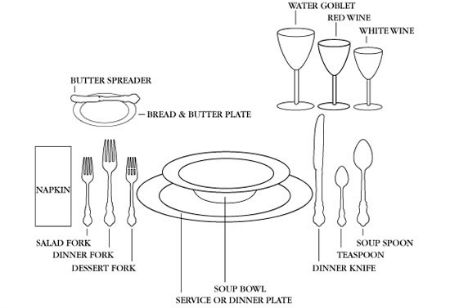 Dinner Setting Photo by Replacement, Ltd.
Use the silverware farthest from your plate first.
Here is the silverware and dinnerware rule: Eat to your left, drink to your right. Any food dish to the left is yours, and any glass to the right is yours.
Starting with the knife, fork, or spoon that is farthest from your plate, work your way in, using one utensil for each course. The salad fork is on your outermost left, followed by your dinner fork. Your soup spoon is on your outermost right, followed by your beverage spoon, salad knife, and dinner knife. Your dessert spoon and fork are above your plate or brought out with dessert. If you remember the rule to work from the outside in, you will be fine.
Use one of two methods when using the fork and knife:
American Style: Knife in right hand, fork in left hand holding food. After a few bite-sized pieces of food are cut, place knife on edge of plate with blades facing in. Eat food by switching fork to right hand (unless you are left handed). A left hand, arm or elbow on the table is bad manners.
Continental/European Style: Knife in right hand, fork in left hand. Eat food with fork still in left hand. The difference is that you do not switch hands – you eat with your fork in your left hand, with the prongs curving downward. Both utensils are kept in your hands with the tines pointed down throughout the entire eating process. If you take a drink, you do not just put your knife down, you put both utensils down into the resting position: cross the fork over the knife.
Once used, your utensils (including the handles), must not touch the table again. Always rest forks, knives, and spoons on the side of your plate in the 4:20 position.
For more formal dinners, from course to course, your tableware will be taken away and replaced as needed. To signal that your are done with the course, rest your fork, tines up, and knife blade in, with the handles resting at five o’clock an tips pointing to ten o’clock on your plate (4:20).
Any unused silverware is simply left on the table.
General Social and Dining Etiquette Rules
Dress Code: Follow whatever dress code is requested on the invitation or suggested by the host/hostess.
Arrival: Arrive at least 10 minutes early unless otherwise specified. Never arrive late!
Hostess Gift: It is proper to bring a small hostess gift, one that the hostess is not obliged to use that very evening. Gifts such as flowers, candy, wine, or dessert, are not good hostess gifts, as the hostess will feel that it must put it out immediately. You must not ever expect your gift to be served at the dinner party.
Seating: At a dinner party, wait for the host or hostess sits down before taking your seat. If the host/hostess asks you to sit, then do. At a very formal dinner party, if there are no name cards at the table, wait until the host indicates where you should sit. The seating will typically be man-woman-man-woman with the women seated to the right of the men.
Prayer: A prayer or ‘blessing’ may be customary in some households. The dinner guests may join in or be respectfully silent. Most prayers are made by the host before the meal is eaten.
Toast: Sometimes a toast is offered instead of a prayer. Always join in with a toast. If the host stands up during the toast, also stand up.
End of Dinner: Serving tea or coffee signifies that the formal part of the evening is over. Guests may now feel free to leave, or linger if the host or hostess encourages them to do so.
Thank You Note: After a formal dinner party, a thank you note should be sent to the hostess. Depending on how well you know your hosts, a telephone call is also acceptable.
Serving food:
Food is served from the left. Dishes are removed from the right.
Always say please when asking for something.
At a restaurant, be sure to say thank you to your server and bus boy after they have removed any used items.
Butter, spreads, or dips should be transferred from the serving dish to your plate before spreading or eating.
Passing dishes or food:
Pass food from the left to the right. Do not stretch across the table, crossing other guests, to reach food or condiments.
If another diner asks for the salt or pepper, pass both together, even if a table mate asks for only one of them. This is so dinner guests will not have to search for orphaned shakers.
Set any passed item, whether it’s the salt and pepper shakers, a bread basket, or a butter plate, directly on the table instead of passing hand-to-hand.
Never intercept a pass. Snagging a roll out of the breadbasket or taking a shake of salt when it is en route to someone else is a no-no.
Always use serving utensils to serve yourself, not your personal silverware.
Eating:
Do NOT talk with food in your mouth! This is very rude and distasteful to watch! Wait until you have swallowed the food in your mouth.
Always taste your food before seasoning it. Usually the hostess has gone to a lot of work making sure the food served is delicious to her standards. It is very rude to add salt and pepper before tasting the food.
Do not blow on your food to cool it off. If it is too hot to eat, take the hint and wait until it cools.
Always scoop food, using the proper utensil, away from you.
Cut only enough food for the next mouthful (cut no more than two bites of food at a time). Eat in small bites and slowly.
Do eat a little of everything on your plate. If you do not like the food and feel unable to give a compliment, just keep silent. It is acceptable to leave some food on your plate if you are full and have eaten enough. If the food served is not to your liking, it is polite to at least attempt to eat a small amount of it. It is never acceptable to ask a person why they have not eaten all the food. Don’t make an issue if you do not like something or can’t eat it – keep silence.
Even if you have dietary restrictions, it is inappropriate to request food other than that which is being served by the host at a private function. If you have serious dietary restrictions or allergies, let your host know in advance of the dinner.
Do not “play with” your food or utensils. Never wave or point silverware. Do not hold food on the fork or spoon while talking, nor wave your silverware in the air or point with it.
Try to pace your eating so that you do not finish before others are halfway through. If you are a slow eater, try to speed up a bit on this occasion so you do not hold everyone up. Never continue to eat long after others have stopped.
Table Manners:
Unfold your napkin and place it on your lap within 1 minute of sitting at the table to dine. When you are finished with your dinner, place it loosely on the table, not on the plate and never on your chair.
Keep elbows off the table. Keep your left hand in your lap unless you are using it.
Do not talk with your mouth full. Chew with your mouth closed.
Guests should do their best to mingle and make light conversation with everyone. Do not talk excessively loud. Give others equal opportunities for conversation. Talk about cheerful, pleasant things at the table.
Do not clean up spills with your own napkin and do not touch items that have dropped on the floor. You can use your napkin to protect yourself from spills. Then, simply and politely ask your server to clean up and to bring you a replacement for the soiled napkin or dirty utensil.
Loud eating noises such as slurping and burping are very impolite. The number one sin of dinner table etiquette!
Do not blow your nose at the dinner table. Excuse yourself to visit the restroom. Wash your hands before returning to the dining room. If you cough, cover your mouth with your napkin to stop the spread of germs and muffle the noise. If your cough becomes unmanageable, excuse yourself to visit the restroom. Wash your hands before returning to the dining room.
Turn off your cell phone or switch it to silent or vibrate mode before sitting down to eat, and leave it in your pocket or purse. It is impolite to answer a phone during dinner. If you must make or take a call, excuse yourself from the table and step outside of the restaurant.
Do not use a toothpick or apply makeup at the table.
Say “Excuse me,” or “I’ll be right back,” before leaving the table. Do not say that you are going to the restroom.
Whenever a woman leaves the table or returns to sit, all men seated with her should stand up.
Do not push your dishes away from you or stack them for the waiter when you are finished. Leave plates and glasses where they are.
Once used, your utensils, including the handles, must not touch the table again. Always rest forks, knives, and spoons on the side of your plate or in the bowl. When you are finished with a course, place your utensils (silverware) used on your place in the 4:20 position
Wine:
Never turn a wine glass upside down to decline wine. It is more polite to let the wine be poured and not draw attention. Otherwise, hold your hand over the wine glass to signal that you do not want any wine.
Hold your wine glass by the stem, not the rim. See How To Successfully Taste Wine – Wine Tasting Basics.
Where a different wine is served with each course, it is quite acceptable to not finish each glass of wine poured
Dividing or sharing the restaurant bill with others:
Always assume that if you are dining in a group of more than 6 people (3 couples), that the check is going to be divided evenly among everyone.
When dining with other couples, if you know you are going to ask for a separate check, tell the server before you order so that the process is simplified later.
Take into account any significant ($15 or more) price differences in orders. If someone only orders soup and everyone else orders 2 to 3 courses, it is not fair to make them pay the same.
If there are a couple people not drinking alcohol while the rest of the group is, separate the beverage total to take this into account and do not overcharge the non-drinkers
Proper tipping etiquette in a restaurant:
At a restaurant, always leave a tip. Tips can vary from 15% to 25%.
Waiter: 15% to 20% of the bill; 25% for extraordinary service
Wine steward: 15% of wine bill
Bartender: 10% to 15% of bar bill
Coat check: $1.00 per coat
Car attendant: $2.00 to $5.00
Remember that the amount you tip reflects the total price before any coupons, gift certificates, etc. Just because you get a discount, does not mean that your server did not serve up the full order.
If the owner of the restaurant serves you himself, you should still tip him. He will divide the tip among those who work in the kitchen and dining room.
Specific Food Types Etiquette Guide
Appetizers, Hors d’oeuvres, Canape:
Food that is served at a cocktail party or during a pre-meal cocktail hour is intended to be eaten with the fingers. This includes olives, pickles, nuts, canap, deviled eggs, and chips.
Artichokes:
It is both proper and polite to pluck the leaves with your fingers, leaving fork and knife aside for now.
Pull off a leaf, holding it by the pointed end. Put the other end in your mouth and pull it between your teeth, scraping the length of the leaf (the edible portion of the leaves becomes greater as you get closer to the center of the artichoke).
Just before you get to the very center, leaves will become almost white with purple tips. Be careful of these leaves because their purple ends are prickly. When the leaves are pulled, you will be left with the base, the heart, crowned with a fuzzy patch. You have now reached the best part of all, the very reason for eating artichokes: the heart. Carefully scoop away the fuzzy stuff with your knife or spoon (though a properly prepared artichoke will already have the choke removed). With knife and fork, cut bites from the heart like pieces of prime fillet.
If you are provided with a dip such as a vinaigrette or mayonnaise, put a small part of the edible portion of the leaf in the dip and scrape with your teeth as directed above. Do not overdo it on the dip or you will not taste the artichoke.
Asparagus:
Most etiquette books say that you can eat whole asparagus spears, without a sauce, by picking up with your hand. However, if you do this at a restaurant or dinner party, you will draw strange glances. Be safe and use your knife and fork to cut and eat them. Only pick asparagus up with your hands if the hostess does.
Avocado:
If the avocado is served in its shell, it is eaten with a spoon.
If it is sliced on a plate or in a salad, eat it with a fork.
Bacon:
Bacon can be consider finger food if it is dry, crisp, and served whole.
If bacon is broken into pieces, served in thick slices, or cooked but still limp, it should be eaten with a knife and fork. The rule is simply that bacon with any fat on it should be eaten with a knife and fork.
Berries:
Generally, eat berries with a spoon, whether they have cream on them or not.
Bread:
Use your fingers to remove bread from the serving plate. When a bread and butter plate is on the table, use it appropriately.
Break slices of bread, rolls and muffins in half or in small pieces never larger than one bite. Butter each bite at a time. Small biscuits do not have to be broken. It is never appropriate to cut a roll with a knife.
When the rolls are served in a basket, take one, and always pass the basket to your right. Place the roll on the break plate, which is located on the left side.
Use your own butter knife and the butter on your plate; buttering should be done on the plate or just above it. Use your butter knife for spreading and not as the butter server. The butter knife remains on the bread and butter plate at the end of the meal.
Caviar:
To preserve the full flavor of caviar, scoop it out using mother-of-pearl utensils, and NEVER use a metallic spoon (metal oxidizes the eggs), which will create an unwanted (and pretty horrid) metal bite. If necessary use a wood or plastic spoon.
Do not mush caviar up while you are serving yourself or others, lift the spoon carefully. Caviar should be scooped from the container vertically from top to bottom to avoid crushing the egg.
If caviar is passed to you in a bowl or crock with its own spoon, serve a teaspoonful onto your plate. As the following accompaniments are offered, use the individual serving spoon in each to take small amount of minced onion and sieved egg whites and yolks, as well as a few lemon slices and a couple of toast points. Assemble a canapé to your taste with a knife, then use your fingers to lift it to your mouth.
If you are at a cocktail party or reception, where prepared caviar canape are being passed on trays, simply lift one off the plate and pop it into your mouth.
When served caviar as an hors d’oeuvre, no matter how much you might be tempted by its luscious flavor, it is considered bad taste to eat more than an ample serving of about two ounces, or about two spoonfuls.
Cheese:
Informal Meal: When sliced cheese is served as an accompaniment to a dish, such as apple pie, it is eaten with a fork.
Appetizer: If cheese is served as an appetizer, such as cubes on toothpicks, it is eaten with fingers. If served a wedges of cheese (such as on a cheese plate), a slice of cheese is cut from a wedge, placed on a cracker, and brought to the mouth with the fingers.
Chicken:
It once was acceptable to pick up food on a bone, such as chicken, if it could be held with two fingers. I do not recommend that you do this in a public setting.
When dining at the restaurant or in a public place, chicken should always be eaten with a fork and knife.
If you are at an informal barbecue, in the fast food restaurant where you bought the chicken, and/or at your own home, it is perfectly acceptable to eat chicken with your fingers.
Chips and Dips: If you really like the dip served, and need every part of your chip covered in it, use a spoon and place some dip on your plate. Do not double dip!
Clams and oysters in the half shell: Hold the shell with the left hand and lift the clam out using your oyster fork.
Corn on the Cob: Corn on the Cob is usually not served in a formal setting, but if it is, it is perfectly acceptable to pick it up and eat it.
Crab, shrimp and lobster cocktails: These are always eaten with a cocktail fork.
Crab/lobster claws: Crack them with a nutcracker and the meat taken out with an miniature or oyster fork.
French Fries:
In a fine dining restaurant, use your knife and fork.
When dining at a dinner party and the setting is very formal, you should use a fork. The best tactic is to watch what your host or hostess does, then do the same.
In the vast majority of eating situations in the United States, French fries are eaten with the hands. It does not matter which hand. If served with a hamburger in a casual atmosphere, use your fingers and pick up a whole French Fry. Exception: If the French Fries are covered with something (like cheese, gravy, chili, etc.), they are considered utensil foods (use your fork).
Olives:
Generally, olives are considered a finger food. It is perfectly acceptable to pick up and eat an olive with your fingers. Remove pit with your fingers. If you prefer not to use the finger method, use a small fork to stab olive and remove olive pit from your mouth.
Depending on your dining situation, you can either choose to eat olives or leave them on the plate. If you are on a job interview, do not eat them. Also, in a highly formal dinner, do not eat them unless your host or hostess does. The best tactic is to watch what your host or hostess does, then do the same.
Emily Post indicates that, where olives are part of a salad, they are treated like the rest of the salad and taken in by fork and the pit deposited on the fork to return.
Pasta or Spaghetti:
The perfect method for eating spaghetti or other long stringy pasta is to twirl it around your fork. Use a spoon to help if needed.
It is also acceptable to cut pasta with a knife and fork. You can get some leverage by turning the pasta while holding the tines of your fork against the edge of your plate. It is even correct to neatly cut the pasta if twirling is too hard.
What is undeniably bad manners – is slurping in a mouthful of trailing pasta without benefit of twirl or knife. It is often loud, and it is never pretty.
If possible, serve warm pasta in warm, shallow bowls instead of on dinner plates. The sides of the bowl aids in turning pasta noodles on the fork.
Pineapple: Use a knife and fork to eat fresh pineapple slices.
Potatoes:
Baked potatoes are most often served already slit. If not, cut across the top with a knife, open the potato wider with your fork, and then add butter, sour cream, chives, salt, and pepper to taste.
You may eat the skin as you go along. Do not take the insides out and put the skin aside (or take the aluminum foil off). Eat it by scooping out the insides bite by bite.
Risotto:
Using a fork or a spoon, push the grains of cooked rice out slightly toward the edge of the bowl, eating only from the pulled out ring of rice.
Continue spreading from the center and eating around the edges in a circle. This will keep the risotto hot as you enjoy your risotto.
Salad:
If you are served large pieces or a whole wedge of lettuce, cut one bite at a time, using the knife provided.
If the salad is served before or after the main course, use the smaller fork. If the salad is considered the main course, use the entree fork (large fork).
Sandwich:
Small Sandwiches: Such as tea sandwiches or canapes, may be picked up and eaten with your fingers.
Large Sandwiches: If not cut in half, should be cut with your knife before lifting and eating.
Hot Sandwiches: Any hot sandwich or open-face sandwich that is served with a gravy requires a knife and fork.
Wraps: Such as burritos and other sandwiches in which the filling is wrapped in thin flat bread (usually tortillas or pita bread) are eaten with the hands. Any sandwich filling that falls from the sandwich to the plate is eaten with a fork.
Shish-kabob:
Appetizers: Shish kebab are eaten directly from the skewer only if they are served as an appetizer.
Dinner Entrée: Hold the tip of the shish-kabob in one hand and use the dinner fork to remove the pieces with the other. When all the food has been removed from the stick, place the emptied skewer on the edge of your plate. Always eat the meat with your utensils.
Shrimp:
Shrimp Cocktail: If large shrimp are served in a stemmed glass, pick them up with an oyster fork or whatever fork is provided and bite off a mouthful at a time, dipping into the sauce before each bite.
Large Shrimp: If large shrimp are served on a platter with sauce and no fork, pick up with your fingers, dip into sauce and put to your mouth. When eating shrimp with the tail still on, hold the shrimp by the tail and dip it into the sauce once. Eat it in one bite if it is not too large. Otherwise, eat it in two bites. Do not dunk the second bite into the sauce! Then discard the tail as you would olive pits or toothpicks.
Deep-Fried Shrimp: Tail-on deep-fried shrimp is meant to be eaten with the fingers.
Skewered Shrimp: If eating shrimp on a skewer, slide the shrimp off onto a plate (even if it is a paper plate at a cook out). Skewered shrimp should never be eaten like a corn dog.
Tail on: When eating shrimp with the tail that are part of some dishes or fried foods, remove the tail with a fork and set to the side of your plate or on a separate “discard dish” if one is provided.
Soup:
Dip the spoon into the soup, moving it away from the body, until it is about two-thirds full, then sip the liquid (without slurping) from the side of the spoon (without inserting the whole bowl of the spoon into the mouth).
It is perfectly fine to tilt the bowl slightly (again away from the body) to get the last spoonful or two of soup.
To eat bread while eating your soup, do not hold the bread in one hand and your soup spoon in the other.
When ready to eat a bite of your bread, place the spoon on the under plate, then use the same hand to take the bread to your mouth.
Sushi:
At most sushi bars, the waitress will offer a hot towel to wash your hands so you can pick up sushi with clean fingers. At home use hot washcloths.
With your Sushi order, you will be served some pickled ginger, a small mound of wasabi, and soy sauce. Eat a slice of pickled ginger after each variety of sushi to cleanse your palate. It is not proper to mix the wasabi with the soy sauce.
Do not rub your chopsticks together to remove any splinters. It is considered rude!
Sushi is meant to be finger food, quick and tasty. It is preferable to eat sushi with ones hands rather than with chopsticks, but both ways are acceptable in America.
Eat the whole sushi roll at once. It is not appropriate to eat part of a piece of sushi and place the other piece back on a plate. Once you have picked something up you should eat all of it. Exception: If the sushi is just too big to eat at once, bite the sushi in half and place the remainder back on the plate.
Do not dip the rice portion of the sushi pieces into the soy sauce as it becomes too moist and can cause sushi to fall apart. Simply dip the topping or the seaweed (Nori) in the soy sauce before eating.
If a piece of fish is on top of your sushi, put the whole portion in your mouth, holding the sushi so the fish part touches your tongue (turn sushi upside down).
37 Responses to “United States Dining Etiquette Guide”
Paul Percy
New to your blog. Stumbled upon it browsing the web. Keep up the great work. I am hoping you update it regularly.
Jan
was hoping you could add “where to place your silverware at the end of the meal” – which indicates or signals to others and your server that you are finished and that your plate may be removed.
Linda Stradley
It is included: Once used, your utensils, including the handles, must not touch the table again. Always rest forks, knives, and spoons on the side of your plate or in the bowl. When you are finished with a course, place your utensils (silverware) used on your place in the 4:20 position.
Wojtek
At first, you described the Continental and the American ways of using table utensils and then, when proceeding to the position of the left hand, you only mentioned the American way, without mentioning that it is an absolute no-no in Europe ( to keep the left arm under the table).
Floan
It seems to be a new thing in the US to remove dinnerware from the table when one person is finished and others aren’t. I was always told that the server should wait until all are done, unless there is another reason to remove it, such as a bowl of shells or a shortage of dinnerware. Please comment.
Linda Stradley
I, also, do not like it when a server tries to remove dinnerware from the table when everyone is not done eating! I always respond and let them know that everyone is not done eating yet.
Soma
Great write up! Easy to read and understand. Please keep it up and updated. Best wishes.
Kaylin Rose
Has really good facts and was a good study guide and helped me get the to score on my test.
Chris
I always thought that you should put your napkin on your seat if you needed to excuse yourself for a minute? Since table space is often limited, I can’t imagine putting it on the table.
Cathy
This is excellent. How should one place one’s knife and fork while not in use during the meal? A friend insists on placing the fork with the tines on the plate (turned upside down) and the handle on the table and the knife with the blade resting on the lip of the plate (pointed up) and the handle on the table. I have never seen this done before and think it’s bad manners. Can you advise?
Denis Mountain
I would say that before eating or placing the order, one should carefully read the restaurant menu cover as it saves from a lot of trouble.
maid cart
Admiring the time and energy you put into your blog and detailed information you present.
It’s good to come across a blog every once in a
while that isn’t the same out of date rehashed material.
Great read! I’ve saved your site and I’m adding your RSS feeds to my Google account.
Ellen H.
I like that you talked about how you should never use a table napkin to wipe your face and noise because it’s an inappropriate action. My fiance’s mother is going to meet me in an Italian restaurant next week. I want her to have an impression on me, so it’s important for me to be aware of the things that will make me look respected and professional. Thanks!
Suzanne Harley
Is it improper to use a knife to push food onto ones fork when dining?
Linda Stradley
It is not suggested.
Kenya Nix
Love , love, lovvvvvvvvvve what was done with u.s. etiquette information that was deeply appreciated as well as need. Thanks, Yours Truly, Key.
Lowell Nafziger
Any suggestions for charcuterie?
Noah Gonzalez
this is simple, but to me it seems sort of complex, i’m never going to a formal dinner
Lynda Robertson
Although your blog is 99% correct, I strongly disagree with your view regarding the placement of napkins, unless you are a female. Gentlemen should, always, tuck their napkin into their shirt collar.
I await your response…many thanks.
Whats Cooking America
It is acceptable for men to tuck their napkin into their shirt collar if they are eating a messy meal such as lobster or spaghetti in order to protect their formal attire.
Larry Weaver
Thanks for the tip to not talk loud while eating out. I have a really bad habit of talking pretty loud when I get nervous. I am planning on going on a date to a cafe this week, so I will do my best to keep my voice down to maintain proper etiquette even though I’m pretty nervous about the date.
Angela Waterford
My sister has invited me out to dinner, but she told me that I should choose the restaurant that we should go to. Thanks for the tip that I should call the restaurant if we run into some problems and will be late for more than 15 minutes. I think I’ll survey some restaurants that she’ll also like so we can enjoy our food when we go out.
Lynda Robertson
I utterly agree that gents napkins should be tucked into their collars. This is the correct etiquette in the U.K.
Parker Higgins
I have gone to so many formal events and I have many to come. This is really helpful. Thanks!
Nancy
Glad to be of help! I always have to review before going to a formal event, it is always good to study.
Nancy
Vivian Black
You made a great point about napkins and how you should unfold it and put it in your lap to protect your clothes. My husband and I are looking for a lunch deli restaurant that we can go to during our vacation next month. We will keep these tips in mind as we search for a professional that can help us best.
Carrie
When one is entertaining at home in a more formal way be it a religious holiday or charity event, in respect to seating arrangements where should the host’s significant other be seated…? To the right or to the left of host? And where should host’s personal assistant be seated if present?
tbh
Your article information really good thanks for sharing your content.
Rebecca Gardner
Thanks for explaining that it’s best to simply excuse ourselves without specifying that we’re going to the restroom. I’m currently looking for a nice local restaurant where I can take a potential new business partner sometime next week. Since I’m not too experienced with dining etiquette, the tips you shared here will be really helpful to practice and keep in mind!
Kamal
Great post about Restaurant Dining. I really appreciate your efforts put on this blog. Thanks for sharing this…
Tom Newton
Excellent article. We vacation in France annually and my wife insists that it is bad etiquette to ‘spear’ my salad. She says that the salad pieces should be ‘scooped’. Can anyone enlighten?
Eli Richardson
I’m glad you talked about dinner etiquette and how they’re a must for a good impression. Recently, my brother mentioned he has an important business meeting coming up, and he’s worried about his table manners. The meeting will take place at a restaurant, so I’ll be sure to share this article with my brother. Thanks for the tips on how to make a great impression with dining etiquette manners.
Chuck
Nice job on the etiquette list, with one significant (in my opinion) omission. A diner should not repeatedly scrape or clank his teeth on his fork. Food is removed from the fork into the mouth with the lips, not the teeth. Many parents omit this rule and thus many young people, and a few old ones, are in the practice of closing their teeth on the fork and pulling the fork between them, producing a loud metallic scraping sound with every trip of the fork. This is a neanderthal habit. Please tell your children!
Danielle Gurion
I disagree with any tucking napkins into shirt collar after age of two.
David C Fisher
My wife, who was raised in the Philippines, advises that it is etiquette at a dinner party for the wife to serve the husband first (before the guests) and vice versa if the husband is serving. Is this also good etiquette in the U.S. ?
Gilda B
Bravo! These rules should be required reading, repeated regularly in this world that is rapidly disintegrating into high tech cave man society.
A couple of things I would add: not only is it unacceptable to ask your hostess for different foods due to food allergies, it is unacceptable to ask her for anything that isn’t being offered. If red wine is not offered, she may not want to risk stains on her silk upholstery. If butter is not on the table, there is a reason!
Regarding crystal and china, treat it like it is museum quality. Do not clink your wine glasses to toast. Raise your glass instead. Clinking glasses is hard on crystal, and it is unrefined and unsophisticated as well. Certainly never bang on your glass with your knife to make an announcement. That is rude behavior even if the crystal is not an issue! Do not rush to the kitchen after dinner carrying plates and washing dishes if your hostess asks you not to. Her china and crystal may be irreplaceable, and she may be very particular about how it is handled.
Do not play with the centerpiece or candles. Do not rock your chair on the back two legs. These admonishments may seem too basic to bring up, but I have experienced every one of them as a hostess, and often multiples at the same dinner party. Sometimes I have to remind myself that I invited these cave people into my home because I’m fond of them.
Allan
I suffer from partial facial paralysis including right side of the mouth.
How does one handle water, wine, coffee (or tea), and soup?
I have a difficult time not being able to consume these things without a straw without it going down my shirt.