It's True - Dark Chocolate Is Healthy Chocolate!

  Home  |  Recipes  |  Diet Recipes  |  Dinner Party Menus  |  Food History  |  Culinary Dictionary  |  Diet, Health & Beauty

Baking Corner | Regional Foods  | Cooking Articles | Hints & Tips | Herbs & Spices | Restaurant Reviews | Newspaper Columns


Check out the History of Hot Chocolate

Check out my many Chocolate Recipes (includes candy, cookies, cakes, puddings, & misc. chocolate recipes)


How To Make Shaving Chocolate


Chocolate Clay Roses


Dutch-Process Cocoa vs. Unsweetened Cocoa


Linda's Favorite Chocolate Recipes

Chocolate Aggies

Chocolate Biscotti

Chocolate Clay Roses

Chocolate Creme Brulee

Chocolate Espresso Cookies

Chocolate Fudge Cheesecake

Chocolate Jalapeno Cake

Chocolate Meringue Cookies (low fat)

Chocolate Mousse Cake

Chocolate Oblivion Truffle Torte

Chocolate Peanut Butter Pizza

Chocolate Pots de Creme

Chocolate Pots de Creme (Low-Fat)

Chocolate Strawberries

Chocolate Sundae Cookies

Chocolate Truffle Bars
Diana Torte

Cognac Laced Truffles

Dieters Beware Brownies

Flourless Chocolate Cake
(low carb & low calorie)

Molten Chocolate Cakes

Raspberry Brownie Delight
Ten Plus Brownies

Thomas Keller's Molten Chocolate Tart

Toast with Chocolate and Fleur de Sel

Turtles

Uncle Jimmy's Chocolate Pound Cake

White Chocolate Bread Pudding

The list goes on and on - check out all my favorite Chocolate Recipes.


Facts & Trivia:

Chocoholic: - n [chocolate + -oholic (as in alcoholic)](1968): a person who craves or compulsively consumes chocolate. - Webster's Dictionary

Did you know that the Aztecs considered all chocolate an aphrodisiac? Because of this, all foods made with chocolate were strictly forbidden to women.

Although chocolate is not an aphrodisiac, chocolate contains phenylethylamine (PEA), a natural substance that is reputed to stimulate the same reaction in the body as falling in love. So - heartbreak and loneliness are great excuses for chocolate gorging!

Chocolate is old-school Viagra. Montezuma reputedly chugged a cup of chocolate before entering his harem, while Casanova called chocolate the "elixir of love" and drank it instead of champagne.

Christopher Columbus is said to have brought back cacao beans to King Ferdinand from his fourth visit to the New World around 1502, but they were overlooked in favor of the many other treasures he had found. Records suggest that he didn't particularly like the Aztec delicacy of "hot chocolate"- a thick cocoa drink laced with ground chiles and dyed red to look like blood - but recognizing its potential he took a load of cocoa beans back to Spain.

The early Spanish explorers thought the primary (if not only) use of chocolate was medicinal. Chocolate drinks were developed in Spain that were seasoned with pepper, vanilla, sugar and cinnamon or mixed with beer or wine. They became such a hit that Spanish society ladies had them served during Mass.

The first attempt at making a solid chocolate product came in the 1700's, when Mexican nuns raised money for their convent by producing and exporting solid chocolate bars.

The first "chocolate box" was introduced by Richard Cadbury in 1868, when he decorated a candy box with a painting of his young daughter holding a kitten in her arms. Cadbury also introduced the first Valentine's Day candy box.


Chocolate Toxicity In Dogs

Did you know that chocolate can be lethal to dogs. About 2 ounces of milk chocolate can be poisonous to a 10-pound dog. The same holds true for cats and other household pets.

Chocolate doesn't cause acne. This is just another myth about chocolate that has been disproved by doctors for some time.

The ability of the sugar in chocolate to drive up blood sugar (glycemic index) is about the same as oatmeal.


Dark Chocolate Is Healthy Chocolate!
It's The Best Medical News In Ages!
Studies in prestigious scientific journals say dark chocolate is healthy chocolate
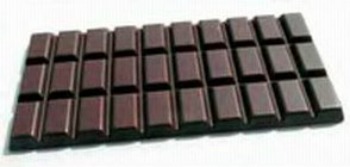
Dark Chocolate -- not white chocolate or milk chocolate -- is good for you. There is no question that chocolate procures pleasure for those who eat it. - Never feel guilty again!

If you enjoy chocolate, eat a little daily - but make it the dark kind.

Eating 2 ounces (50 grams) a day of plain chocolate with a minimum content of 70% chocolate solids can be beneficial to health, providing protection against heart disease, high blood pressure, and many other health hazards as well as essential trace elements and nutrients such as iron, calcium and potassium, and vitamins A. B1, C, D, and E and it's a lot tastier than boring old vitamin pills too. A 1 1/2-ounce square of chocolate may have as many cancer-fighting antioxidants as a five-ounce glass of red wine.

About 50% of all food cravings are for chocolate, far more than cravings for "something sweet" (16%), salty foods (12%), baked goods (11%), and fruit (4%). Some people go so far as saying they are addicted to chocolate. But that's no license to go on a chocolate binge. Eating more dark chocolate can help lower blood pressure. Remember, you do have to balance the extra calories by eating less of other things.

What is it that makes chocolate so irresistible? A large part of chocolate's allure, of course, lies in the taste - a deliciously rich concoction that satisfies the most intense craving.  But several chemical reactions are also at work. For one thing, chocolate stimulates the secretion of endorphins, producing a pleasurable sensation similar to the "runner's high" a jogger feels after running several miles. The question arises: Why is chocolate such a powerful food? And what makes it the most commonly craved food? (About 40% of women and 15% of men report chocolate cravings.)

A new study by market research publisher Packaged Facts titled Market Trends: The U.S. Market for Gourmet Chocolate reports that the higher cocoa, lower sugar content and antioxidant properties of premium dark chocolate are making it a more attractive treat for health-conscious Americans, especially those counting carbs. The potential health benefits of premium dark chocolate versus higher sugar, higher fat mass-market counterparts are causing consumers to reevaluate their attitudes toward the gourmet chocolate market.

A word of caution: Not all chocolate is heart healthy. White chocolate, which a Harvard researcher points out is "not really chocolate at all," and milk chocolate may expand the hips rather than help blood flow. And none of the instant cocoa mixes in the local grocery store contain the flavonoids that improve blood vessel function.


Short History of Chocolate

Aztec Indian legend held that cacao seeds had been brought from Paradise and that wisdom and power came from eating the fruit of the cacao tree. Because of a spelling error, probably by English traders long ago, the cacao beans became know as the cocoa beans.

The Spanish general, Hernando Cortes, landed in Mexico in 1519. The Aztecs believed he was the reincarnation of one of their lost gods. They honored him by serving him an unusual drink, presented in a cup of pure gold. This unusual drink was called "chocolatl" by the Aztecs.

When Cortes returned to Spain, he took the cocoa bean with him and there is was mixed with sugar and vanilla. this sweet drink became fashionable and soon there were chocolate houses in all the capitals of Europe.

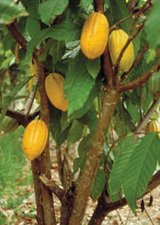
A delicate tree, cacao is only grown in rain forests in the tropics, usually on large plantations, where it must be protected from wind and intense sunlight. The tree is harvested twice a year.

Milk chocolate was invented in 1876 by a Swiss chocolatier, Daniel Peter (1836-1919) of Vevey, Geneva. Daniel Peter successfully combined chocolate with powdered milk to produce the first milk chocolate. Today, the finest chocolate is still made in Switzerland, and the consumption of milk chocolate far outweighs that of plain chocolate.

Chocolate was introduced to the United States in 1765 when John Hanan brought cocoa beans from the West Indies into Dorchester, Massachusetts, to refine them with the help of Dr. James Baker. The first chocolate factory in the country was established there.


Chocolate Glossary

Unsweetened Chocolate:
It is also called baking, plain or bitter chocolate. Since no sugar has been added to the chocolate it has a strong, bitter taste that is used in cooking and baking but is never eaten out of hand. 

Bittersweet Chocolate:
Still dark, but a little sweeter than unsweetened. It is unsweetened chocolate to which sugar, more cocoa butter, lecithin, and vanilla has been added. It has less sugar and more liquor than semisweet chocolate but the two are interchangeable in baking. Bittersweet has become the sophisticated choice of chefs. It contains a high percentage (up to 75%) of cocoa solids, and little (or no) added sugar. 

Semisweet Chocolate:
Slightly sweetened during processing, and most often used in frostings, sauces, fillings, and mousses. They are interchangeable in most recipes. The favorite of most home bakers.   It contains a high percentage (up to 75%) of cocoa solids, and little (or no) added sugar. 

German Chocolate:
Dark, but sweeter than semisweet. German chocolate is the predecessor to bittersweet. It has no connection to Germany; it was developed by a man named German.

Milk Chocolate or Sweet Chocolate:
Candy bar chocolate. Chocolate to which whole and/or skim milk powder has been added. Rarely used in cooking because the protein in the added milk solids interferes with the texture of the baked products. It contains approximately 20 percent cocoa solids.

White Chocolate:
Many people might argue that white chocolate is not really chocolate. It is made from sweetened cocoa butter mixed with milk solids, sometimes with vanilla added. Since cocoa butter is derived from the cocoa bean, then we can only conclude that real white chocolate is indeed chocolate.

Conveture:
A term generally used to describe high-quality chocolate used by professional bakers in confectionery and baked products. The word means "to cover" or "to coat." It has more cocoa butter than regular chocolate. It's specially formulated for dipping and coating things like truffles. Chocolate of this quality is often compared to tasting fine wine because subtleties in taste are often apparent, especially when you taste a variety of semisweet and bittersweet couvertures with different percentages of sugar and chocolate liquor.


How Chocolate Is Made

Cacao trees are often interplanted with tall shade trees to protect them from direct sunlight. Pods grow on the trunks and larger branches of the trees and take five to six months to ripen. Fruit on the higher branches are harvested with blades on long handles and lower branches are cut with machetes.

The pods are cut open with machetes to reveal between 20 to 40 beans each, surrounded by a mass of stickly, white pulp. Traditionally, this was done immediately after harvest; today, pods are sometimes first stored whole for a few days to prime them for fermentation.

Fermenting begins when the beans come into contact with the air. Here, a workrt uses a stick to gauge the depth of the mass in a vara, or measuring box, to determine the wage of the harvester, before transferring it to the fermentation bin. During fermentation, the pulp disintegrates, producing steamy heat and a pervasive, yeasty, sour smell. It is at this point that the beans first develop thier complex characteristics.

Drying of the beans after fermentation is done on slatted wooden trays in the open air. The beans are spread out evenly and raked periodically so that they dry uniformly. As the beans dry, their colors deepen, turning them into a carpet of sepia, umber, and mocha.

Aeration of the dried beans during storage is important to prevent the formation of mold. A worker tosses beans with a shovel to expose them evenly to the air.

Grading of the beans is done mechanically at the larger farms; smaller producers do it by hand. From baskets, the dried beans are transferred to burlap bags and transported to local selling stations, where they may be bought by large companies for export.

Arriving at the chocolate mills, the beans undergo a thorough cleaning, followed by the roasting which brings out the particular flavor of each variety. Throughout this process, a constant and exact temperature must be maintained. Correct roasting is exceedingly important since under-roasting leaves a raw taste and over-roasting results in a high pungent or even burnt flavor.

Now comes the cooling, shelling, and winnowing, from which the cocoa beans emerge cleaned and ready for blending. This important process requires expert knowledge and skill. Not only must the beans be selected which will produce the best chocolate flavor, but uniformity of blend must be preserved year in and year out.

After the blending, the cocoa beans are milled or slowly ground between great heated millstones. Under heat and tremendous pressure, the cocoa butter melts and mixes with other parts of the beans forming the ruddy chocolate liquor. The fragrant chocolate odor is now noticeable.

The liquor is then treated according to the product to be made. For unsweetened chocolate, the liquor is poured into molds and cooled rapidly in refrigerating rooms. Then the cacao emeres in familiar form, as bars of chocolate, ready to be wrapped and sold.


Storing Chocolate

Keep the chocolate in a cool, dry place. Chocolate is best kept at around 68 to 72 degrees Fahrenheit, the temperature of a pantry or dark cabinet. It has a shelf life of approximately one year. The normal air conditioned room provides adequate protection.

Freezing chocolate is not recommended; when you freeze it and then thaw it out, it will have a greater tendency to bloom.

NOTE: Bloom is the white, filmy reside that can develop on chocolate. This usually happens when the chocolate is stored in a warm place, but can happen when you freeze it.


Melting and Tempering Chocolate

Please note that melting chocolate is not the same as tempering chocolate. Tempered chocolate has been subject to certain temperatures and techniques that alter its chemistry. Tempering produces the texture and sheen we expect from fine chocolate candies. It is a method of melting and cooling chocolate. It gives chocolate a shiny luster. To temper chocolate, check out the one of the following:

How To Temper Chocolates from the cookbook Dessert Circus, by Jacques Torres:

Tempering is important because it determines the final gloss, hardness and contraction of chocolate. When you melt chocolate, the molecules of fat separate. In order to put them back together, you must temper it. There are a variety of ways to do it but the result is always the same. Chocolate is tempered when its temperature is between 84° and 88°F (29° and 31°C).

One of the easiest way to temper it is to place chocolate in the microwave for thirty seconds at a time on high power until the chocolate it melted. Be very careful not to overheat it: The chocolate may not look as if it has completely melted, because it retains its shape. The chocolate should be only slightly warmer than your bottom lip. You may still see lumps in it once you've stirred it, but don't worry; the residual heat of the chocolate will melt it. You can also use an immersion blender to break up the lumps and start the recrystallization process. Usually the chocolate begins to set (recrystallize) along the side of the bowl. As it begins to crystallize, mix those crystals into the melted chocolate and they will begin the recrystallization process. Chef Torres likes to use a glass bowl because it retains the heat and keeps the chocolate tempered for a long time. (note: this is one way to temper chocolate. Chef Torres has other options in his book).

Checking tempering: A simple method of checking tempering is to apply a small quantity of chocolate to a piece of paper or to the point of a knife. If the chocolate has been correctly tempered, it will harden evenly and show a good gloss within five minutes.

A Question of Temperature - Tempering Chocolate to Make Delicious Candies.


Melting Chocolate
:

  • Melt chocolate in the top of a double boiler over hot, not boiling, water (too high a temperature changes the flavor and color).

  • Speed up melting by first cutting the chocolate into small pieces, so that more surface area is exposed to the heat.

  • Stir chocolate constantly while melting to keep the temperature consistent throughout.

  • You can also melt chocolate in the microwave.  Heat dark chocolate on medium heat (50% power) and milk and white chocolate  on low heat (30% power).  Stir every 15 seconds, heating the chocolate until just melted (stop when the chocolate is partially melted and stir to melt the remainder).

TIPS: 

  • Make sure the melting pan does not touch the water in the bottom pan or it will become too hot.

  • Remember, chocolate is an oil-based product, and oil and water don't mix. Be careful not to drip any water into the chocolate.  One drop of moisture in the chocolate makes it tighten and become unsatisfactory for dipping. Thoroughly dry all spoons, whisks, and bowls used for stirring or melting chocolate.

  • If chocolate starts to harden after melting, add enough vegetable oil to liquefy.


Using Unsweetened Cocoa

There are two styles of cocoa - natural and "dutched." The difference is an additional processing step.  Natural cocoa is mildly acidic. Dutched cocoa has been alkalized (so its supposed to be smoother, less bitter and more soluble).


Substituting unsweetened cocoa for Dutch-Process Cocoa -
3 tablespoons (18 grams) unsweetened cocoa powder plus a pinch (1/8 teaspoon) baking soda.

Substituting Dutch-Process Cocoa for unsweetened cocoa - Leave out any baking soda called for in the recipe.

Substitute 1 (1-ounce) square of unsweetened baking chocolate with 1 tablespoon oil plus 3 tablespoons unsweetened cocoa.
 

Rule of Thumb:
Dutch process is alkalized and cocoa such as Hershey's cocoa is non-alkalized. If your recipe calls for Dutch process cocoa and you don't have any and you want to use Hershey cocoa, add a smidge of baking soda to even out the alkalinity and keep the cake from being coarse and dry.  And vice versa - if you are baking a cake and it calls for regular cocoa and all you have is Dutch-processed cocoa, just leave out any baking soda in the recipe.