
Accent Seasoning – Spike Seasoning:
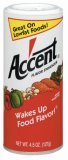 Accent Seasoning – A seasoning also called MSG (Monosodium Glutamate). It is commonly used in Asian cooking. It is not a favored seasoning or enhancer in the United States as many people are allergic to it. It is an optional seasoning and can very easily be left out of recipes.
MSG is the sodium salt of the amino acid glutamic acid and a form of glutamate. It is sold as a fine white crystal substance, similar in appearance to salt or sugar. It does not have a distinct taste of its own, and how it adds flavor to other foods is not fully understood. Many scientists believe that MSG stimulates glutamate receptors in the tongue to augment meat-like flavors.
Additional information on MSG from FDA and Monosodium Glutamate (MSG) by U. S. Food and Drug Administration:
Monosodium glutamate (MSG) is used as a flavor enhancer in a variety of foods prepared at home, in restaurants, and by food processors. It’s use has become controversial in the past 30 years because of reports of adverse reactions in people who’ve eaten foods that contain MSG. Research on the role of glutamate–a group of chemicals that includes MSG–in the nervous system also has raised questions about the chemical’s safety.
Studies have shown that the body uses glutamate, an amino acid, as a nerve impulse transmitter in the brain and that there are glutamate-responsive tissues in other parts of the body, as well. Abnormal function of glutamate receptors has been linked with certain neurological diseases, such as Alzheimer’s disease and Huntington’s chorea. Injections of glutamate in laboratory animals have resulted in damage to nerve cells in the brain. Consumption of glutamate in food, however, does not cause this effect. While people normally consume dietary glutamate in large amounts and the body can make and metabolize glutamate efficiently, the results of animal studies conducted in the 1980s raised a significant question: Can MSG and possibly some other glutamates harm the nervous system?
Reader comments on Accent Seasoning:
Your MSG information seems out of date. Please at least consider removing the injection study information. Injected MSG is not relevant to ingested MSG, as is the case in cooking. – Sincerely, Daniel Dewey (10/17/14)
http://www.sciencefriday.com/segment/10/10/2014/is-msg-bad-for-your-health.html
http://www.pri.org/stories/2014-10-03/science-suggests-msg-really-isnt-bad-your-health-after-all
On your site under accent you have the following – I want to point out that this is not entirely accurate. – (6/11/11)
ACCENT is used in the United states quite extensively as a flavor enhancer. People are not allergic to MSG as you indicate. There have been double blind placebo tests done and none of the subjects that said they are allergic showed any allergic reaction to MSG. We would be happy to provide details of the study for your review which was done at Scripts in San Diego, CA. This is a myth that is being spread on the internet and we would appreciate you changing your web information. Glutamate is the most abundant amino acid in all proteins on earth and is found naturally in a lot of foods we eat such as cheese, beef, poultry, mushrooms, tomato, etc.
Glutamate contributed by MSG seasoning is just a small percentage of the glutamate consumed every day as part of a normal, healthy diet. This is the case even in countries where MSG is used widely to season home-made food. Monosodium glutamate is the salt of an amino acid – one of the most abundant amino acids in our diet. Amino acids are the building blocks for proteins, whether in our bodies or in our food. Glutamate is found in food either ‘bound’ into protein or as ‘free’ glutamate. ‘Bound’ glutamate becomes ‘free’ as proteins break down – when meat or cheeses are aged, for example, or when food proteins are digested.
The glutamate from MSG seasonings and the glutamate from other foods are treated by our bodies in exactly the same way. Most of the glutamate we consume, whether naturally occurring in food or as seasoning, does not enter the bloodstream – it is used by the cells lining the digestive tract for energy. Our bodies also make glutamate as part of normal metabolism, and our major organs store glutamate. There is about 10g of free glutamate in our bodies, of which 6g is stored in our muscles.
Brendan Naulty, President
Ajinomoto Food Ingredients LLC
8430 West Bryn Mawr Ave
Suite 635
Chicago, IL. 60631
773 308 7852
I am a little confused. I always thought that MSG was a type of nutritional yeast, and therefore always feared that Spike had MSG, but was never really sure. You claim that hydrolized vegetable proteinIS MSG. To add to the confusion, I am not personally allergic to MSG, but I do not think it is good for ones health, and some people are very allergic to it, so I would like an informed answer so that when I prepare food for others, I will avoid using Spike if it has MSG. Is it possible that if it does contain MSG, that it is a healthy version of it, or is there any such a thing? Personally, I love Spike Spice mix better than any other, but it will curb my use of it if it contains MSG. Still, I seek to know the truth on the matter. – Anna (1/07/07)
ANSWER:
I see what you are saying, and it does sound confusing! Check out the following article on MSG by Truth In Labeling:
Truth In Labeling – HIDDEN SOURCES OF PROCESSED FREE GLUTAMIC ACID (MSG)
FEEDBACK:
Thank you so much for your help. Thank you for sending the link that you found, because it boils the info down to straight facts. I really like how concise and straight forward it is. I will save the information. This is really helpful for those who are rightly concerned about causing any discomfort to those who may be allergic to MSG. It appears that Spike Spice does indeed contain some, so I will be limiting (if not avoiding altogether) the use of Spike. It is a shame, because it is a very flavorful seasoning. But no taste is worth the ill effects that MSG has on those who get an allergic reaction to it. Thanks again for your prompt and informative reply. After writing to you, I did find some information also. You may want to look at it too. It is at:
Truth In Labeling – Expert Opinion: Monosodium Glutamate– The link address indicates that both your information and mine come from the same source. The link I found is more detailed, but also a little more difficult to figure out what they are trying to say. Still, you may find it interesting to read how much effort is made to sneak MSG into food and spices, despite the complaints of extremely painful reactions to it. It is angering actually. It is not fair to those who suffer the consequences, nor is it fair to people who, like me, are not allergic themselves, care to not cause any harm to others with the food they serve.
Spike Seasoning:
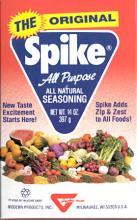 From the Italian kitchen of late internationally acclaimed gourmet nutritionist, Gaylord Hauser.
Spike’s Seasoning Ingredients contains: Salt and sea salt crystals, special high flavor yeast, hydrolyzed vegetable protein, mellow toasted onion, onion powder, orange powder, soy flour, celery leaf powder, celery root powder, garlic powder, dill, kelp, Indian curry, horseradish, ripe white pepper, orange and lemon peel, summer savory, mustard flower, sweet green and red peppers, parsley flakes, tarragon, rosehips, saffron, mushroom powder, parsley powder, spinach powder, tomato powder, sweet Hungarian paprika, celery powder, cayenne pepper, plus a delightful herbal bouquet of the best Greek oregano, French sweet basil, French marjoram, French rosemary, and Spanish thyme.
Spike’s seasoning claims to contain no MSG but does contain hydrolyzed vegetable protein.
I could not find a recipe to make it at home. I doubt that anyone would try to make a copycat recipe for anything with so many ingredients. Spike’s comes in either regular or salt free. Made by Modern Products, Inc., Milwaukee, Wisconsin, 53209, U.S.A. Spike’s is a commercial product that is available at most supermarkets (in the spice section) and health food stores.
Categories:
Herbs, Spices and Seasoning Hints & Tips
15 Responses to “Accent Seasoning – Spike Seasoning”
chris madsen
Nothing in the comments above can explain the effects of MSG on my body. On this substance I am the ultimate double-blind. Only recently, I ate a simple fish dinner in a restaurant and spent the next day out of action (culprit: risotto made with
industrial stock). Six months earlier a family dinner did the same thing.
I agree that glutamic acid is a normal component of our biochem. I’m a biologist; I know this stuff. But the MSG makes me very sick.
J G Broadfield
Interesting that looking at data, MSG is now made from different sources than traditionally ( a med website) and it’s also been pointed out by a friend that MSG ‘allergy’ may actually be to the thing being um..salted?… with MSG ..;o)
I thankfully do not seem to get a reaction from MSG… but whatever your allergy, I sympathize… mine is bell/hot peppers and need an epi pen… sigh…
Phyllis
Thank you for your comment. I am sorry that you are so allergic to MSG. I I’m also one of those. They can do all the studies they want, but it doesn’t keep me from getting very sick when I eat it even unknowingly. I think I can tolerate some of the natural occuring MSG, but any of the added MSG does me in.
DPNY
I have no adverse reaction to accent seasoning. I really like the pump in flavor it gives to food. I’m still unsure just how safe it is when used for a LONG amount of time:(
KT
We have been consuming glutamates for thousands of years. Asia uses more msg then any other place in the world, and they have been for hundreds of years. If it had any long term problems, we would have already seen them occur in the Asian populations.
Liz rice
Spike without salt only has about half of the above-listed ingredients. It does not taste the same at all to me.
Laura
The 2011 comment by the President of Ajinomoto Food Ingredients LCC, forgot to mention that ‘processed free glutamic acid’ (which is the chemical name for MSG) always contains natural AND synthetic forms of glutamate (the “L” and the “D” forms), as well as impurities, some of which can be carcinogenic.
His letter to you focuses upon how “NATURAL” glutamate is (it is) and sidesteps entirely that his company’s product is a SYNTHETIC, processed chemical. Some forms of industrially-processed ‘processed free glutamic acid’ (e.g., HVP or hydrolyzed vegetable protein) always contains synthetic form of glutamate (“D” form) and impurities, some of which are carcinogenic.
Ajimomoto is, of course, the original company which first commercially started selling MSG in 1909 and it holds the patent on MSG.
Your website post must have really hit the mark to have this Ajinomoto President feel the need to counter it …and ask you to change your website!! I think it’s time you did another article on MSG’s dangers!
The Truth in Labeling Campaign, cited above, is an excellent source for families who want to know how to avoid the excitotoxin MSG. See also Dr. Russell Blaylock’s book: Excitotoxins: The Taste That Kills, and MSGTruth.
MSG, by the way, is classified as an excitotoxin. We know it is NOT an allergen; since the ’70’s that has been a favorite industry rock to hide MSG under by blaming the victim.
As people who love to cook, research “umami,” which is how Ajimomoto now refers to MSG on its website (even THEY know the ‘word’ MSG is feared by consumers). The inventor of MSG, according to Ajimomtot, also coined the term ‘umami.’ Read the late Jack Samuel’s (from the Truth in Labeling Campaign) article about it, “New Propaganda About MSG,” here: https://www.westonaprice.org/health-topics/modern-foods/new-propaganda-about-msg/. And read, “Umami: The World’s Cleverest Marketing Scheme, by Anneli Rufus,” here: https://www.psychologytoday.com/blog/stuck/201006/umami-the-worlds-cleverest-marketing-scheme-1 .
Then go check out how many of your favorite cooking websites, TV shows (e.g., America’s Test Kitchen/NPR’s Fresh Air: ‘Test Kitchen’: How To Make Vegetarian Dishes Pop With A Little Umami), cookbooks, “Umami Bomb” restaurants, chefs, and newspaper columns all hawk the wonders of ‘umami,’ our so-called new ‘fifth sense of taste.’
PLEASE counter this new wave of slickMSG PR campaigns which are endeavoring to keep toxic MSG hidden in our foods.
KT
One, msg is not harmful to the human body. Two, the majority of synthetic chemicals produced are exactly the same as natural ones. Only a handful of chemicals have been shown to be highly carcinogenic, and we deal with those. Three, ever consider that the people writing the anti msg stuff are just selling their own stuff to you? Like the books you mentioned.
My first point is demonstrated and proven by the long term use of msg in Asian countries. My second point is simple chemistry. Whether or not the molecule is natural or formed in a lab, h2o is h2o.
Greg
It is impossible to be allergic to MSG. That’s not how allergies work. Can we stop echoing this false food scare?
John Davis
You can say whatever you want… I have learned the hard way that MSG is the common link (possibly exacerbated with my tendency of being slightly dehydrated) to my terrible migraines. If I don’t eat MSG, I don’t get them (with the exception of extreme dehydration, which I have learned to also avoid). I wonder if others who report adverse reactions to MSG aren’t also suffering from poor hydration. It may-or-may-not be of use to know that I am an ectomorph who lead a very, very active lifestyle when suffering from migraines.
Donna
I always have issues when I consume any food with MSG. The symptoms are always the same. I get a dull headache, severe stomach cramps, bloating, and gas. This usually lasts for 36 to 48 hours. It is always this ingredient that causes these issues. We used to cook with Accent flavor enhancer. After I eliminated it, my problems went away. We thought I had irritable bowel syndrome. If anyone can say that anyone else cannot have an allergic reaction to anything, I don’t believe it.
Victoria Chapman
Every available study from universally recognized and respected sources say MSG has no negative health effects. The origins of this rumor is based on simple anti-Asian (Chinese) racism. Even the first line of this, ” Accent Seasoning – A seasoning also called MSG (Monosodium Glutamate). It is commonly used in Oriental cooking. It is not a favored seasoning or enhancer in the United States . Oriental? Not favored in the US? Racism, and hysterical responses by attention seeking hypochondriac’s claims refuted by controlled studies, is NOT a reasonable source to make health decisions by. I use GOYA’s Sazonador Total because I can’t find ACCENT anywhere. I have no complaints from those who eat my delicious food and rave. I don’t even inform people that they’re eating something contaiing MSG anymore, although I did for years.
John Clark
MSG is safe and always has been. Please refer to the FDA site below. This is a massive urban legend.
https://www.fda.gov/food/food-additives-petitions/questions-and-answers-monosodium-glutamate-msg
Rebecca Loyd
MSG used as a spice is DEFINITELY harmful. If my daughter eats it, even unknowingly, she is in bed for 2-3 days with stomach cramps and diarrhea. She’s 45 years old and has had this problem all of her life. I don’t think it’s an allergy. It is an intolerance to this food additive. I am so glad that it is being recognized as harmful, and that many companies are taking it out of their food production.
Minnie Hudson
I used accent flavor enhancer for a ling time and i really liked it, but lately i bought a new can , it doesn’t taste the same like something is missing. I heard the same thing from my friends. what am i missing? thanks