
Truffles – The allure of truffles – It’s all about the smell!
Did You Know?
You smell truffles and you become willing to do whatever you have to do to have them.
Truffles are the culinary equivalent of sex. You love them or you do not. You smell them or you do not. You need them or you do not.
That most women describe the aroma of fresh truffles and truffle oil as earthy and very sensual? That most men just laugh and give you a funny look when you tell them what women think of truffles and truffle oil? Remember that I said most men and not all!
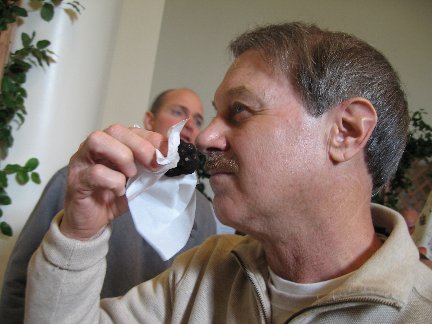 For centuries, truffles have been said to possess mystical aphrodisiac powers. What is it about truffles that make them so irresistible to gourmet cooks? Why this allure? It is all in the particular odor of a few types of truffles. Connoisseurs actually consider truffles an aphrodisiac, but there is no scientific evidence to this claim. Some describe their smell as musky, earthy, pungent, or even sexy, although none of these terms adequately describe the odor. Once you have smelled a truffle, you long to smell it again and again.
Truffles don’t really have much of a ‘taste,” but the smell is so overwhelming that it infuses any meal (and often the refrigerator). The actual taste of truffles is a little bland and when sliced over food, they are chewy. It is the smell that keeps you coming back.Part of the reason is also their scarcity. Truffles are buried in the earth like little black diamonds (so nicknamed by French gastronome Brillat-Savarin). It seems to be human nature to crave what is hard to come by. Finding them is not easy. It takes patience, persistence, and knowledge of their growing conditions, as they’re elusive.
Note from Linda Stradley – One whiff and the seductive smell sends me to heaven! I have personally taken a poll of my lady friends, and most feel the same way I do. So, what are you waiting for? Give truffles and truffle oil a try in your cooking. They are so gourmet!
Oregon Truffles:
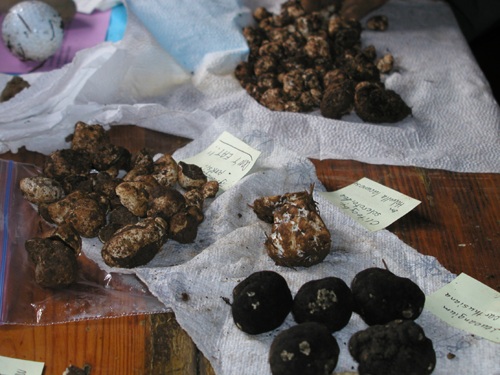
The mention of truffles brings up images of the expensive black and white truffles of France. But the truffles from Oregon are just as aromatic, and less than one-tenth the price of their famous French counterparts. Oregon truffles are emerging as one of the world’s great delicacies, taking their richly-deserved place next to their legendary European cousins.
Only in the past 20 years or so have several species of Oregon truffles become recognized for their culinary quality and potential value in the marketplace. In fact, with truffle production declining in Europe since 1900, Oregon’s relatively untapped supply is gaining more and more notice. Truffles grow west of the Cascade Mountains, from Vancouver Island, British Columbia, south to northern California. Fortunately for Oregonians, prime habitat for Oregon’s culinary truffles (both white and black) is found in young, fast-growing Douglas Fir tree plantation in the foothills of the Willamette Valley.
Truffles are a fungi, like mushrooms, but which grow under ground. Truffles also are the fruiting bodies of my corrhizal fungi that live in soil and associate with tree roots. But, instead of fruiting above ground, the truffle fruits below ground – and never sees the light of day (unless it is dug up). As a result, most people have never seen a truffle! Yet, truffles are common in the Pacific Northwest – especially in Douglas Fir forests, as they grow in the needles and topsoil around the Douglas fir tree. Most of the harvest takes place on tree farms.
Oregon truffles are not attractive, as they grow underground and look like it. These small potato-like fruits are warty and gnarled. Some are the size of golf balls or small nuts; some are larger. It is believed, that in many parts of the Northwest, truffles may be as common as above-ground mushrooms. In the Pacific Northwest, truffles are still a relatively untapped source of wild food.
Two main types of Oregon truffles are currently harvested in the state, the Oregon white truffles (Tuber oregonense) and (Tuber gibbosum). The while truffles are actually two species that fruit at different times of the year, but are sold as the same truffle.
Cooking with Oregon Truffles:
Grated over a dish of food, a tiny amount of truffle shavings can change a common dish into food for royalty. The ripeness or maturity of the truffle is the key, because the odor only becomes intense when the spores are ready to be released. To extend these expensive treats, keep in mind that a little truffle goes a long way. A small amount will give you a lot of flavor and aroma.
The truffles flavor and aroma can be destroyed by heat, so finding ways to incorporate their use into food preparation with little or no heat is important. Do not cook truffles, because the flavor escapes too much. Delicate white truffles are best when not cooked at all, but shaved raw over your favorite dish. You always want to maximize the truffle flavor, using the least amount of the ingredient as possible. So always slice into paper-thin wedges or strips. Use a truffle shaver (similar to a cheese grater) when shaving truffles.
Truffles can be stirred into a risotto or scrambled eggs, but should be added at the end of the cooking time, as a finishing touch. When shaved paper thin, it makes dime-size rounds of an attractive dark-tan color, accented with a pretty, lacy network of white veins.
Try putting some ripe truffles in a jar them with some bourbon. The resulting essence will make a wonderful sauce for your cooking.
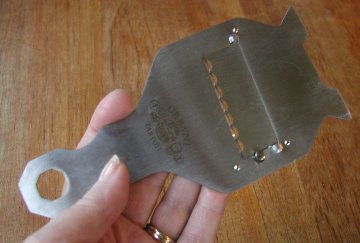
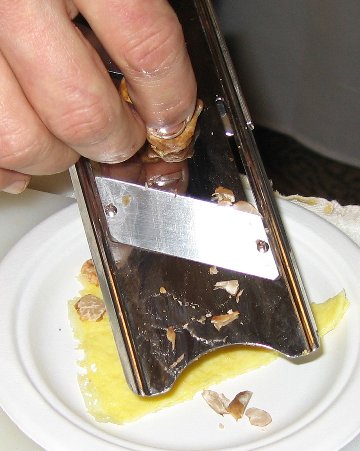
Photos of truffle shavers.
The French consider Oregon truffles as “non-truffle truffles” or “false truffles,” but chefs across the United States consider them every bit as delicious and exotic as their European cousins and are using them in their culinary masterpieces. In the winter, Oregon truffles have become a festive fixture on the menus of Oregon restaurants specializing in regional cuisine.
The late James Beard (1903-1985), American chef and food writer, has been quoted as declaring the Oregon truffle “at least as good…as Italian white.” You will find Oregon truffles in the markets from November to March, but they’re sporadic. In other words, buy them when you see them.
Purchasing and Storing Oregon Truffles:
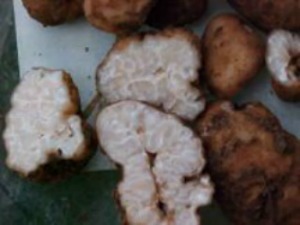
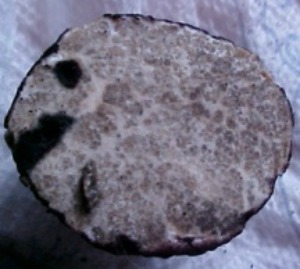
Not only do truffles need to be ripe to develop the strongest odors, but they need to be fresh. Make sure that the black or white truffles you’re buying are fresh. Look for mature truffles that are firm with a slight give, not spongy or slimy. If they feel soft or have soft spots, they’re starting to decay. They get slimy and smelly when old. If you can see the interior, white truffles should have a light brown marbling on the inside; black truffles will have charcoal-gray marbling.
Ripe Truffles:
The scent should be pungent, but in a good way – floral, chocolate or fruit aromas in black truffles, and musky-spicy perfume in white truffles. Truffle should smell, but not stink! Any truffle that has an ammonia smell should be tossed! Proper handling, quick shipment, and prompt use preserve these qualities and enhance the dining pleasure.
Once you purchase and take home your truffle/truffles, use it as soon as your can before the truffle dries out and the wonderful aroma dissipates.
Lightly rinse the truffles, pat dry with paper towels, brush use a soft basting brush or mushroom brush, and carefully pick out any dirt and mold in the nooks and crannies with the tip of a knife.
Do not cut the truffles until you are ready to use them – they lose aroma rapidly.
Storing Ripe Truffles: As truffles grow underground, you will need to clean them before cooking.
Options for storing:
Wrap each truffle with a paper towel and refrigerate in a paper bag or a perforated plastic container. Store the container on the lower shelf or door of the refrigerator, where it is less cold. This will maintain freshness for 2 to 3 days. NOTE: Do not seal them in a plastic bag, as they will succumb to moisture and will rot.
Store truffles in a glass jar with hard-cooked eggs for 1 to 2 days in the refrigerator. This will infuse the eggs with the wonderful aroma of the truffles.
Truffles can be frozen, for a maximum period of 6 months, in a vacuum package or in an air-tight container with a minimum of air space in order to conserve their aroma. If freezing, do so in small usable quantities. As long as they are not defrosted and refrozen, the original freezing process will not harm the flavor of the truffles. Wrap the truffles in saran or plastic wrap, then in aluminum foil. Place in a closed container (even a baggie with a tie) and into the freezer.
The truffle can also be stored in olive oil prior to freezing. Completely cover the truffles with the oil (the truffles must be completely covered with oil or fat to avoid freezer burn. Freezing truffles in oil should force most of the aromatic esters (the elements which truffles are sought after) into the oil, where they should be captured for later use.
Unripe Truffles:
If you use truffles immediately after collection from the ground, they are often unripe and will have almost no aroma, even if they are mature enough to eat. If your truffles are real hard and do not smell like much, wait!
They must be washed with water and brushed just before using or storing.
The outside must be immaculate since they will be used unpeeled. Rinse the truffles, brush with a damp towel, dry with a paper towel, and brush or pick out the dirt in the nooks and crannies with the tip of a knife.
Your truffle may take several days to ripen so as to develop their flavor and odor. Store them in an air-tight container (resealable plastic bag) in your refrigerator until the aroma “comes up” – you will know when that happens as an you smell smell the aroma.
Some condensation will build up inside the bag. This is normal and actually hastens the ripening process.
According to Jack Czarnecki, world-renowned wild mushroom expert, and co-owner of the Palmer House Restaurant in Dayton, OR: Truffles are bone-white on the inside when unripe, then mature so that the interior looks like a slice of pepperoni with a dark brown background with multiple veining networking throughout the interior. This is the state at which it is best consumed. A fully ripe truffle has three main characteristics:
The truffle will turn color white white to light tan, and finally to medium brown.
The truffle will become softer and exhibit a little “give” when squeezed.
The truffle will give off an odor of musty, earth, and a spicy, garlic-like gaseous smell.
Recipes using Oregon Truffles and Truffle Oil:
Check out Linda’s six-course dinner menu (with recipes) for a Truffle Gourmet Dinner.
Asparagus with Truffle Oil Vinaigrette
Grilled Shrimp with Truffle Oil Vinaigrette
Mashed Sweet Potatoes with Truffles and Bourbon
Mixed Greens with Truffle Oil Dressing
Pasta with Poached Eggs and Truffle Oil
Poached Garlic Soup garnished with minced black truffles.
Risotto with Chives and Truffle Oil
Quotes on Truffles:
At the time I write, the glory of the truffle has now reached its culmination . . . . In fine, the truffle is the very diamond of gastronomy . . . . The truffle is not an outright aphrodisiac, but it may in certain circumstances make women more affectionate and men more amiable. Who ever says truffle, pronounces a great word, which awakens erotic and gourmand ideas both in the sex dressed in petticoats and in the bearded portion of humanity. – Jean Anthelme Brillat-Savarin (1755-1826), French author and gastronomist, from his book The Physiology of Taste, 1825.
The most learned men have been questioned as to the nature of this tuber, and after two thousand years of argument and discussion their answer is the same as it was on the first day: we do not know. The truffles themselves have been interrogated, and have answered simply: eat us and praise the Lord. – Alexandre Dumas(1802-1870).
When asked by a social-climbing Paris hostess how he liked his truffles, Curnonsky replied, “In great quantity, madame. In great quantity.” – Curnonsky (Maurice Edmond Sailland), French writer (1872-1956)
You pay its weight in gold for it, then in most cases you put it to some paltry use. You smear it with foie gras, you bury it in poultry overloaded with fat, you chop it up and drown it in brown sauce, you mix it with vegetables covered in mayonnaise…..To hell with thin slices, strips, trimmings, and peelings of truffles! Is it not possible to like them for themselves? – Colette (Sidonie Gabrielle) French novelist. (1873-1954)
Frequently Asked Questions Using Oregon Truffles:
Question: Do I peel the outside skin off or do I use it?
Answer: They do not really peel – but they can seem that way if you hit them with a hard-enough water spray. Just washing them off under running water with a slightly dampened toothbrush, soft basting brush, or mushroom brush is the best way to do it. Just be sure you get any dirt or mold off of them before slicing over food: the dirt is not the best addition, but does help hold the truffle for a longer shelf-life.
Question: Could you please tell me how long you can keep a truffle in oil for and what do you do if the truffles has a cloudy edge around it inside the oil?
Answer: The truffle can also be stored in olive oil prior to freezing. Completely cover the truffles with the oil (the truffles must be completely covered with oil or fat to avoid freezer burn). Freezing truffles in oil should force most of the aromatic esters (the elements which truffles are sought after) into the oil, where they should be captured for later use.
Question: After you open a bottle of truffle oil, is it typical for truffle oil to lose its aroma?
Answer: Check out my web page for more information on Truffle Oil. Even though it is recommended that you keep your oils in a dark cool cabinet. I always keep my rarely used ones in the refrigerator. Since I started doing this, my truffle oil has not lost its aroma. The oil will cloud up and solidify, but that dissipates once you bring the oil back to room temperature.
Sources:
Truffles…A Culinary Delight From The Forest, An Oregon Garden Guide to Truffles, May 2005, by Dave Pilz, Forest Mycologist, Department of Forest Science, Oregon State University, Corvallis, OR and Mike Bondi, Oregon State University Extension Agent, Oregon City, OR.
The Fungus Among Us, by Jessica Maxwell, Green Gourmet, National Audubon Society, January-February 2005.