
Asparagus Information
How to Cook Asparagus starts with understanding this crisp, sweet vegetable. The best time to enjoy asparagus is when it is fresh and in season and when it is properly cooked. Learn how to select and purchase, how to prepare, and how to eat asparagus – plus favorite asparagus recipes.
Nutrition
How to select and purchase
How to Cook
Serving suggestions
How to store
Recipes
Asparagus “pee”
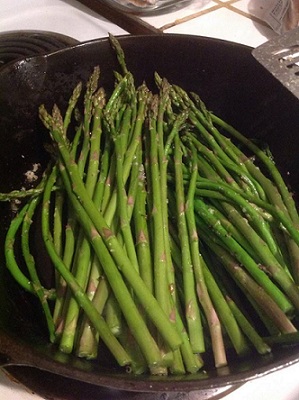
Asparagus (Asparagus officinalis var. altilis L.) is a hardy perennial vegetable native to the seacoasts of Europe and eastern Asia, where it has been cultivated for over 2,000 years. It was a well-known and valued vegetable to both the Greeks and Romans. Early settlers brought asparagus to North America, where it has been grown in home gardens since colonial times. Commercial production began in this country in the middle of the 19th century.
The underground portion of the plant consists of a network of rhizomes, fleshy storage roots, and fibrous roots. The fleshy roots (as well as the spears) are initiated from the rhizomes. Together, the fleshy roots and rhizome make up the crown, which is the perennial portion of the plant. Fleshy roots serve not only as storage organs for the carbohydrates received from the fern, but also as the site of fibrous root development. Fibrous roots, which live for one or two seasons, function in the absorption of water and nutrients from the soil.
The word asparagus comes from the Greek “asparagos,” meaning shoot or sprout. Asparagus spears are, in fact, edible shoots that develop on rhizomes when the soil temperature is warm and the water supply is favorable. The spears, if not harvested, develop into ferns 4 to 6 feet tall. Carbohydrates and other compounds necessary for plant growth and development are produced in the ferns throughout the growing season. These substances are translated to the fleshy roots, where they are stored and used to produce spears the following Spring.
Asparagus plants are dioecious, meaning that male and female flowers are produced on separate plants. The flowers are small, bell shaped, and whitish green. Male flowers are more conspicuous than female flowers. Following pollination of female flowers by bees, a berry, which has one to eight seeds and turns red at maturity, develops. The seeds, which are threshed from the berry when dry, are single, large, black, and generally round with one flattened side. Female plants are somewhat less productive and shorter lived than male plants because of the energy allocated to seed production. Thus, in a given planting of dioecious hybrids or plants from open-pollinated sources, the ratio of male to female plants initially is 50:50. As the age of a planting increases, the ratio of male to female plants increases.
Nutrition:
Asparagus has a wealth of nutrients and fiber. It has very low sodium and the calorie content make a nutritionally wise choice for today’s health-conscious consumer.
A 5.3 ounce serving of asparagus provides 60% of the recommended daily allowance for folacin which is necessary for blood cell formation, growth, and prevention of liver disease. Folacin has been shown to play a significant role in the prevention of neural tube defects, such as spina bifida, that cause paralysis and death in 2,500 babies each year. Asparagus is the leading supplier among vegetables of folic acid.
How To Select and Purchase Asparagus:
Select bright green asparagus with closed, compact, and firm tips. Also look for cut ends that are not dry. Select asparagus stalks that are about the same thickness so cooking will be uniform. Thickness does not influence quality. If the tips are slightly wilted, freshen them up by soaking them in cold water.
How To Cook Asparagus – Cooking Tips and Times:
Stovetop:
Saucepan or Steamer: Cook fresh asparagus in a small amount of boiling water until tender. Fresh asparagus will be crisp-tender in 5 to 8 minutes.
Frying Pan: Place a strip of folded aluminum on the bottom and up the sides of the pan, extending over the edges. Bring water to a boil; add asparagus spears and cook, uncovered, until crisp-tender, 3 to 5 minutes. Use foil strips to gently lift the spears to a serving dish.
Double Boiler or Percolator: To steam asparagus in an upright position, fasten the stalks into a bundle using a band of foil or string. Stand the stalks upright in the double boiler or percolator with the tips extending an inch or more above the boiling, salted water (a glass cooking vessel works best). Cover and cook until tender, 5 to 8 minutes.
Stir-Fry: Cut spears diagonally in 1/2 inch pieces, leaving tips whole. Stir-fry pieces in butter or hot oil, in a skillet or wok at medium high heat. Stir constantly until tender-crisp, 3 to 5 minutes.
Oven:
Fresh Asparagus: Preheat oven to 425 degrees F. Wash the asparagus and snap or cut off the tough ends of the asparagus. Arrange asparagus in a single layer in a shallow baking pan. Drizzle the asparagus with olive oil until well coated. Sprinkle with salt and pepper. Roast the asparagus in the oven until tender, approximately 12 to 18 minutes, depending on the thickness of the asparagus spears and until the desired tenderness.
Barbecue Grill:
Fresh Asparagus: Drizzle with olive oil until well coated. Sprinkle with salt and pepper (if desired). Place the prepared asparagus on the barbecue grill over medium-high to high heat and roast for approximately 8 to 10 minutes, or until desired tenderness. If roasting on the barbecue, it requires constant turning to avoid burning the bottom.
Microwave:
Fresh Asparagus: Microwave fresh asparagus by placing one pound in a microwavable baking dish or serving bowl. If cooking whole spears, arrange with tips in center. Add about 1/4 cup water and cover tightly. Microwave at 100% power for 4 to 7 minutes for spears, 3 to 5 minutes for cuts and tips. Stir or turn halfway through cooking time.
Frozen Asparagus: Microwave in a covered microwavable baking dish with 2 tablespoons of water. Cook at 100% power for 4 to 7 minutes, stirring or rearranging once.
Canned Asparagus: Drain all but 1 tablespoon of liquid, and microwave at 100% power for 2 to 4 minutes, stirring once halfway through cooking time.
Serving Suggestions and Ideas:
Try with lemon juice only.
Chives, parsley, chervil, savory, tarragon or other spices melted into butter are delicious when poured over Asparagus.
Sour cream, yogurt, and mayonnaise are easy toppings.
Medium dry white wines are best with Asparagus. Look for CheninBlanc, FumBlanc or French Colombard.
For pur, soups or salads, break or cut Asparagus spears at the tender part and use the trimmed ends that you might otherwise discard.
Place them in a covered saucepan and boil until tender.
Strain through a sieve or food mill forcing some of the pulp through, or process in a food processor or blender. Use as pur or mix with thecooking water for soups, stews, creamed dishes, or sauces.
For easy, fun grilling, skewer several spears with bamboo skewers to make a unique “raft”.
How To Store Asparagus:
Fresh Asparagus: Storage of fresh asparagus is important. Fresh asparagus must be kept refrigerated at all times. Wrap a moist paper towel around the stem ends and place in the refrigerator. Keep fresh asparagus moist until you intend to use it.
Frozen Asparagus: Keep frozen asparagus in the freezer until you are ready to use. Do no defrost before cooking. If the asparagus does defrosts, cook it immediately. Do not refreeze! Make sure you use the asparagus within eight (8) months.
Canned Asparagus: Keep canned asparagus in a cool, dry place.
Favorite Asparagus Recipes:
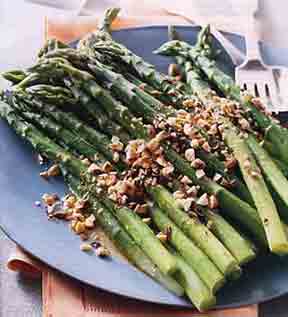
Asparagus with Balsamic Viniagrette
Asparagus with Lemon Viniagrette
Asparagus with Orange Dressing and Toasted Hazelnuts
Asparagus with Poached Eggs and Shaved Parmesan
Asparagus With Sesame And Chive Blossoms
Asparagus with Sherry Vinaigrette
Asparagus with Truffle Oil Vinaigrette
Cold Asparagus with Lemon-Mustard Dressing
Guacamole Dip (lowfat) – Canyon Ranch
Roasted Asparagus with Goat Cheese and Bacon
More delicious Asparagus Recipes to satisfy all you cooking needs.
Asparagus “Pee”
Asparagus constituents are metabolized and excreted in the urine, giving it a distinctive, mildly unpleasant odor. The smell is caused by various sulfur-containing degradation products.
Serious scientific research in this field dates back to 1891, when M. Nencki tentatively identified a compound known as methanethiol as the culprit. The odor appears within an hour after eating just a few spears of the offending vegetable.
As a result of studies it was not only shown that only around 40% of the test persons displayed this characteristic smell, but also that not everyone is able to smell the odor once it is produced.
Benjamin Franklin, in a discussion of bodily discharges, once noted:
A few stems of asparagus eaten shall give our urine a disagreeable odor; and a pill of turpentine no bigger than a pea shall bestow upon it the pleasing smell of violets.
In a British men’s club there is a sign reading:
During the asparagus season, members are requested not to relieve themselves in the hat stand.
Source: Information is from the California Asparagus Commission, Cornell University.