
How to Choose and Use Onions
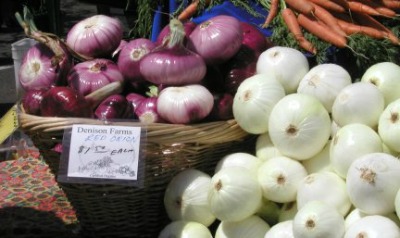
Onion Myths and Facts:
To keep your automobile windshield from frosting at night, slice an onion and rub the windshield with the onion. The juice will keep it frost-free.
To cure baldness, rub head with the onion. The onion juice was supposed to cause hair to grow “thick as thistles.” Note: You may have to sleep alone, but at least you’ll have hair!
To select your husband-to-be from among suitors, it is said that if the name of each suitor is written on an onion and then placed in a cool dark storeroom, the first onion that sprouts will be the man she should marry!
Onion Breath: To get rid of “onion breath” – eat several sprigs of vinegar or salt-dipped parsley. You can also chew on fennel seeds or coffee beans. You now have a “different” breath!
Green Onions vs. Scallions:
A green onion can be classified as a type of scallion. Both can be used interchangeably. True scallions are identified by the fact that the sides of the base are straight, whereas the green onion is usually slightly curved, showing the beginnings of a bulb. They should be stored, wrapped in a plastic bag, in the vegetable crisper section of the refrigerator for up to 5 days.
Simple Onion Cutting Tips:
One large onion = about one (1) cup chopped onion.
One medium onion = about 3/4 cup chopped onion.
The bigger and firmer the onion, the easier it will be to cut. A wet onion is easier to peel than a dry one.
Use a sharp knife: A dull knife can slip and will mash rather than slice through the onion. Use a straight-edge chef’s knife, if you have one, rather than a serrated knife, for cleaner cuts.
Be sure your cutting board is positioned securely on the counter. If necessary, place a damp kitchen towel underneath to keep the board from sliding around.
If cutting onions ahead of time, pack them in a plastic zipper-lock freezer bag, squeezing all the air out, then enclose in a second plastic zipper-lock freezer bag, and refrigerate, to keep everything in your fridge from tasting like onions.
When you need only a small portion of an onion, do not peel the whole onion. Cut off the size you need and peel it. The remaining portion will keep longer with the skin on it in the refrigerator.
Use pre-cut onions within two days.
Save onion trimmings, including the papery brown skin and add to soup stock for golden color, store in a well-sealed plastic zipper-lock freezer bag in your freezer.
Juicing onion: If you need the juice of an onion, squeeze half an onion with the skin on it. Use a lemon squeezer.
Sweating Onions:
Sweating is the process of releasing flavors with moisture and low temperatures. Fat, in this case, is used just to hold the non-volatile flavors as they are released from the onion. No browning takes place. The pan is covered so the lid traps steam, which condenses and drips back on to the onions. Some cooks cover the onions directly with a piece of foil or parchment, than add a lid as well. The cooked onions have a more mellow favor with this technique as the more you cook an onion, the sweeter it gets. Sweating onions is especially desirable when making white sauces that contain onions, as no color is added to the sauce. Also used in make risottos.
Sauteing Onions:
Sauteing uses a small amount of fat, and it’s done in an uncovered pan. As fat reaches higher temperatures than water, cooking usually occurs quickly, and you can easily see the onions become translucent as they move from raw to cooked. Some fat is also absorbed by the onion. Sauteing adds deeper flavors and richer colors to the onions. This basic technique is more common in cooking onions.
Onion Nutritional Values:
Serving Size: 1 medium onion (148 g)
Amount Per Serving
Calories: 60
Calories from Fat: 0
% of Daily Value
Total Fat: 0g 0%
Saturated Fat: 0g 0%
Cholesterol: 0mg 0%
Sodium: 5mg 0%
Total Carbohydrate:14g 5%
Dietary Fiber: 3g 12%
Sugars 9g
Protein 2g
Vitamin A: 0%
Vitamin C: 20%
Calcium: 4%
Iron: 2%
Percent Daily Values are based on a 2,000 calorie diet.
Source: PMA Labeling Facts 1.
Sweet Onions – What are Sweet Onions:
How about eating a raw onion that is almost as sweet as an apple? Certain fresh onions, called sweet onions, are known for their mild, even sugary, taste. These onions contain more sugars and fewer sulfur-containing compounds than other onions do.
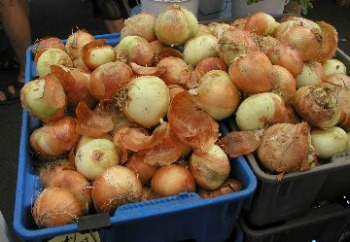
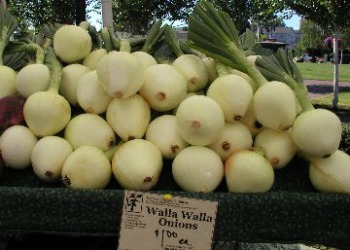
Did you know?
Some sweet and mild onion varieties (available in the spring/summer) have a similar sugar content (or sometimes even less sugar) than the storage varieties. Naturally, we do not always taste that difference due to both water and sulfur content present in a raw onion. However, we can often taste those differences when onions are cooked!
Sweet onions are often named by geographic origin and described as being sweet. The best known are:
Vidalia from Georgia
Walla Walla from Washington
Maui from Hawaii
Imperial from California
Carzalia from New Mexico
The Texas Spring or Supersweet from Texas
OSO Sweets from Chile, South America
The above sweet onions are available from February to August. Because their individual seasons are short, they often command premium prices.
Buying Onions – How To Choose and Use Onions:
Sweet onions have a thinner, lighter color skin than storage onions and tend to be more fragile. Signs in produce sections usually differentiate between sweet onions and storage onions. Another indication is price – sweet onions are a premium product that can range anywhere from 79 cents a pound and up.
Look for sweet onions that are light golden-brown in color, with a shiny tissue-thin skin and firm, tight, dry necks. (Ordinary storage onions are darker and have a thicker skin.) When cut into, sweet onions should have a creamy white interior.
Avoid onions that are soft or sprouting. Young onions are sweeter than old ones. They should have absolutely NO SMELL whatever. If they do, they are probably bruised somewhere under the skin and are on their way out.
Storing Onions:
Sweet onions are high in water and sugar content so they require more care when storing; treat them gently to avoid bruising. Store away from potatoes because they will absorb water. Generally, sweet onions will keep for 4 to 6 weeks or longer. Cut onions should be wrapped tightly in plastic wrap and refrigerated. Favorite ways to store “sweets”:
In the refrigerator: Store in a single layer in the vegetable bin on paper towels. Or, for longer storage, wrap in foil.
In pantyhose: Take a leg from a pair of clean, sheer pantyhose, drop an onion into the foot, tie a knot and repeat as necessary. Hang in a cool, dry, well-ventilated area. Cut above the knot when ready to use.
On racks or screens: Place on elevated racks or screens, not touching, in a cool area.
In the freezer: For long-term storage, sweet onions can be frozen, but their texture changes so frozen onions should be used only for cooking. Chop and place on a cookie sheet and place in the freezer. When frozen, place in freezer containers or bags. To store whole onions, peel, wash, core and freeze in a freezer-proof container or bag.
Drying: Chop and dry in the oven, using the lowest setting. Remove when thoroughly dry but not brown. Store at room temperature in airtight containers.
Favorite Onion Recipes:
Baked Stuffed Onions with Spinach Feta
French Onion Pissaladie – French Onion Tart
French Onion Marmalade – Confit D’ Oignon
Roasted Sweet Onions with Mint
Tarte Flambee – Alsatian Bacon and Onion Tarte
Comments and Questions from Readers:
I was fortunate to find your article about onions on the web today. Thank you so much for telling your audience all about the amazing onion. We appreciate your helping to spread the word and help to educate people about all onions and their nuances!
Aside from the kudos, I thought you would enjoy knowing about the National Onion Association. Many people are not familiar with our organization.
I also thought you would be interested to learn how some U.S. sweet and mild onion varieties (available in the spring/summer) have a similar sugar content (or sometimes even less sugar) than the storage varieties. Naturally, we don’t always taste that difference due to both water and sulfur content present in a raw onion; however, we can often taste those differences when onions are cooked!
I share this, because it is one of my favorite facts and was one of the most surprising things I learned about onions when I began working for the association. Hope this is just as fascinating for you as it was for me. Thanks again and keep up the great work
Kimberly Reddin
National Onion Association
Web: www.onions-usa.org
Blog: www.onions-usa.org/onionista
Twitter @Onionista
Question:
I am by no means an excellent cook, but I try to make some dishes that my wife and I both enjoy. I do have a problem – my wife absolutely hates onions! That certainly puts a dent into a lot of recipes. My question for you is if you know of a proper substitute for onions? I cannot seem to find anything on the internet, so I hope you can help me. – Steve Walker (11/17/99)
Answer:
I have a friend that also can not eat any onions. There is no substitution for onions, but you can spice your recipe up by other mean. Does you wife like garlic? You can use some garlic in place of the onions. Otherwise, you’ll have to be creative with herbs to give that added “zip” that onions do.
2 Responses to “Onions – How to Choose and Use Onions”
william sartin
I read recently ….pre- cutting onoins . Then cooking with them the next day is DANGEROUS-Poisonous ?
Is there any truth to this ??? thanks
Whats Cooking America
It’s been proven to be an Urban Myths per the Snopes article. https://www.snopes.com/food/tainted/cutonions.asp It’s perfectly fine to pre-cut onions a day or two ahead of using in cooking as long as they are sealed and stored properly in the refrigerator. I would not recommend keeping the cut onions past 2 days.