
How To Make Perfect Deviled Eggs
Deviled eggs are a favorite at any gathering. Read all of our helpful tips and tricks to making the perfect deviled eggs every time and serve these at your next spring get together!
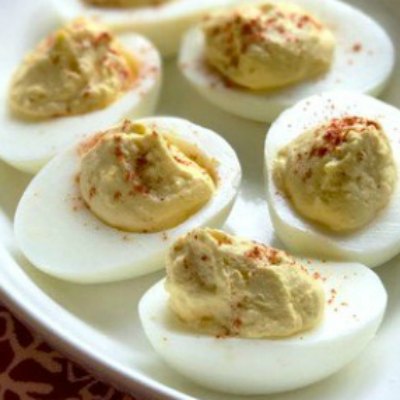
History of Deviled Eggs:
The origin of deviled eggs can be traced to Rome as far back as 4th and 5th Century A.D. where boiled eggs were seasoned with wine, broth, oil and various spicy sauces and served as a first course for a meal. Even in China, boiled eggs were steeped in tea for flavorings (see recipe for Tea Infused Marble Eggs).
The first stuffed egg is credited to Andalusia (now part of Spain) in the 13th century. It became more of a common practice to serve stuffed eggs in Europe by the 16th and 17th Centuries. You will find many different versions and traditions for deviled eggs served among several different European countries. In Sweden for example, deviled eggs are the traditional dish of the Easter Smörgåsbord where it’s favored to find sour cream, chopped red onion or caviar mixed with the yolk and garnished with pickled herring, dill or chives on top.
“Deviled” became associated with stuffed eggs in 18th Century England:
The term “deviled” means: A term describing food that is dark, rich, chocolate, spicily piquant or stimulating it is “deviled.” Means a highly seasoned, chopped, ground, or whole mixture that is served hot or cold.
Many foods, including eggs and crab, are served “deviled.” The term “deviled” referring to meat, fish, and cheese spreads, is somewhat different. Spiced potted meats have been popular for centuries. William Underwood introduced his famous deviled ham in 1867. The earliest use of this culinary term was typically associated with kidneys and other meats, not stuffed eggs.
The classic preparation of deviled eggs stuffed with blended yolk, mayonnaise, mustard and paprika, was first referenced in an 1896 Fannie Farmer cookbook, “Boston Cooking-School Cookbook”. However, it was not until post World War II in the 1940’s, when stuffed deviled eggs became widely popular for most Americans. These days cooks are coming out with many creative and exciting variations to mix with the egg yolk for the stuffing.
Steps to Making Perfect Deviled Eggs:
- Cook eggs according to the How To Boil Eggs instructions.
- Let eggs cool and then peel. See below for easy peeling.
- Using a sharp knife, cut eggs lengthwise in half.
- Remove egg yolks and place them into a mixing bowl.
- Using a fork, mash egg yolks together.
- Add ingredients to the mashed egg yolks according to your favorite recipe.
- Fill egg whites with the yolk mixture – you want to have the mixture heaping.
- Arrange the filled white halves on a plate.
- Garnish with your desired toppings.
- Serve well chilled. NOTE: The stuffed eggs may be made 1 day in advance and kept covered and refrigerated.
How To Boil Eggs:
Extremely fresh eggs are not recommended when making hard-boiled eggs. They are very difficult to peel. Boiling eggs is the best use for eggs nearing their expiration date.
How To Center Yolks: To help center the yolks in the eggs, the night before the eggs are to be cooked (approximately 12 hours), store your eggs on their sides in the refrigerator. Seal the egg carton with a piece of tape and turn on its side to center the yolks.
Use Room Temperature Eggs: Bring your eggs to room temperature before cooking. The temperature of the egg at the start of the cooking process will affect the cooking time. An egg that is at room temperature at the start of the cooking process will require about 1 minute less cooking time than eggs taken directly from the refrigerator. If the egg has been stored in the refrigerator it can be warmed gently under a flowing hot tap water.
Place the eggs in a single layer in a pan with enough cold water to cover eggs completely.
Bring the water to a boil, remove from heat, cover tightly with a lid, and allow to remain in the water approximately 15 to 20 minutes. If the eggs are boiled or cooked too long, the protein toughens or becomes rubbery and a greenish or purplish ring forms around the yolk.
Then place the hot eggs under running, cold water to cool quickly. This way of cooking is also known as “coddling.” It does not toughen the whites as boiling does. This will also help prevent discoloration of the yolk and will also assist with the peeling process, as the cold water creates steam between the egg white and the shell which makes the shell easier to remove.
Refrigeration is necessary for hard boiled eggs if the eggs are not to be consumed within a few hours. Hard-cooked eggs in the shell can be refrigerated up to one week only.
How To Peel Hard-Cooked Eggs Easily:
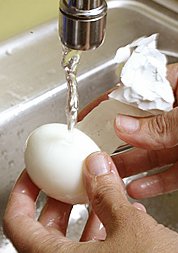
This is what I do:
I place the eggs in the pan they were cooked in and add cold water.
I then crack the eggs under water (this seems to help loosen the membrane under the shell).
Start peeling at the larger end, where the air pocket is, and remove the shell under running water to make the shelling easier. You must get a hold of the membrane under the shell when you remove the shell. Very fresh eggs are harder to peel. The fresher the eggs, the more the shell membranes cling tenaciously to the shells.
Hints and Tips:
- Place filling in a sealable plastic bag. Cut off tip from bottom corner and squeeze filling into egg halves. When finished, throw away the bag. No mess and no fuss.
- If the deviled eggs have to be covered in plastic wrap, put toothpicks in some of the eggs to hold the wrap up.
- For serving at picnics, place your perfect deviled eggs in a plastic container, seal, and place in ice chest. You may take out of ice chest, just before serving.
Additional Egg Cooking Techniques:
Learn All About Eggs and How To Cook Them – Lots of interesting information regarding eggs.
Baked (Shirred) Eggs – In France, this basic methods of baked eggs is called oeufs en cocotte.
Boiling Eggs – According to the American Egg Board, the terms “hard-boiled” and “soft-boiled” eggs are really misnomers, because boiling eggs makes them tough and rubbery. Instead, these eggs should be “hard-” or “soft-cooked” in hot (still) water.
Microwave Eggs – How to microwave poached eggs, fried eggs, scrambled eggs, and boiled eggs.
Poached Eggs – The best eggs for poaching are the freshest eggs you can find. If eggs are more than a week old, the whites thin out. Whites of fresh eggs will gather compactly around the yolk, making a rounder, neater shape.
Scrambled Eggs/Omelets – Scrambled eggs make a delicious and quick meal, but there is a little science to getting them just right. The secret to successfully scrambling eggs is slow cooking.
Categories:
Appetizers Cooking Lessons - Cooking 101 Easter Egg Appetizers Egg Hints and Tips Egg History Fourth of July Memorial Day Spring Recipes Summer Vegetarian Appetizers Vegetarian Recipe Collection
One Response to “How To Make Perfect Deviled Eggs”
Lisa
I stored my egg carton sideways as recommended but I messed up and did it for 3 days instead of overnight. Are the eggs ruined now?