
Mastering Meringue
Making Perfect Egg White Meringue is much like blowing air into a balloon while whipping. Beating or whisking causes the protein in the egg whites to unfold, forming films that trap the air bubbles, and the sugar stiffens the foam. A perfect egg white meringue is really nothing but a foam, and foam is a big collection of bubbles.
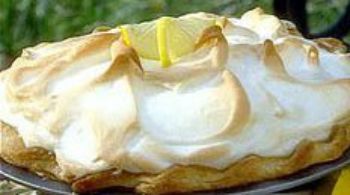
Age of Eggs:
Meringue recipes work better with eggs that are at least 3 or 4 days old. Thin, older egg whites whip more easily to a higher volume than thick, fresh egg whites. Once whipped, the foam from thin whites is less stable because the liquid film drains more easily from the bubbles. If volume is more important than stability, then older eggs are better to use. For better stability, a good rule of thumb is to use fresher eggs for meringues, saving older ones for general baking.
Do not make egg white meringues on a rainy or really humid day (remember that they are mostly air and if that air contains a lot of water, it will have an effect).
Separating Eggs:
Cold eggs separate more easily than those at room temperature because the whites hold together better.
Cracking the egg: Crack eggs on a flat surface, such as your counter top, rather than the edge of a bowl. This reduces the chance that a shard of shell will puncture the yolk.
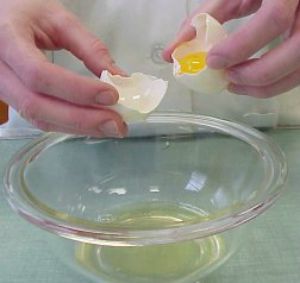 To separate an egg: Crack the egg and hold the shell halves over a bowl. Transfer the yolk back and forth between the halves, letting the white drop into the bowl. Do not cut the yolk (whites containing any yolk will not beat properly). Transfer the yolk to another bowl.
The tiniest bit of fat or egg yolk will wreck a meringue, as fat interferes with the formation of good foam. When separating eggs, if a speck of egg yolk falls into the egg whites, lift it out with an empty eggshell half. Do not try to fish it out with your fingers; the oil on your skin will prevent the egg whites from expanding.
Avoid letting your fingers touch the areas that will come in contact with the egg whites. That way, you will avoid leaving oils from your hands on the utensils you just washed.
Room Temperature: After separating, bring egg whites to room temperature to ensure volume when beating (as warmer eggs whip faster than cold eggs). Egg whites right out of the refrigerator will not whip well. The ideal temperature to whip a common meringue is room temperature, about 70 degrees F. (21 degrees C.). Usually 30 minutes is adequate to obtain room temperature.
A beaten egg white can foam to 6 to 8 times its original volume if the egg whites have been at room temperature for 30 minutes before beating.
Bowls and Utensils:
Copper, stainless-steel, or glass bowls work best for making meringues. Avoid using plastic bowls for whipping egg whites as they can often harbor traces of grease or fat, which prevents the whites from getting stiff. Whichever type of bowl you use, be sure it is spotlessly clean. Make sure that all your utensils are immaculately clean, completely grease-free, and completely dry. Meringues are very sensitive and they do not like any moisture.
Place the egg whites into a large, tall bowl and set your mixer to medium-high speed. NOTE: I would not hand beat a meringues (too much work). Beating or whisking causes the protein in the egg whites to unfold, forming films that trap the air bubbles, and the sugar stiffens the foam. As the mixing time increases, the bubbles become smaller and more numerous; this increases the volume and makes a more-stable structure.
Adding Sugar:
Do not add sugar before whipping the egg whites. Adding sugar at the beginning can double the time you have to whip the egg whites to get a foam. Add the sugar at the very end when the whites have formed soft peaks.
I like to use superfine sugar when making meringue because it dissolves faster than table sugar. When beating egg whites and the recipe calls for sugar, Gradually add the sugar, a few spoonfuls at a time and beating the whole time.
For optimum volume and smoothest texture, sugar should be added gradually, beating after each addition until sugar is dissolved before adding the next. Adding some or all of the sugar before beginning to beat will result in less volume.
By varying the amount of sugar in the final mix, you control how hard or soft the final meringue will be. As a general rule, add a total of 1/4 cup of granulated or superfine sugar for each egg white. Do not make meringues that have less than 2 tablespoons of sugar per egg white. If you use any less, the foam will not set and the meringue will shrink. To tell if the sugar is dissolved when you are beating egg whites for meringues, rub a bit of the foam between your fingers. If it feels gritty, the sugar is not dissolved, so keep beating for a few minutes. It should feel completely smooth when the sugar is dissolved.
Tips below from Milk Street Magazine, Fall 2017:
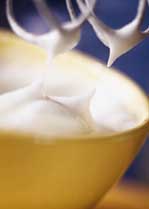 Soft peaks – Place egg whites in a clean glass or metal bowl (not plastic), and beat with an electric mixer on medium speed or with a rotary beater until egg whites form gentle peaks with tips that curl over when the beaters are lifted.
Perfect egg whites: To check that you have the perfect egg whites, remove the whisk from the bowl, scoop up some of the whites, and hold the whisk upright. The foam should form gentle peaks with tips that curve back, apostrophe-like, onto themselves.
Mixing soft-whipped meringue with batter – Do not completely fold the soft-whipped egg whites and batter together. Leaving streaks in the mixture is desirable as this helps prevent deflation of both the whites and batter which help produce lighter baked goods.
Stiff peaks – Continue beating egg whites on high speed until they form peaks with tips that stand straight when the beaters are lifted. Once you start a making whipped egg whites, continue it straight through and finish it off. Do not stop halfway to take a break. The meringue is done when it is not runny and when you can hold a spoonful of it upside down and none of it drops off. Also when you swirl a spoon through it and the swirls hold their shape indefinitely.
Using Meringue:
Make the meringue first – then prepare the filling (such as pie filling).
Place meringue on the piping-hot filling to begin cooking the bottom of the meringue. The residual heat carried by the filling cooks the base of the meringue ever so slightly, making it less prone to leaking or shrinking. Make sure the meringue completely covers the hot filling right up to the edge of the crust. This helps the bottom of the meringue cook and stick to the filling so it will not slide off the when it is cut. Use a small spoon or spatula to make high peaks and decorative swirls in the meringue before baking.
Baking Perfect Egg White Meringue:
Meringues will become more done if you bake them at a lower temperature for a longer time. Bake the meringue at 325 degrees F. for 20 to 30 minutes or until a cooking thermometer registers 160 degrees F. Remember a hot filling is important.
 This is the type of cooking and meat thermometer that I prefer and use in my cooking. I get many readers asking what cooking/meat thermometer that I prefer and use in my cooking and baking. I, personally, use the Thermapen Thermometer shown in the photo on the right. Originally designed for professional users, the Super-Fast Thermapen Thermometer is used by chefs all over the world.
Cutting Meringue:
To cut you perfect baked egg white meringue into serving pieces, use a knife dipped in cold water.
Storing Meringue:
There is no simple solution to this problem of storing a meringue-topped pie. This type of pie is best served the day it is made.
Remember, meringue pies only last a day or two, and then the meringue starts breaking down. If you place any cooked meringue in the refrigerator (no matter how long you baked it), it will bead and weep. Prepared meringue pies should be stored under an inverted bowl at room temperature.
However, custard and cream meringue-topped pies (especially when using eggs in the filling) always have to be kept refrigerated because the filling is perishable. Any pie containing pumpkin, custard, or cream pies are very good breeding grounds for bacteria.
Learn All About Eggs and How To Cook Them
Making Natural Easter Egg Dyes
25 Responses to “Perfect Egg White Meringue”
Lilfox
At what point do you start adding sugar to the egg whites
Linda Stradley
Per Directions: Do not add sugar before whipping the egg whites. Adding sugar at the beginning can double the time you have to whip the egg whites to get a foam. Add the sugar at the very end when the whites have formed soft peaks.
Nancy Lee Westrell
Always see cream of tartar in meringue recipes – but you don’t add. Comments?
Brenda
This is actually a page to teach tips on preparing meringue where we do not feature a specific recipe. If you look at our Lemon Meringue Pie recipe, for example, we list Cream of Tartar as an ingredient for the meringue topping: https://whatscookingamerica.net/LemonMeringuePie.htm
Susan Huntley
Every time I make meringue there is a thick clear liquid that forms around the edge of my pie. Also after I cut the pie the same liquid forms in the bottom of the pie. What am I doing wrong?
Linda Stradley
This is called “weeping.” Check out this article from Sunset Magazine on meringue weekping.
Melvin Batanes
This is very helpful. Keep making instructions or blogs, whatever source of information about baking for everybody. Bless you. I had a difficulty, stressed making a foamy meringue for my chiffon cake and never made it. After reading this, I will now be able to perfect my chiffon cake. Thanks a lot. Keep up the best work.
Lukas
Why do you add the sugar gradually and not all at once? I’ve made meringue before, so I’m not doubting the method, but I’m curious as to why.
Linda Stradley
For optimum volume and smoothest texture, sugar should be added gradually, beating after each addition until sugar is dissolved before adding the next. Adding some or all of the sugar before beginning to beat will result in less volume.
Saly
A lot thanks for detalies , I had learn a lot . I tried recently to do meringue , but it was a big trouble to cook them. I start with 325 F for 20 minutes after that I I change to 160 F, I keeped in oven over 4 hours with the door open a little bit , and I levead to cool in oven , and after all dosent was to dry . Where I am wrong ?
Linda Stradley
Meringues will become more done if you bake them at a lower temperature for a longer time. Bake the meringue at 325 degrees F. for 20 to 30 minutes or until a cooking thermometer registers 160 degrees F.
Dan Hobbs
I made this an was a complete failure low and long is no going to produce a nice tall meringue it will fall also I do not agree with the sugar amount ……one cup of sugar four a four egg meringue will make a heavy merigue that going to fall and 20 to 30 minutes bake assures you of a total failure
Whats Cooking America
As long as the sugar is added gradually to the egg whites and not all at once when mixing, the volume of the meringue should not fall. You can add anywhere from at least 2 tablespoons of sugar per egg to 1/4 cup.
Freida Jones
I’m 73 year old and am only now am learning the full instructions to making meringue for cream pies. This has been a well kept secret. Thanks so much. My coconut cream pie is in the oven and looking good, plus the raw meringue was best yet.:)
Amelia
I think meringues is a sweet desert 🙂
Billy Roden
I beat the egg whites until stiff and started adding sugar one tablespoon at a time but it would not dissolve quickly. I continued to beat the whites and they got thick and held heavy swirls that I thought looked like it would come out looking professional. The meringue sat on the counter while I prepared the chocolate filling and when I added the meringue to the hot filling the meringue appeared to be breaking down and would not for nice peaks on the pie.
Doug Spittler
Wait; in the reply above to Billy Roden, dated November 3, 2017, it’s stated a meringue should be added to a “warm” filling, not a hot filling. However, in the _article_ above it’s stated “Place meringue on the piping-hot filling to begin cooking the bottom of the meringue. ”
Which is it?
Nancy
Doug, thank you for letting me know of the error in the comment. The recipe is correct, the meringue should be added to the HOT filling. I will correct the previous the reply to Billy Roden. Thank you again for your sharp eyes!
Billy Roden
And how is the meringue spread without getting the filling on the meringue causing a slight discoloration? I just took the pie out of the oven and it looks nice but not with tall peaks like I wanted but it does appear to be adhered to the side of the crust.
Whats Cooking America
The meringue spreads easily over the lemon curd if you use a spatula. You need to “gently” spread. After you spread the meringue, then you can take a butter knife a create peaks all over the top before baking. If you do not have tall peaks, then it sounds like you did not beat the meringue in the mixer until it reached the stiff peak stage. You need to make sure the peans stand straight up without drooping before spreading on the pie.
norbert protsman
Can one use powered sugar when making meringue for pies, etc?
Kathy Pierce
I love that you give so much information. Even experts will find tips they weren’t aware of.
Lana newlin
To get more browning on the meringue , I swirl it onto pie and make sure there are no peaks, turn the oven to 250 and most of the entire top browns. I also sit in front of the oven and watch it like a hawk to prevent offer browning.
Jacquie Lee
I’m making Pavlovas and they come out too “browned” for my liking. The ones in restaurants are almost Snow White. Time ? and Temp?
Patricia King
At 74 and still learning how to properly make my merengue. I think I have found my problem, I have not been adding the incorrect amount of sugar, as I am mixing. I guess after all these years of randomingly adding my sugar amounts, I had been adding just heaping amounts, not really measuring properly. I will be trying again on the two pies we love most; sweetpotato and then lemon. Thanks for your very clear precise instructions.