
One taste of this Cornell Chicken recipe and you will definitely know why it is so popular. My husband loves it! This delicious chicken is served everywhere in New York state, especially during the outdoor grilling season. During the New York State Fair, which takes place each summer in Syracuse, it is said that over 5,000 Cornell Chickens are consumed, marking it as the unofficial food of the event.
This recipe was developed by Dr. Robert C. Baker (1921-2006), a former Cornell University poultry science and food science professor who helped develop chicken nuggets, turkey ham, and poultry hot dogs.
History of Cornell Chicken: In 1946, Baker researched and developed innovative ways to use poultry. This Cornell Chicken Barbecue Sauce recipe has stood the taste test of time, having been showcased for more than five decades at his Baker’s Chicken Coop at the New York State Fair in Syracuse, N.Y. Baker developed the recipe while working for Pennsylvania State University, but the barbecue sauce he devised was not appreciated until he joined the Cornell faculty with a mandate to promote New York state’s poultry industry. This recipe is considered a central New York state regional food and if often referred to as “State Fair Chicken.”
According to the Lansing Star Online Newspaper:
Each year the Bakers set up shop in a big red building with covered seating on either side where customers line up for chicken dinners, wings, salt potatoes, salads and a whole menu of delicious choices. The smell of chicken is irresistible as you walk by and it is hard not to go in and get a plate of chicken.
The tradition was begun 56 years ago by Bob Baker, a retired Cornell professor, and his wife Jackie. Dr. Baker is known for inventing “Cornell Sauce,” a marinade for chicken. They ran the restaurant until 1988, when their daughter Renee Sandsted took it over.
1999 – President Bill Clinton, Hillary Rodham Clinton, and their daughter, Chelsea, toured the New York State Fair. There they visited Baker’s Chicken Coop eatery, specifically to savor a taste of the famous Cornell Barbecued Chicken. As the first family arrived at the barbecue stand, one of Baker’s daughters presented the Clintons with a basket of New York state apples. “Those apples look good, but where’s the chicken?” the president asked.
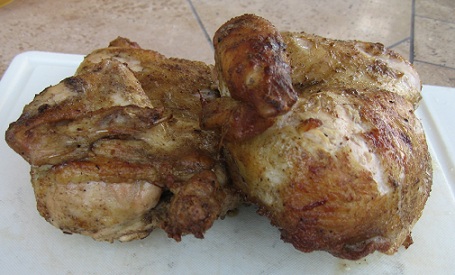
According to Robert Baker, “Barbecue broilers without sauce are like bread without butter. The barbecue sauce is a basting material. Brush it on the broiler halves every few minutes during cooking.”
- 1 egg
- 1/2 cup vegetable oil
- 1 cup cider vinegar
- 2 teaspoons coarse salt*
- 2 teaspoons poultry seasoning
- 1/4 teaspoon black pepper, freshly ground
- Poultry pieces (half chicken, whole chicken, whole chicken legs, chicken thighs, and/or chicken breasts)
-
In a large bowl, whisk the egg. Add the oil and whisk until the mixture gets thick, homogenous, and a bright yellow, approximately 2 minutes. Whisk in the cider vinegar, salt, poultry seasoning, and pepper. NOTE: If you prepare the barbecue sauce ahead of time, refrigerate until ready to use. As this sauce is high in acid which kills any bacterial that might be present in the eggs. If you are still worried, use pasteurized eggs.
-
In a large resealable plastic bag, place the chicken pieces of your choice. Pour the prepared sauce over the chicken and let marinate in the refrigerator for at least 2 hours or up to 24 hours (the longer you marinate, the better).
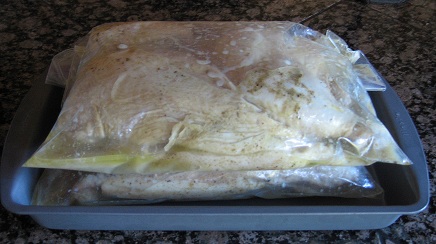
-
When ready to grill, preheat barbecue grill (spray grill with vegetable-oil cooking spray before heating).
-
Place the marinated chicken over indirect heat on the grill (to the side of the grill).
-
Barbecue with Charcoal: When coals are ready, spread them around the edge of the firebox (24" round) and keep a squirt bottle near the fire to put out flames. Turn the chicken often and don't let it burn. Breasts take about 25 minutes or until a meat thermometer registers an internal temperature of 165 degrees F. (juices will run clear when cut with the tip of a knife). Do not close the lid on the barbecue.
-
Gas Barbecue (since you cannot maintain a hot fire without closing lid): Place prepared chicken onto hot grill. Cover barbecue with lid, open any vents, and cook approximately 20 to 25 minutes or until a meat thermometer registers an internal temperature of 165 degrees F. (juices will run clear when cut with the tip of a knife); turning several times during barbecuing.
-
You want to slow roast the chicken on your gill. Baste the chicken every 5 or 10 minutes with the Barbecue Sauce.
-
Discard any barbecue sauce that was used to baste the chicken. Do not serve any leftover basting sauce as it will have been contaminated with raw chicken during the marinating process with repeated basting. Remove from grill, transfer onto a serving plate and enjoy!
-
Makes about 1 1/2 cups sauce. Yield: Enough for 5 pounds of chicken.
* Adjust the quantity of salt to meet individual health needs and taste. I use less salt than called for in the recipe. Barbecued chicken basted frequently during cooking will be saltier than chicken that has been lightly basted.
I get many readers asking what cooking/meat thermometer that I prefer and use in my cooking and baking. I, personally, use the Thermapen Thermometer. Originally designed for professional use, the Super-Fast Thermapen Thermometer is used by chefs all over the world. I only endorse a few products, on my web site, that I like and use regularly.
You can learn more or buy yours at: Super-Fast Thermapen Thermometer.
Sponsored Content
Categories:
Barbecue Sauces Dinner Grilled & Smoked Chicken Grilled Chicken Breasts, Legs, Wings & Thighs Mid-Atlantic Poultry Dishes HIstory
18 Responses to “Cornell Chicken Barbecue Sauce History and Recipe”
Tom
What is “poultry seasoning?” Obviously not salt and pepper…
Whats Cooking America
Poultry seasoning is a pre-mix of dried herbs that can be purchased in U.S. stores. It’s a combination of sage, thyme, marjoram, rosemary, nutmeg and black pepper. I found an All recipes link to make homemade poultry seasoning mix: https://www.allrecipes.com/recipe/233909/homemade-poultry-seasoning/
Rosemary
This is an awesome basic marinade. Poultry seasoning can be found in the spice department
Maria Bard
I always add parsley and a lot of garlic powder! Not the salt!
JC
Grew up south of Oneonta, NY. Passing by Brooks Barbecue ( that used the Cornell mixture or close to it) was nirvana. We were so happy whenever Dad stopped for some Brooks on the way home!
Bruce Abbott
Grew up near Dr. Baker and Dr. Ward, his associate. Played with their kids in the 50 and tasted this receive many times at their homes. Used it for decades, in fact, mixed some up tonight!
Nancy
It’s fun to hear from people that are familiar with the original recipe!
Carol
My dad used help out at the local church bbq. This was the sauce they used. I loved and got the recipe. Never knew the name of it not the history. Thank you!
Nancy
You’re welcome! Thank you for visiting.
Giovanni
I grew up on Long Island in the sixties and my Dad was a Scout leader . We had a concrete block chicken BBQ pit in our back yard and this is the way he always BBQ chicken for us and the Scouts when they would do their yearly camp outs. I live NC now built a block BBQ pit and cook chickens every summer . The southerns love it they call it doing a chicken picking instead of their pig pickin. Thanks to Cornell university for inspiring this recipe
And to JC I know Brooks very well miss going there
Terry
Actually , he created it at Penn State
Louise
I’m curious as to why there would be any problem using a raw egg in the marinade. Wouldn’t any bacteria be killed in the grilling process?
Lisa Luciano
My family grew up in the Ithaca NY area, and I worked at Cornell like many locals. I really liked Bakers Acres in Lansing and used to visit for flowers and antique tea cups. While in college I won an award by the Ithaca Women’s Business Association, and I was honored with several other women at a dinner put on by the owners of Bakers Acres. The main course was chicken with this delicious recipe, with buttered potatoes and a side salad with beautiful edible flowers!
Everything and everyone was so lovely at that dinner, I’ll never forget how special they made me feel. Quite a nice memory with very nice people 🌷
Vygal
I read of on Dr. Robert C. Baker and found this recipe. I will have to try this out. Cheers for the author for making this available. And I will always remember Dr. Baker.
Barbara J. Baay
I grew u in Norwich NY during the 50’s snd 60d. We called it Notwich chicken since the firemen and any other organization would use this for barbecue. It’s a hometown taste my siblings and I still use.
Jeff Sandsted
There’s no need to be concerned of the possibility that there may be bacteria in the sauce. It isn’t just the heat of the fire that would kill the bacteria but in addition, the extremely lo PH in the vinegar kills any and all bacteria present.
Megan
I really want this chicken but it’s winter and cold here so I don’t want to do it on the grill outdoors. Would this recipe work in the oven?
Duane
This is definitely an open fire and smoke recipe. The key is 18” above the coals. The drippings create a unique smoke on the chicken. Frequency of baste creates a delicious skin crust that develops over a slow cooking for 60+ minutes. When the drum stick bone turns…….it’s time to eat. I always set some untouched fresh sauce aside to serve at the table. Both marinade and basting sauce have been exposed to raw chicken. Enjoy