
Herbs, Spices, and Seasoning Guide
It is hard to imagine what cooking would be like without the unique flavors provided by herbs, spices, and the many seasonings available. Read all of our favorite tips and tricks in this helpful Seasoning Guide.
For centuries Herbs and Spices have been an integral part of many of the world’s great cuisines. Today we take for granted black pepper and the other spices over which wars where once fought. At one time only kings and other wealthy people could afford such a delicacy as cinnamon. Today all supermarkets and most small grocery stores have well-stocked spice shelves offering a wonderful selection of herbs and spices.
The term “spices” is often used broadly to include all seasonings. Spices come from the bark, roots, leaves, stems, buds, seeds, or fruit of aromatic plants and trees which usually grow only in tropical countries. Pepper, allspice, cloves, nutmeg, mace, cinnamon, ginger, saffron, and turmeric are spices.
Herbs are soft, succulent plants which usually grow in the temperate zone. Until recently cooks have had to make do with very few fresh herbs, such as sage, parsley, and thyme. Nowadays you can also find fresh basil, coriander, chervil, tarragon, rosemary, and dill. Since herbs are at their best when they are young and freshly picked, it is well worth growing your own.
Check out and use this Herbs, Spices, and Seasoning Guide.
Herbs, Spices, and Seasoning Guide
How To Preserve Fresh Herbs:
The faster the herbs dry, the more flavorful the resulting dried herb will be.
Conventional Oven: Place clean dry herb sprigs on a foil-lined baking sheet. Bake at the lowest setting until herbs are dry and brittle. This should take about 12 hours. Strip leaves from stems & place in small airtight storage containers.
Air Drying: Tie small bunches of herbs with string and hang upside down by the stems in a dry warm spot out of direct sunlight. Be sure air circulates freely around the bunches. Let dry till leaves are brittle. This usually takes a few days to a week, depending on the thickness of the leaves. Pick off the dried leaves & store in tightly covered containers in a cool, dry place about two weeks or till dry and brittle.
Microwave Drying: Pick when the dew has just gone off. Put on paper towels on a plate in the microwave. Zap on high for a minute to start (at that point they appear “wet”). Stir them, zap again for another minute, move around again, and zap approximately 30 seconds more or until they are dry and crumbly. Rub between your hands to break up, pick out any twiggy parts and put in small jars or baggies.
Freezing Herbs: Wrap in foil or plastic wrap. You can also chop clean herbs, place in ice cube trays & fill with water. When needed remove herb ice cubes and drop into hot cooking liquid. You can also wrap bunches of fresh herbs in foil or plastic wrap and freeze them for several weeks. You should expect some discoloration of frozen herbs. Mark the date on the container of your dried herbs. They can be kept for one year. Heat, moisture and light rob herbs of flavor. You can also make herb butters and herb vinegars.
Making Herb Vinegar
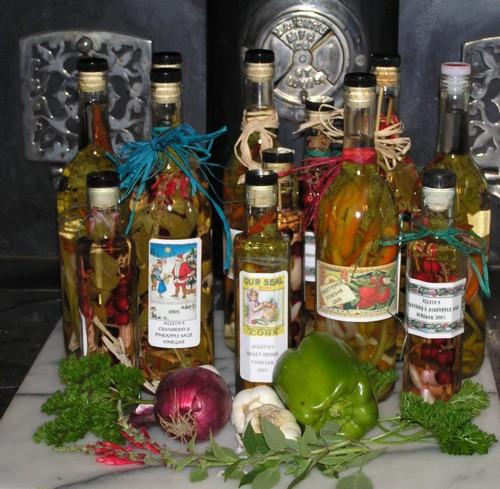
The following are the guidelines that I have perfected over the last 18 years of teaching and making herb flavored vinegar. The method used is for a mild delicate flavored vinegar that is pleasing to the eye, as well as delicious used in cooking.” – by Alleta HustonHerb vinegars have a long shelf life. Use herb vinegars in vinaigrettes and marinades or to add zest to cooked vegetables.
Check out Making Herb Vinegar.
Hints For Using Herbs and Spices:
Substituting dried herbs for fresh herbs: Dried herbs are stronger in flavor than fresh leaf herbs. When adding dried leaf herbs to a recipe that calls for fresh ones, substitute 1/3 the amount called for in the recipe.
When using dried herbs, crush them in the palm of your hand or between your fingers. This will release the flavor quicker. Use only one strong-flavored herb (rosemary, sage, winter savory, etc.) in a food. A strong-flavored seasoning may be combined with several mild-flavored ones. Whole herb leaves are a better choice than ground or powdered herbs because they hold their flavor longer in storage; pulverize just before using.
Substituting whole spices for ground spices: When adding whole spices to a recipe that calls for ground spices, use 1 1/2 times as much as the recipe call for.
Increasing a recipe: When doubling a recipe, do not double the herbs and spices. Increase them by 1 1/2 times and then taste, adding more if necessary. In general, always taste for seasoning before adding salt.
Menu Planning: Don’t season more than one dish in a meal with the same herb. Also, every dish on the menu does not need to be herbed – two or three at the most is enough.
Use only one (1) strong-flavored herb (rosemary, sage, basil, mint, dill, marjoram, tarragon, thyme, etc.) in a dish at a time. However, a strong-flavored herb may be combined with several mild-flavored ones (chervil, chives, parsley, savory, etc.) for delightful dishes.
Grinding and Crushing Herb and Spices
Grinding or crushing herbs and spices immediately before cooking releases the aromatic flavor of the herb or spice and will deepen the flavor of any dish.
For crushing a small amount of herbs or spices, a mortar and pestle is quick to use and you can control the coarseness of the grind. For large batches of herbs and spices, a spice mill or a coffee grinder is convenient and quick.
To simply crack or crush some spices without grinding them to a powder, place the spices in a sturdy plastic bag and then set on a cutting board. Bear down with the bottom of a heavy saucepan or a heavy wooden rolling pin.
If you are grinding spices to add to delicate baked goods, sift them after grinding to get rid of any woody bits and pieces.
Buying Herbs and Spices
Most herbs and spices are sold both whole and ground. It is preferable to buy whole spices and grind them yourself. Shop in a busy store for your herbs and spices. Busy stores are more likely to move their inventory rapidly and thus have fresh herbs and spices. Consider buying high-quality spices from reputable mail-order companies. I, personally, have found that they are always very fresh and aromatic.
Don’t buy herbs or spices that look faded or uneven in color.
For whole spices, check that there is very little powder or broken bits in the container.
For ground spices, the finer the grind, the better the quality.
When buying spices and herbs from a large bulk bin, make sure there is plenty of aroma.
Don’t buy more than you can use with 6 months to 1 year.
Recipe Definitions:
What is bouquet garni?
Bouquet garni (boo-Kay gahr-NEE) are little bundles of herbs and spices tied together with twine or wrapped in cheese cloth. These packets of herbs and spices are added to soups, stocks, sauces, braises, or any dish with a lot of liquid and requiring a long simmer. This technique keeps all the herbs and spices together, making for easy removal when the dish is cooked. Some cooks leave a few inches of twine on the bouquet garni and tie the end to the pot handle for easy removal. Others let the package swim freely in the pot.
How much is a sprig?
Unless a recipe specifies a length of a sprig, a sprig is about a 4-inch piece of stem with the leaves still attached.
How much is a bunch?
A small bunch of herbs is equal to a small handful of sprigs, a little less than 1 inch in diameter, 3 to 4 inches long and about 1-half ounce by weight.
A large bunch would be equal to a medium-size handful of sprigs, about 1 1/2 inches in diameter and 1 ounce by weight.
Handling and Storage of Herbs and Spices:
Whole spices will keep their flavor indefinitely as long as they are kept in tightly closed containers away from heat and light. Herbs in leaf form will keep longer than herbs in ground form. Ground spices and herbs will keep their flavor for up to a year after purchase (whether opened or unopened, as long as they were fresh when purchased and kept in tightly closed containers in a cool place. If kept at room temperature, in a pantry for example, herbs and spices will keep for only 6 months.
Never store herbs and spices next to or above the stove (this will shorten their life). To tell if a herb or a spice has lost its flavor, smell it – if it has no aroma, it should be discarded.
Shelf Life and Storage of Herbs:
Herbs do not “go bad”, they lose potency. Heat, light, and moisture damage the dried botanicals. Proper storage for medicinal and culinary herbs requires glass containers, well-sealed, away from moisture, heat and light. Do not store herbs or spices in plastic, vinyl bags, aluminum or tin containers. Avoid keeping herbs near the stove, in the refrigerator, or in the bathroom.
With proper storage, you can expect the following shelf life:
whole, dried herbs – 2 years
cut, dried herbs – 1 year
powdered herbs – 6 months
Growing Fresh Herbs
Nothing is better than the flavor of fresh herbs!
Why not grow your own and have fresh herbs when you need them?
Herbs are very easy to grow in your garden or even in a kitchen windowsill. Most herbs can be started from seeds, but it is much easier to buy small plants for a head start.
When your herbs come into bloom, add the flowers to your soups, salads, or use as garnishes.Check out Edible Flowers and Culinary Lavender.
2 Responses to “Herbs, Spices, and Seasoning Guide”
Sandra L Pace
This site is the best for info on spices and seasonings. Thank you so much!
Theresa M. Gardner
Amazing data. I now have a better understanding of herbs, spices and seasonings. This is so clear to understand. Finally found a cite that meets my needs.