
Originally objects such as coins, beans, pecans, and peas were hidden inside of every King Cake. Wealthy Louisiana plantation owners in the later 1800s would sometimes put a precious stone or jewel in their King Cakes. In the mid-1900s, a small plastic baby became the symbol of this Holy Day and was placed inside of each King Cake.
The New Orleans tradition is that each person takes a piece of cake hoping to find the plastic baby inside. The recipient of the plastic baby is “crowned” King or Queen for the day and that person is obligated to host the following year’s party and supply the King Cake.
The King Cake tradition came to New Orleans with the French settlers around 1870, continuing a custom dating back to twelfth century France. Similar cakes were used then to celebrate the coming of the three wise men calling it the feast of Epiphany, Twelfth Night, or King’s Day.
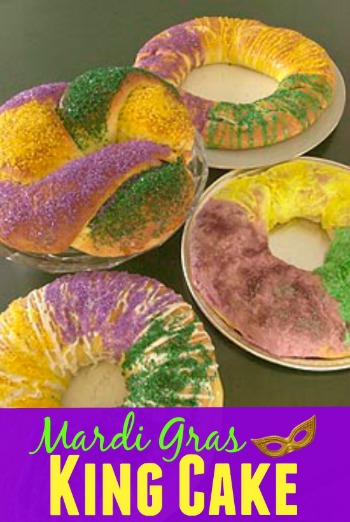
King Cakes are created in varied shapes and flavors. From braided King Cake to the traditional New Orleans King Cake, they are all something to celebrate.
This is my version of the traditional King Cake. Normally this is a very labor intensive cake to make, so I use the bread machine to do the work for me. Using the dough cycle on your bread machine will half the work needed for this traditional Mardi Gras treat. King Cakes are a lot like cinnamon rolls but they are twisted into a large oval.
- 1/2 cup water, warmed to 110 degrees F.
- 1/2 cup milk, warmed to 110 degrees F.
- 1/2 cup granulated sugar
- 2 teaspoons salt
- 1 teaspoon nutmeg, ground
- 1 teaspoon lemon zest
- 5 egg yolks, room temperature
- 1/2 cup butter, room temperature
- 4 3/4 cups bread flour or unbleached all-purpose flour
- 3 teaspoons instant active dry yeast
- 1 teaspoon cinnamon, ground
- 1 egg white beaten with 1 tablespoon milk
- 1 tiny (1-inch) plastic doll
- 3/4 cup granulated sugar
- Coloring paste in green, purple and yellow
- 3/4 cups powdered sugar (confectioners' sugar)
- Juice of 1 lemon
-
Place all ingredients in bread pan according to manufacturer's instructions; select dough setting and press start. Check the dough (don't be afraid to open the lid). The dough should form a nice elastic ball. If you think the dough is too moist, add additional flour (a tablespoon at a time). The same is true if the dough is looking dry and gnarly. Add warm water (a tablespoon at a time).
When dough cycle has finished, remove dough from pan and put into a lightly oiled bowl. Cover bowl with plastic wrap and place in a draft free place to rise for approximately 1 hour or until the dough doubles in volume.
Lightly coat a large baking sheet with butter or vegetable spray; set aside.
Remove dough from bowl and place on a lightly-oiled surface. Using your fist, punch dough down with a heavy blow. Sprinkle cinnamon over the top, pat and shape dough into a cylinder. Twist dough to form a curled cylinder and loop cylinder onto the buttered baking sheet. Pinch the ends together to form a circle. Cover dough with plastic wrap and let sit for approximately 45 minutes or until the dough doubles in volume.
Preheat oven to 375 degrees F. Brush top and sides of cake with egg white wash and bake on middle rack of oven for 35 to 40 minutes or until golden brown. A good check is to use an instant thermometer to test your bread. The internal temperature should be between 200 and 210 degrees. Remove from oven and place on a wire rack to cool. If desired, at this time, you can hide the plastic doll in the cake.
Makes 1 King Cake.
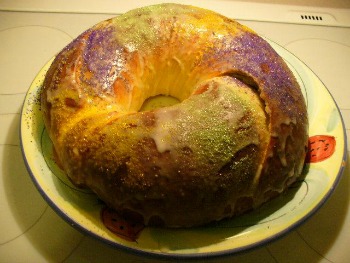 Colored Sugars Instructions:
-
Squeeze a dot of coloring paste in palm of hand. Sprinkle 2 tablespoons sugar over the paste and rub together quickly. Place this mixture on wax paper and wash hands to remove color.
-
Repeat process for other two colors; set aside.
Lemon Frosting Instructions:-
In a small bowl, combine powdered sugar and lemon juice until smooth (depending on size of lemon, add water if mixture is too thick or additional powdered sugar if too thin).
-
Spoon icing over top of the cake. Immediately sprinkle on colored sugar, alternating between the three colors.
 I get many readers asking what cooking/meat thermometer that I prefer and use in my cooking and baking. I, personally, use the Thermapen Thermometer. Originally designed for professional use, the Super-Fast Thermapen Thermometer is used by chefs all over the world. I only endorse a few products, on my web site, that I like and use regularly.
You can learn more or buy yours at: Super-Fast Thermapen Thermometer.
Sponsored Content
Additional Mardi Gras Recipes:
Bread Pudding with Bourbon Sauce
Categories:
Cajun/Creole Cakes History Dessert Recipes Historical Cakes Mardi Gras Sweet Yeast BreadsComments and Reviews
Leave a Reply